
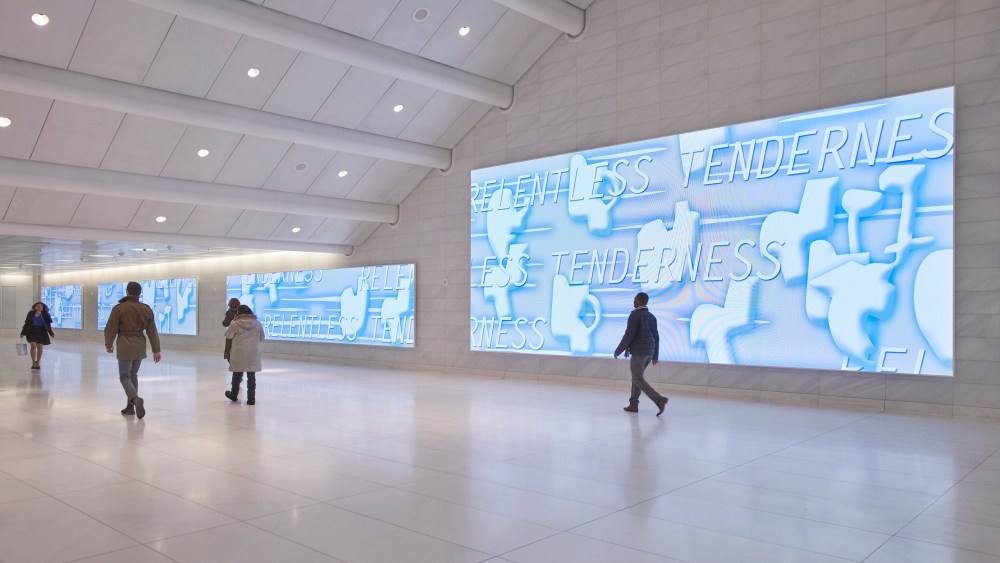
Public Art Fund’s “Commercial Break,” which features the work of 23 artists across New York, is intended to be a respite from the massive, monolithic advertising cycle that churns out messages as loudly and frequently as possible. The artist interventions can be seen through March 5 on a large billboard in Times Square; a 3,000-square-foot, 360-degree LED marquee at Barclays Center; 19 digital screens at Westfield World Trade Center; hundreds of LinkNYC’s Link kiosks in the five boroughs, and publicartfund.org, where work is embedded as a pop-up ad.
“The artists realized from the start that this is so radically different from a gallery or museum, and that they couldn’t do work they normally do and adjust it to the format,” said associate curator Emma Enderby.
Related Articles
“Commercial Break” was partly inspired by Public Art Fund’s exhibition, “Messages to the Public,” which ran on the 800-square-foot animated Spectacolor light board in Times Square from 1982 to 1990.
You May Also Like
“When we did ‘Messages,’ the Spectacolor was one of the only screens in Times Square,” Enderby said. “Now advertising is so pervasive, it’s on phones and computers — everything has built-in advertising.”
“The artists knew they had to be in dialogue with the advertising cycle,” said associate curator Daniel S. Palmer. “Some of them worked on how they could disrupt the advertising cycle. They realized they could use an authoritative voice and not have to sell something or be beholden to a brand. They felt that they could take a leap. The artists understood the nuances of how advertising works. They used art as a break to the commercial cycle.”
The art is altering the environments in which it’s displayed and having an effect on the public. At Westfield World Trade Center, digital screens are usually filled with fast-moving images in bright, dramatic colors. Hayal Pozanti’s “Relentless Tenderness” features her enigmatic language of abstract forms in multicolored paintings and digital images. “There’s a very conscious change of color, tone and pace,” Enderby said. “The reversal is quite striking and people stop and notice that they’re in a different type of environment than they were in 10 seconds earlier.”
The businesses that lent advertising platforms to Public Art Fund understood that art would add another dimension. “A few people got excited about collaborating and pushing the envelope of how the screen can be used,” Palmer said.
Kate Cooper’s, “We Need Sanctuary,” at Barclays Center, digitally manipulates images of women to question the aesthetics of advertising and representations of femininity.
“There’s a political and subversive nature to a project like this. It’s not a romantic notion of what it means to be subversive,” Palmer said. “There’s a new generation that wants to address issues. Our site partners were enlightened enough to understand that it’s important to give voice to different voices.”
The artists weren’t given total carte blanche. “A family-friendly place like Westfield World Trade Center is a politically loaded space and [Westfield] is careful not to offend,” Enderby said, referring to the fact that the World Trade Center was destroyed on 9/11. “They want it to be an uplifting space. There were certain things artists weren’t going to be able to do there, but they could work within their parameters and explore political things in a different way.”
“There’s hope and inspiration and optimism in Hayal’s message of relentless tenderness,” Palmer said, also citing Korakrit Arunanondchai’s HD video trilogy in Times Square, which includes, “Whisper to me the chorus for the new world,” with a photo of Trump Tower and the caption, “on the saddest day of the year.”
“Meriem Bennani’s digital video,”Your Year by Fardaous Funjab,” at Barclays Center, explores issues surrounding the hijab’s cultural significance and preconceived Western notions about Islamic attire, while “Your Year” suggests an inclusive, multi-ethnic calendar that unifies Islamic and secular holidays. “She’s addressing the current political situation,” Palmer said,” in a way that uses the power of art.”