
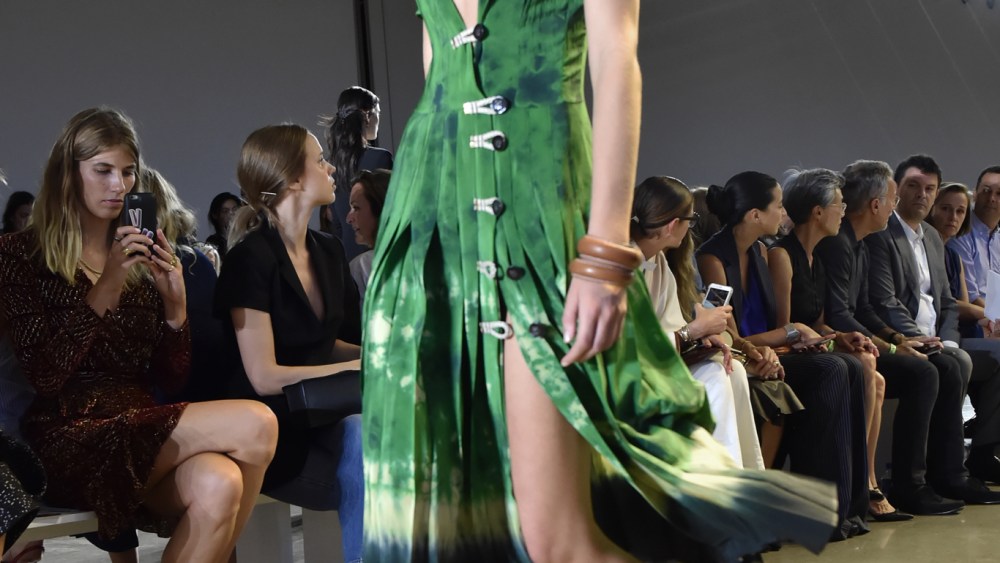
NEW YORK — It was a season in which a French label (Givenchy) designed by an Italian (Riccardo Tisci) was one of the highlights of New York. It was also a season when there seemed to be few new trends and store executives lamented the ever-expanding ranks of designers doing shows.
Spring 2016 “wasn’t an overall game changer,” said Linda Fargo, senior vice president of fashion office and store presentation at Bergdorf Goodman.
Asked what she liked most about the direction of the season, Kelly Golden, owner of Neapolitan Collection in Winnetka, Ill., replied, “Not much. I felt like the whole ath-leisure category and vibe has taken over most of the New York Fashion Week runways. Designers aren’t taking as many risks as they should and used to.”
Related Articles
“It’s been a rather lackluster New York in general,” said another retailer, who requested anonymity.
You May Also Like
There were trends, though, including cold-shoulder blouses and dresses, culottes, wide pants, pleats and lingerie details. Fargo said a number of these trends and items bubbled up as potential drivers of business, including shirting, languid tailoring, ribbed knits, Spanish influences, and elevated riffs on the bohemian theme.
Ken Downing, senior vice president and creative director of Neiman Marcus, praised the return of the tailored blazer. “It’s nice to see a sharp tailored piece of clothing entering back into designers’ psyches,” he said. “Michael Kors said, ‘I’m going to make the word ‘blazer’ not an ugly word.'”
“Crocheted lace with a grandmotherly handcrafted quality, done with a very modern spirit” also appealed to Downing. “I love the idea of something done with a very crafty hand and a modern eye, which kept it from ending up in the vintage bin.”
“There was a real return to glamour with Jason Wu and Proenza Schouler, with everything from eyelet to lace,” said Roopal Patel, fashion director of Saks Fifth Avenue. “The cold-shoulder trend feels new. I like the idea of the eyelet ruffle influence at Proenza Schouler, Michael Kors and Oscar de la Renta. There was a lot more originality in some of the shows, which had been lacking in past seasons.”
Freed of Lincoln Center, designers “could synchronize their clothing with their choice of venue,” Patel said. “It really made the collections come to life.”
Jeffrey Kalinsky, executive vice president of designer merchandising at Nordstrom, said his favorite trends were embellishment, the color white and flamenco references in ruffles and flounces, as seen at Givenchy, Alexander Wang, Proenza Schouler, Marc Jacobs and Rodarte.
Gia Ghezzi, fashion director of Intermix, liked the Victorian ruffled necklines, romantic florals and mini-tulips skirts, especially those by Zimmermann, whose collection was “the perfect balance of classic and sexy.”
“We have seen a lot of bohemian with an injection of military influence mixed with embroidery, feminine prints, lace,” said Jennifer Cuvillier, style director at Le Bon Marché. “There were beautiful summer colors such as khakis, sand and butternuts. It’s a fresh new trend for next summer.”
Steven Cook, senior vice president of buying and merchandising at Holt Renfrew, praised the new wide pant leg, which he saw in a variety of price ranges. Givenchy’s deconstructed tuxedo number was at the high end of the spectrum. “The flowing dress is a great easy thing,” he said. “It’s a must-have. We saw it in a lot of different collections. It’s a good commodity item for the season.”
“My favorite trend was the new luxury bohemian attitude created not only by ethnicity but tie-dye, crinkled materials, off-the-shoulder dresses and ruffles,” said Sebla Refig Devidas, buying director, ladies merchandising group, at Beymen in Turkey. “After a very luxurious but heavy fall/winter attitude, what I liked most about this spring/summer is the variety of ideas from bohemian to clean cuts and ethnic to day looks.”
“There’s a feeling of languid fluidity and long, leaner silhouettes (tunic over wide-leg pants, gilets over culottes),” said Sarah Rutson, vice president of global buying at Net-a-porter. “There’s midi- and maxi-lengths, asymmetry, ties and ruffles, summer sequins, soft pastels and neutrals. Items include the slipdress and re-engineered men’s shirting. Pleated skirts continue, and culottes and cropped trousers continue still.”
Tight-fitting sheaths and minidresses were in short supply on the runways. “It’s ankle-length or long,” said Marie De Reynies, divisional merchandise manager for women’s wear at Printemps. “I didn’t see many minis. A lot of times it was a camisole dress with straps, but the length was midcalf or above the knee or longer.”
“I liked the look and season, it’s very wearable and the look crosses age barriers,” said Suzanne Timmins, senior vice president and fashion director of Hudson’s Bay Co. and Lord & Taylor. “All ruffles, lace and flounce aside, there’s a relaxed mood. I’m loving the feeling of the fluidity of shapes and not-so-tight silhouettes, like a body-in-motion-kind-of-clothes.”
Not everyone saw must-have items in the fashion onslaught, though. “No real trends,” said Kalinsky in an e-mail, with a sad face emoticon.
According to retailers, several designers came into their own this season. “[Proenza Schouler’s] original craft and constructions were so supremely confident that even a gown made from a grid of feathers delighted us,” said Scott Tepper, fashion buying and merchandising director at Liberty of London. “These are intensely powerful clothes that will strike a chord with powerful clients — think [chief executive officers], presidents, first ladies and chic surgeons, as well as the new international jet set from Singapore to Kuwait City [in Kuwait] to London.”
“Rosie Assoulin is our New York star,” said Beth Buccini, cofounder of Kirna Zabete. “Her clothes are so interesting and different and she has a unique point of view. She sells really well, too. I’m proud of our customer, that she’s willing to take that risk. We’re going to increase our budget there.”
As far as prices go, “Women are willing to pay for special items,” Buccini said. “If it’s more classic or something they’ve seen before, women are more price-sensitive. Some designers are and some aren’t [sensitive to price]. The ones who address it are ultimately the more successful ones, but in general we’re moving toward a less trend-driven market, which is wonderful for women who want to buy things that will last.
“We seem to have more price concerns in Europe,” Buccini said, noting that some Kirna Zabete customers have said they’re buying European designers in France and Italy because the dollar is trading favorably against the euro.
Nicole Fischelis, group vice president and fashion director at Macy’s Inc., said, “We have huge profits in the Herald Square flagship in spite of tourist declines. The European luxury brands are performing very strongly.”
“Fabrics like linen and gauze and prints such as ikat and tie-dye add to an overall relaxed sensibility that still feels polished,” said Tomoko Ogura, senior fashion director of Barneys New York. “Also handcrafted elements had a strong presence this week and made the styles feel distinct and special. The price-value relationship continues to be instrumental in our buying decisions and we continue to communicate the importance of this to the designers and brands.”
It’s clear that designers want a larger audience to see their runway shows and collections than just the buyers, editors and celebrities who physically fit in a venue. But live-streaming and Instagramming may ultimately be frustrating customers who immediately want what they see. “I fear that we’re creating fashion fatigue with the retail customer,” Downing said. “She wants what she’s seeing now. Are we doing ourselves a disservice by putting on spectaculars six months before the clothes are in stores? Should fashion week go back to showroom presentations for buyers and select press? We’re a time-pressed society and want immediate gratification. When the clothes arrive on hangers with price tags in stores, the consumer has seen them in social media and celebrities have worn them.”
“The show formats will have to change at some point in the future,” said Rutson. “It just seems somewhat archaic in a digital world to be out for four weeks at a time doing fashion shows. As for live-streaming, that’s been going for a while and it’s about ‘inviting’ the general public to be part of the audience in real-time.”
Fischelis said that there’s “something to say about a moment when you’re suddenly transported and inspired.” That feeling, she said, can only be achieved with a live runway.