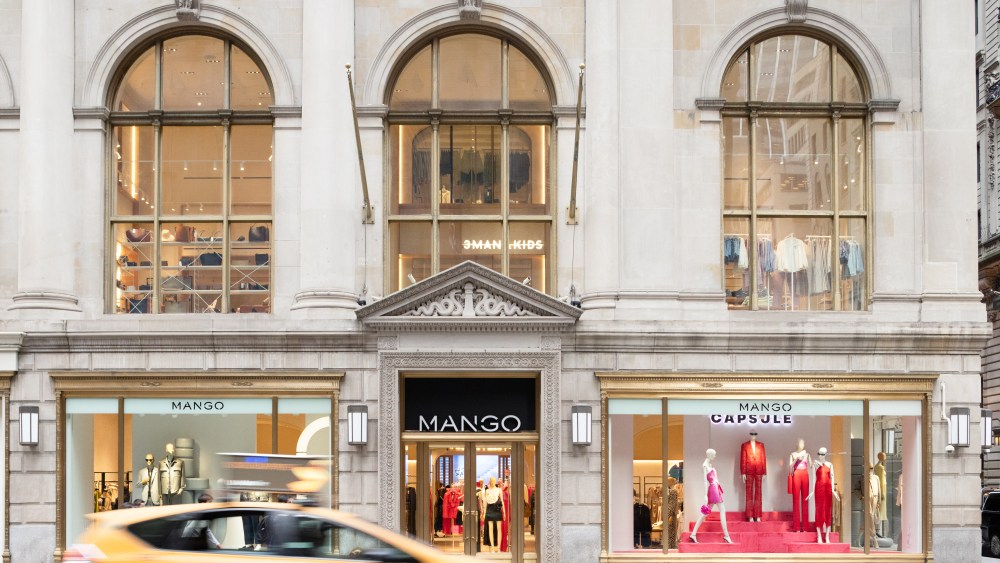
Mango, continuing to build globally with new stores, reported a 20 percent gain in revenues to 1.451 billion euros in the first half of this year.
The Barcelona, Spain-based fashion retailer also reported Wednesday that the first half’s results were 30 percent higher than the same period in 2019, surpassing pre-pandemic figures.
“Our customers value Mango’s unique design proposal and style and we are currently engaged in an ambitious plan of international expansion,” Toni Ruiz, Mango’s chief executive officer, said in a statement Wednesday. “The positive results in the first half of the year strengthen our business model and our ecosystem of various channels and partners.”
Related Articles

While continuing to open stores, the company attributed the gains to improved quality in its products, including with its recently launched capsule collection created in silk, viscose, taffeta, feathers, fringe and sequins; and collaborations, in particular the spring 2023 women’s collection designed in collaboration with the American brand SimonMiller and the renewal of soccer player Antoine Griezmann (who is French) as the face of Mango Man for the spring 2023 season, with a new concept called “Move Forward,” inspired by the player’s spirit of overcoming obstacles.
You May Also Like
The company did not post comparable store sales or profits for the half.
Mango, which has locations in 115 markets around the world, did best during the half in Spain, the U.S., Turkey, Italy and India, all geographies where the company has ambitious expansion plans.
Online, sales grew nearly 10 percent during the half. The Mango app is the online platform with the highest growth in sales.
In Spain, Mango expects to open more than 15 stores this year and refurbish another 15. In Italy, 15 openings are also set.
In the U.S., Mango currently has 10 stores and is planning to open 15 stores this year, for the first time entering Georgia, Texas and California, and cities such as Los Angeles, San Diego, Houston, Dallas, San Antonio and Atlanta. Mango’s goal is to reach approximately 40 stores in the U.S. by 2024 and for the country to become one of its top five markets in turnover.
Mango also cited Turkey and India as “two strategic countries…In Turkey, the excellent sales performance during the first half of the year [is] leveraged by strong growth in both the physical and the online channel,” the company reported.
In India, where Mango operates alongside its local partner Myntra, the company expects to have opened 35 stores in 2023, bringing it 110 there.
With this international expansion, Mango is strengthening its ecosystem of channels and partners, with a stores network now made up of 2,615 stores worldwide, after making over 40 net store openings since last December.
The Barcelona-based Mango has a capital budget this year of more than 200 million euros. Technology, logistics, stores and the new Mango campus will account for the bulk of investment throughout the year.
In its first half report, Mango also cited strengthening sustainability efforts with the creation, alongside other major companies within the sector, of the Textile Waste Management Association. It’s geared to manage textile and footwear waste generated in the Spanish market through the Combined Extended Producer Responsibility System (SCRAP), a group approach to textile recycling and a move toward a circular model.
Mango also reported that it has again joined forces with the marine biologist and National Geographic explorer Manu San Félix to support the Declaration of the Mediterranean, which is his initiative to restore the Mediterranean by creating protected marine areas. As part of the project, Mango has launched a “solidarity” T-shirt and trousers, to support San Félix’s Asociación Vellmarí organization, which promotes replanting posidonia, a plant of the Mediterranean of environmental and economic importance.