
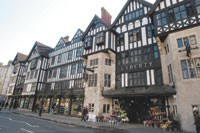
LONDON — Liberty, the landmark London department store famed for its color-drenched paisleys and flower-print fabrics, is delving into the past to fashion its future.
The store opened by the world traveler — and compulsive shopper — Arthur Lasenby Liberty in 1875, is undergoing a quiet revolution intended to turn Liberty into a luxury brand.
The store, which until the Sixties had been synonymous with cutting-edge design in furniture, fashion and the decorative arts, subsequently failed to keep up with competitors Selfridges, Harrods and Harvey Nichols. It had lost its identity as a whimsical emporium that offered customers a cornucopia ranging from original Arts & Crafts furniture, to prized Persian carpets, to the latest Dries Van Noten dress.
Now, however, a new management and creative team is determined to get the store humming again.
“We became followers of fashion rather than leaders,” said chief executive Iain Renwick, who has been spearheading the turnaround effort since he joined Liberty in 2003. “We lost sight of who we are. People weren’t really clear why, exactly, they were coming to Liberty to shop. Now we’re letting Liberty sing again.”
Renwick is a retail and marketing veteran who worked with retail guru Vittorio Radice to turn around Habitat and was chief of European marketing and communications at MTV.
In September, Liberty will launch a new branded accessories collection that features lost prints from the store’s archives splashed onto handbags, luggage, scarves, leather and paper stationery, and woven into duvet covers, sheets and pillowcases.
Renwick has long-term plans to sell those Liberty-branded products via a string of new-generation, stand-alone Liberty stores in key cities worldwide.
“The plan is to create a monobrand from a multibrand environment,” said Renwick, adding that the new Liberty units will sell only the store’s branded goods.
He said there are no plans to roll out cookie-cutter copies of Liberty’s London flagship, which was built in 1924 in mock Tudor style and is a protected London landmark.
“There is no big rollout planned along the lines of Saks Fifth Avenue, Harrods or Harvey Nichols,” Renwick said. “Our goal is to reestablish Liberty as a unique, design-focused company, and to build up Liberty branded goods.”
Related Articles
You May Also Like
Only about 10 percent of sales at Liberty’s London flagship, on the corner of Regent Street and Great Marlborough Street, come from Liberty branded goods. The aim over the next five years, Renwick said, is to increase that to 25 percent.
By 2010, Renwick also wants to have established Liberty as a luxury goods brand with a “clear credibility, an international presence, and a foot on the accelerator to expand.” By 2015, he said, he would like to see Liberty become a “key player” in the international luxury goods market along the lines of “a small Italian luxury brand,” rather than a big fashion house like Gucci or Burberry.
Liberty’s expansion strategy partly resembles that of another London specialty store: Harvey Nichols. Joseph Wan, group chief executive of the store, eventually plans to sell Harvey Nichols-branded women’s wear, men’s wear, accessories, fragrances and food in branded, franchised Harvey Nichols boutiques on major shopping streets globally.
Renwick said he has no plans to build the Liberty brand on the back of the tiny flower prints for which the store is famous.
“For a long time we allowed ourselves to be defined by floral prints, but that’s not who we are,” he said.
That explains why Liberty has spent more than one million pounds, or $1.75 million at current exchange rate, on a new design studio, and why last year the store recruited Tamara Salman, a fashion and textile designer who has worked for Prada and Romeo Gigli. Salman has hired a staff of her own, and she has discovered a treasure trove of lost designs in the store’s archives in Peckham, southeast London.
For this first season, she has pulled out a few of the old prints, toyed with proportions and color schemes and blown up, digitally manipulated and photographed the designs to create new variations.
“Those small floral prints that so many people associate with Liberty were actually from the Thirties,” said Salman, who was born in Baghdad and whose roots shine through in her approach to fashion. “There are so many prints in that archive — a lot of them from 1875 — that are far more exotic and exciting.”
She has chosen Ianthe, a delicate web of Art Nouveau swirls; Hera, a peacock feather shape, and Cristalle, an Indian Victorian floral print. For fall, she will be embossing leather bags with the Ianthe designs, and embroidered scarves and pashminas with the other designs, festooning them with sequins and beads.
“I’m using every sequin in sight,” Salman said during lunch at the store. “More is more.” Last spring, as part of a pilot project, Salman used the prints for bikinis (“Swimwear is so NOT Liberty,” she says with a giggle), terry cloth beach bags and even sexy nightwear.
And while the revived prints — and new accessories — may be the most public expression of Liberty’s new look, there are other, more subtle changes afoot.
The fashion department has been revamped, with a new buying team, a fresh buying strategy and a more individualistic spirit.
“While Selfridges is sexy, gregarious and showy, Liberty is about mystique,” said Luisa De Paula, director of fashion, who spent more than 10 years at Selfridges before joining Liberty.
De Paula said her strategy has been to lighten up the fashion floors and to inject some femininity into the women’s wear floors, which had become “heavy, dark and intellectual.”
She brought in edgy, youthful London designers Emma Cook, Jonathan Saunders and Bora Aksu and added a dash of Marc by Marc Jacobs, Issa’s colorful silk printed dresses, and Love Life dresses made in Liberty fabrics. De Paula even put in a vintage section on the women’s designer floor.
The store also slimmed down its jeans offerings and got rid of several brands, including Juicy (“The customer was just not into it,” De Paula said). Instead, it’s focusing on Paper, Denim & Cloth, Seven and Rogan.
The Liberty team has also blown the dust off the store’s legendary home collection, which Renwick said had become moribund. Soft furnishings bear Salman’s take on the archive Liberty prints, while the furniture floor has undergone a renaissance — and something of a return to the days of Arthur Liberty himself.
Liberty’s passion for the contemporary design of his day led him to buy pieces by Arts & Crafts pioneers Archibald Knox, William Morris and Christopher Dresser. Those original Arts & Crafts pieces, along with 20th century and one-off contemporary designs, are now available at the store. In addition to furniture, there are Persian rugs, folksy ceramics and crystal chandeliers, all in the eclectic, multiethnic spirit of the founder.
So far, these more subtle changes, put in place over the past 18 months, have been working from a sales perspective. For the six months to Dec. 31, 2004 (the most recent earnings period), sales rose 12 percent to 23.7 million pounds, or $41.5 million, from 21.1 million pounds, or $36.9 million, with a rise in all of the key product categories of rtw, accessories and home.
However, losses grew to 2.52 million pounds, or $4.41 million, from 2.3 million pounds, or $4.03 million, because of increased interest charges from external borrowings. The company has since wiped out its debt by selling two of its buildings to a joint venture between Great Portland Estates and the Liverpool Victoria Friendly Society for $127 million.
Year-end results will be released in September.
Liberty plc is 68 percent owned by Marylebone Warwick Balfour Group plc, which is looking to divest its stake in the store by 2007, another major reason Liberty has been getting its house in order. The remaining 32 percent of shares is quoted on London’s AIM secondary market.
Renwick said his strategy in bringing Liberty back to life was to mimic the master.
“I hope I’ve replicated what Arthur Liberty did by bringing together a group of very talented young people who have the very rare talent of being commercially focused and creative,” he said. “It was time for us to reclaim our birthright as a store that fuses fashion and the decorative arts, and allow our design heritage to resonate.”