
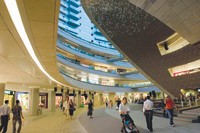
ISTANBUL — It winds deep and long, pools of water at its base, the blue sky shimmering above. A gentle breeze stirs the foliage draping from its steep sides, while sweet birdsong wafts from the trees — mixing with the excited chat of shoppers taking a breather at Starbucks.
For this is no natural beauty spot — rather, it is totally manmade: the latest shopping center to open in retail-hungry Istanbul. Designed to evoke the topographical feature it is named after, the open air, multistory Kanyon brings the latest in a growing line of new labels to Turkey’s largest city, and the more upmarket the better.
Following a lavish ceremony attended by Turkey’s Prime Minister, Tayyip Erdogan, in June, Mandarina Duck, the perfumery Douglas and Furla opened their doors to the Turkish public for the first time as part of the Kanyon development. London department store Harvey Nichols, shirtmaker Thomas Pink and ultraluxury Chinese restaurant Hakkasan are set to open by the end of the summer.
The business district of Levent, where Kanyon is located, is no stranger to malls, with the smart and popular Metrocity just a few hundred yards down the road. But few Istanbul malls are as ambitious and designer-led as Kanyon. Backed by Is Gayrimenkul and the Eczacibasi family, who are behind the stylish two-year-old Istanbul Museum of Modern Art, the mall is a lifestyle concept of shopping, living and working spaces, with the 26 floors of offices and 180 residences (some costing $2 million and all sold out) due to be completed within months.
Set up over 2.7 million square feet (about 404,000 of it for shopping) and costing $200 million, Kanyon has the heady aim of creating a “new world at the heart of Istanbul.”
“We planned for Istanbul residents to meet with nature and breathe freely in the center of the city…we hope they will be happy here,” said Bulent Eczacibasi, chief executive officer of Eczacibasi Holding.
Prime Minister Erdogan called the development “a beacon for the future of Turkey.” The Kanyon management expects 12 million visitors in the first year — almost equal to Istanbul’s entire population. Despite the generally high prices and exclusive brands, they believe around a third of the visitors will make a purchase.
Related Articles
You May Also Like
“That’s a high percentage considering our target market. But you have to remember that while Turks might say $200 for a pair of shoes is expensive, if they really like them they will save up for them,” said Beril Denizel, a spokeswoman for Kanyon.
Even on a hot weekday in summer, when Istanbul’s wealthy are normally sunning themselves on the shores of the Bosphorus or farther afield, Kanyon is buzzing with businessmen snatching a coffee, gaggles of trendy young girls, moneyed expats, coiffed ladies lunching, and so-called “yummy mummies,” almost to a woman pushing Bugaboo prams à la Gwyneth Paltrow.
Offerings range from well-known designer brands, such as Max Mara, Calvin Klein Underwear or Escada, to niche brands, such as the cool young Turkish T-shirt label Ottoman Empire. One store sells Aga cookers, another shows off the Paris-based children’s label Natalys, another entry to the Turkish retail market. There is a Swarovski jewelers, quirky international labels at V2K, the first Apple Center in the country and the first shop selling Istanbul Modern wares, including cushions patterned with tableaux by Jordanian princess Fahrelnisa Zeid.
A host of smart eateries and cafes grace the upper floors, and cool Turkish bar chain Buz has also set up shop. However, Burger King and McDonald’s are also there to remind visitors they are, indeed, in a shopping mall.
There are a handful of Turkish brands, including women’s labels Network and Machka and Ramsay London, a suiting store owned by the prime minister’s friend Remzi Gur, but international brands dominate overall, angering some local labels, who complained they had been frozen out in favor of foreign “no names.” Huseyin Kurtulus of the United Brands Association said he is considering filing a formal complaint over the preferential prices offered to international labels.
“They have been stringing along labels such as Sarar and Damat and then not letting them in — this is outrageous,” Kurtulus said.
Kanyon officials dismissed the claim and said that with 2,500 brands applying for 160 retail spaces, competition was tough and the elimination process arduous, requiring no less than 6,000 meetings to choose the final group. They implied the row is more a case of sour grapes by Turkish companies that have not reached a sufficiently high standard.
But the Kanyon attitude has not convinced the disaffected.
Cemalettin Sarar, whose women’s wear line’s application for space was rejected, said it was easier for him to open a store in Barcelona and New York than at Kanyon, in his own backyard. “I wouldn’t go there now if they gave me the space for free,” he said.
Ipekyol’s owner Yalcin Ayaydin complained about the lack of support for new Turkish labels.
“While foreigners are being asked for $15 to $20 per square meter, we are being asked for $60,” he claimed. “If this isn’t injustice, I don’t know what is,” he fumed in an interview with a Turkish newspaper. “The mentality that supports international names no matter what is completely wrong. If we carry on like this, in five years’ time you won’t find a single company worthy of becoming a brand in Turkey.”