
HONG KONG — Retailers here are expecting a very merry Christmas, thanks in large part to Mainland Chinese shoppers.
Although there are some concerns about a potential slowdown in consumer spending in Greater China, Hong Kong retailers are in an enviable position, thanks to booming tourism, industry watchers claim. Many retailers in the city are expecting double-digit sales growth this holiday season.
Christmas might not be a Chinese holiday, but Chinese are increasingly embracing the commercial part of the season.
“The commercialization of the holiday gets stronger every year. Ten years ago, no one on the Mainland played Christmas music, now everyone does. It’s become a consumer holiday,” said Darlene Lee, managing director at researcher Synovate in Hong Kong.
Related Articles
Christmas is now the biggest shopping season of the year in Hong Kong, albeit with far less seasonality than in the U.S. While holiday sales can make up as much as 75 percent of retailers’ annual revenue in the States, in Hong Kong it’s likely closer to 10 to 12 percent of annual sales, according to Synovate.
You May Also Like
Hong Kong has long been the primary beneficiary of Chinese tourism. Visitors, particularly from Mainland China, have grown at a double-digit clip in 2011, and that momentum is expected to continue. The Hong Kong Tourism Board expects the number of total arrivals this year to break 40 million if the current market situation remains.
Mainland Chinese shoppers make up about one third of the Hong Kong retail market, according to UBS AG analyst Carl Berrisford. The city’s many shopping malls are favored by Chinese tourists because luxury goods are up to 30 percent cheaper than in China (due to lower tax duties), stores often carry a larger collection, and the city has better quality control against counterfeit goods.
Hong Kong retailers are enjoying sales growth that is near double that of their counterparts in Mainland China, Berrisford said in a recent research note, adding that “retail trends in Hong Kong continue to show resilience in a challenging environment.” Sales growth in Hong Kong appears to be “normalizing” to a rate in the low-20-percent range, down from exceptionally high levels in the high-20-percent range in the first and second quarter, but still very high, he wrote.
Indeed, there is even some speculation that Hong Kong retailers could benefit from slowing Chinese growth as Mainlanders opt to visit Hong Kong rather than Europe to spend a little less on travel.
“Even though the outlook is bearish in 2012 with advance warnings about a slight slowing in preorders and concerns across finance and banking, spending is pretty strong for Christmas. The mood is more buoyant than in the U.S.,” said Lee.
Retailers are definitely upbeat.
“This year is very special and will be a record season,” said Maureen Fung, general manager at Sun Hung Kai Properties’ leasing office, which has a portfolio of 20 shopping malls in Hong Kong, including APM Mall in Kwun Tong and IFC Mall in Central.
Fung said the company expects November-December sales at APM Mall to increase 20 percent from a year ago, bringing in 19 million shoppers and sales turnover of 5 billion Hong Kong dollars, or $642 million. Sun Hung Kai Properties hasn’t disclosed sales estimates for its entire portfolio of malls, but Fung said sales could be up as much as 30 percent at some locations.
Harbour City, Hong Kong’s largest shopping mall, expects double-digit growth in December sales, with customer traffic expected to increase 10 percent from a year ago to 330,000 visitors. The mall reported that total retail sales for the first three quarters of the year rose 36 percent over the same period a year ago, reaching 18.9 billion Hong Kong dollars. Retail sales for September alone reached 2 billion Hong Kong dollars, up 39 percent from September 2010.
Retailers have reason to be particularly merry this season. Christmas and the Chinese new year — which kicks off unusually early this year, on Jan. 23 — fall within a month of each other, effectively extending the holiday shopping season.
Because the Lunar New Year falls so close to Christmas this year, holiday promotions started earlier, urging shoppers to buy their gifts as early as the beginning of November.
Retailers are also hopeful that recent government subsidies will spur shoppers’ largesse. The Hong Kong government handed out subsidies of 6,000 Hong Kong dollars, or $771, to all permanent residents over the age of 18 this year, the last of which were paid out in October and November.
Government statistics on actual December retail sales in Hong Kong won’t be available until early next year, but judging by the crowds at stores so far, retailers’ optimism is well founded.
It’s also beneficial for Mainland Chinese shoppers that Christmas falls on a weekend this year, Fung added. Christmas is not an official holiday in Mainland China, but many fly to Hong Kong to enjoy the festivities. Hong Kong hotel occupancy rates for the holiday weekend have reportedly reached 98 percent. It also doesn’t hurt that the Chinese yuan has risen about 4 percent against the Hong Kong dollar this past year, giving Mainland Chinese more buying power.
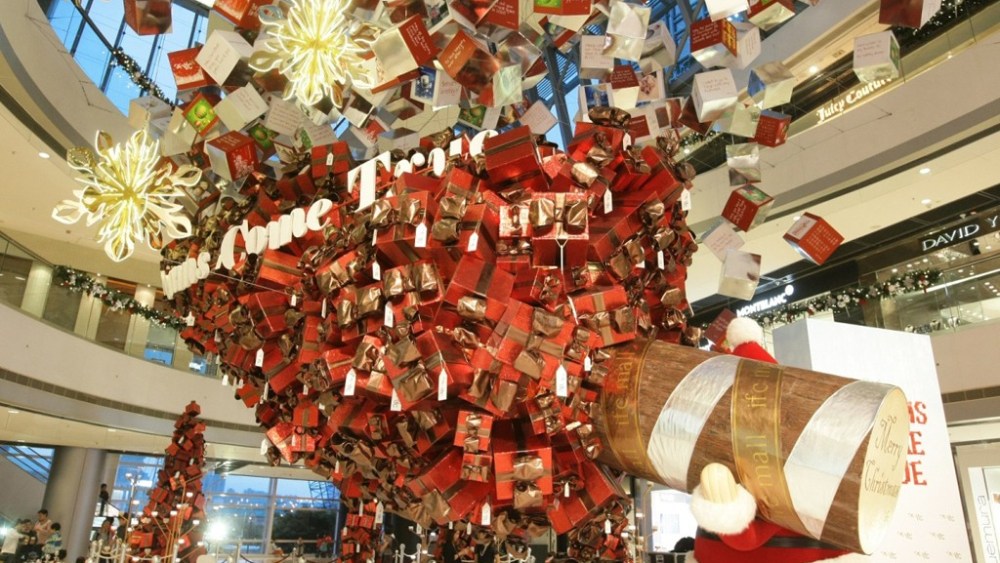
Hong Kong takes holiday decorations very seriously. The city’s skyscrapers are covered in lights spelling out holiday greetings and outlining giant Christmas ornaments, bows and reindeer. Shopping malls spend millions on new decorations every year and also plan special shopping tours for Mainland visitors.
APM Mall said its holiday promotion budget this year was a record 18 million Hong Kong dollars, or $2.3 million, up 20 percent from a year ago. The mall spent 5 million Hong Kong dollars, or $642,500, on decorations alone. APM teamed with fashion illustrator Liselotte Watkins — to design installations that include a fashion runway and a 30-foot Christmas tree made of crystals.
Harbour City spent 10 million Hong Kong dollars, or $1.3 million, on Christmas decorations and promotions this year. The mall worked with Hong Kong Disneyland to create “Toy Story”-themed Christmas decorations including a Christmas tree festooned with 500 little green aliens.
Meanwhile, Mainland Chinese retailers are marketing holiday spirit and promoting the holiday as well. Sun Hung Kai Properties’ Fung noted that Christmas hasn’t been much of a holiday in Shanghai in years past, but this year she’s seeing more Christmas decorations in malls as well as restaurants advertising special buffets and parties.
“People from the Mainland are learning about Christmas and festivals from Hong Kong,” she said.