
WASHINGTON — Retail chief executive officers plan to take their fight against a proposed border tax on imports to President Trump and Capitol Hill on Wednesday as Republican lawmakers continue to press for the tax to level the playing field for Made in America products.
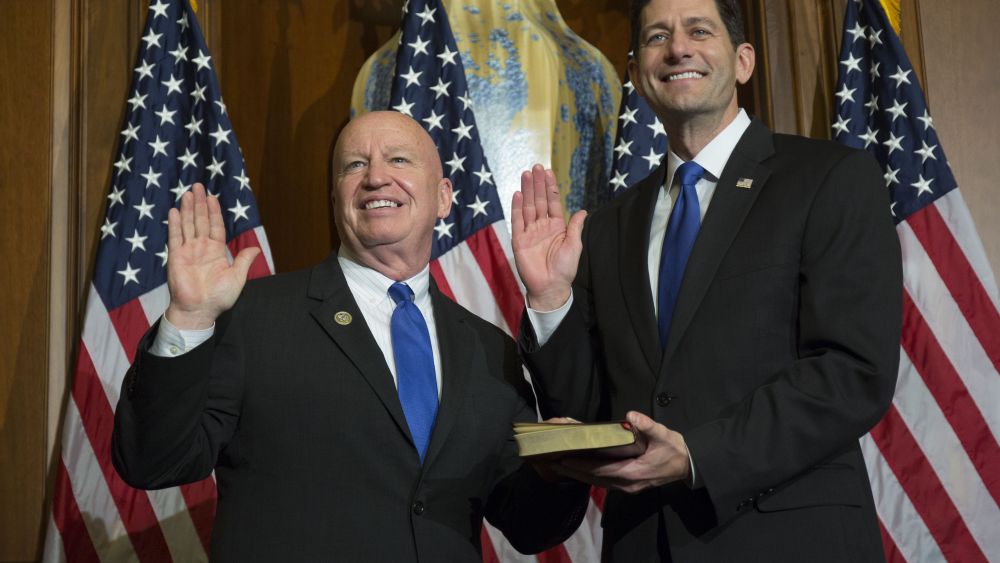
Chief executive officers from Gap Inc., J.C. Penney Co. Inc., Target Corp., Best Buy, AutoZone, Jo-Ann Fabric and Craft Stores and Tractor Supply are said to be set to meet with House Ways and Means Chairman Kevin Brady (R., Tex.) to discuss tax reform and the border tax, according to a source familiar with the planned meeting, who requested anonymity. (Reuters first reported on the meetings.)
Related Articles
A spokesman from Brady’s office confirmed that he is slated to meet with company executives. The ceos are also expected to meet with several senators.
You May Also Like
“Chairman Brady is meeting with ceos from the retail industry tomorrow about our ‘Built for Growth’ tax reform blueprint,” she said.
A spokesman for the Retail Industry Leaders Association also confirmed that several executives will meet with lawmakers Wednesday.
“Given that retail is the largest private sector American employer, retailers support sound policies that spur economic growth and job creation, he said. “Later this week, several top retail executives will visit Capitol Hill to meet with lawmakers and discuss pro-growth policies that will benefit both American consumers and job creators.”
David French, senior vice president of government relations at the National Retail Federation, said:“Retailers are in Washington meeting with both members of Congress and President Trump because the House proposal for a border adjustment tax would drive up prices paid by American consumers, significantly impact the consumer spending that makes up two-thirds of our nation’s economy and threaten the tens of millions of jobs supported by the retail industry.”
An NRF spokeswoman confirmed that the business leaders are also set to meet with Trump at the White House.
Retailers are on the front lines of the consumer-driven U.S. economy. It is extremely important that they engage with elected officials on policies of this magnitude and that their voices be heard and acknowledged,” French added.
On Thursday, Emanuel Chirico, chairman and ceo of PVH Corp., is set to be on a panel about tax reform and likely the border tax issue at the Tax Council Policy Institute’s annual symposium, according to an agenda posted on the institute’s web site. Executives from Wal-Mart and Procter & Gamble are also listed as speakers.
Brady has championed the border tax from his perch on the key House tax-writing committee that is part of a House GOP blueprint on tax reform and is set to give a keynote address at the institute’s symposium on Thursday morning.
The proposed concept of border adjustment tax, also known as “border adjustability” tax, has galvanized the business community in its opposition to the idea.
A group of more than 120 businesses — including Gap, Target, Wal-Mart., Levi Strauss & Co., LVMH Moët Hennessy Louis Vuitton and Hudson’s Bay Co. — along with key industry trade groups, recently launched a campaign aimed at stopping efforts in Congress to implement such a tax that they argue could lead to higher retail prices and a new economic burden on consumers.
Dubbed “Americans for Affordable Products” the coalition plans to run a national campaign to engage consumers and educate lawmakers about a tax policy that they charge will “result in higher costs for their customers on everyday items including food, gas and clothing [and] is the wrong approach.”
Other retailers and brands signing on to the coalition and effort include Abercrombie & Fitch Co., Neiman Marcus Group Inc., Kohl’s Department Stores Inc., Bealls, Chico’s FAS Inc., Clarks, Dillard’s, HSNi, Macy’s Inc., Nike Inc., QVC, Ross Stores, Sears Holding Co. and The Bon Ton Stores Inc.
The “BAT” tax would essentially tax the value of imports but not the value of exports.
Currently, companies that import products can deduct the cost of the product, including materials and labor costs, when determining income taxes, according to industry officials. However, under the House GOP proposal, companies would not be allowed to deduct any of those costs on imported products.
U.S. companies, on the other hand, would be able to continue to deduct the cost of their products if made here and would only be taxed on the profit.
The NRF estimates that if such a tax were implemented in legislation, the BAT would cost families as much as $1,700. But there is also some question about whether retailers will be forced to absorb some of the costs on already thin margins associated with the tax.
House Republicans argue that the border tax could be used to help pay for a sweeping legislative tax reform package that they are currently crafting. As part of that package, lawmakers have proposed lowering overall corporate tax rates to 20 percent from 35 percent.
Brady has made several speeches on the approach and the border tax in recent days.
In a speech before the U.S. Chamber of Commerce at the end of January, he said the border tax would be a “game-changer” for U.S. businesses and the U.S. economy.
“Today, ‘Made in America’ products and services are at a tax disadvantage here in America and around the globe,” Brady said in the speech. “That’s because foreign competitors like China, Europe, Mexico and Canada all adjust their taxes at their borders — adding taxes to American-made products and taking taxes off their own.”
He said because the U.S. does not impose a border tax on imports, U.S. companies are put at a competitive disadvantage.
“This means today Chinese steel is cheaper here in the U.S. than American steel,” Brady said. “Mexican beef and autos are cheaper than American beef and autos. Foreign oil is cheaper than American oil.”
Brady said the House GOP tax proposals “finally ends the ‘Made in America’ tax.”
“For the first time in U.S. history, foreign imports and American-made products or services will be taxed at exactly the same rate here in America,” he said.
The border tax is seen as a consumption-based tax among its proponents, by imposing taxes on where a company’s products are consumed as opposed to where they are produced.
Some experts have argued that retailers would not be hurt by a border adjustment tax because the U.S. dollar would strengthen and offset any increase in costs on imports. But retailers are not convinced by that argument and maintain that the concept is untested and will have a disproportionate impact on retailers who import most of the products sold to consumers in the U.S.
President Trump has floated the controversial idea of imposing a 20 percent tariff on imports from Mexico to pay for a massive border wall that he has ordered to be constructed.
Companies and industry groups are still trying to determine if Trump’s proposal is aligned with what the House Republicans have proposed.