
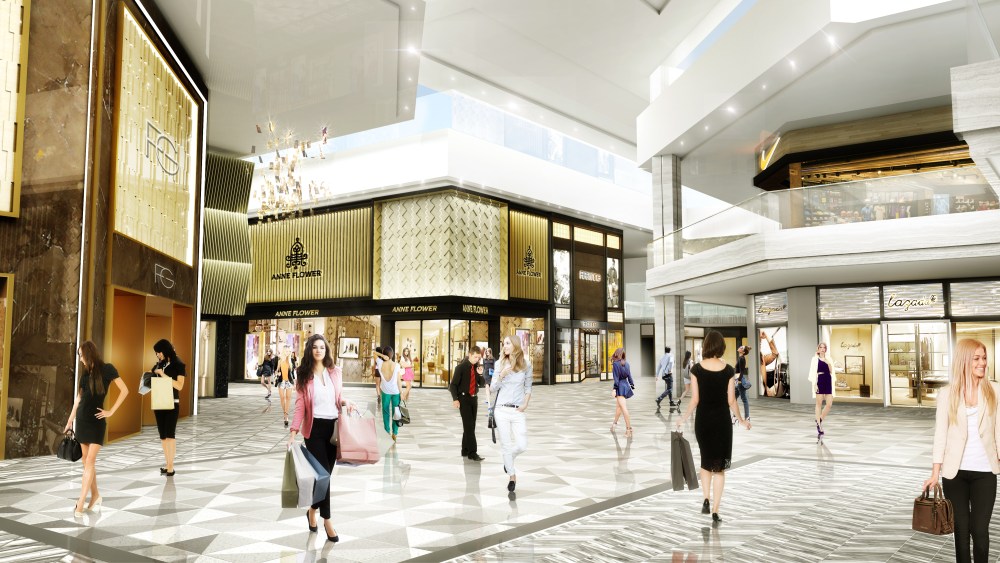
During a conference call about its fourth-quarter metrics, Macerich Co. chairman and chief executive officer Arthur Coppola defended the relevance of shopping centers as department stores such as Macy’s and Sears close units and specialty chains like The Limited and Wet Seal disappear.
Putting a positive spin on the closure of Sears at Kings Plaza, a Macerich mall in Brooklyn, Coppola said, “If we can re-merchandise department store locations and generate returns in the midsingle digits, while ending up with retailers that are more complementary and generate more traffic for everybody’s benefit, I’m going to do that every day of the week.”
Related Articles
Primark has leased part of the 300,000-square-foot Sears at Kings Plaza in Brooklyn, which is also adding new restaurants. Coppola said Macerich is in various stages of negotiation with “five or six other major users to take the remaining space that was occupied by Sears.”
You May Also Like
The mall industry is overly reliant on department stores compared with global benchmarks, Coppola said. “Historically, department stores generated enough traffic to allow us to lease the specialty stores. As certain anchors go away, we’ll bring in non-traditional anchors like sporting goods, grocery stores, entertainment complexes and restaurants. Department stores need to take a page out of our playbook — we’re pruning assets that aren’t core to the fundamental business and reinvesting that money into our core business.”
Coppola also noted that apparel is losing share in malls. “Department stores were 95 percent apparel and soft goods,” he said. “As department stores shrink, we’re going to replace them with a non-apparel tenant that generates a lot more traffic and higher returns. It’s just an evolution of the business model and a good evolution. But there will definitely be less apparel.”
“The apparel market has matured and moved away from smaller specialty stores that trade on foot traffic to large-format fast fashion retailers,” said Robert Perlmutter, senior executive vice president and chief operating officer. “The apparel sector is shrinking in terms of smaller specialty stores, but Zara and H&M represent a shift in the customers’ preferences.We’ve seen food grow to about 10 percent [of the shopping center]. Health and beauty and athletic footwear are expanding.” However, H&M recently said it will slow the pace of new store openings and shutter unproductive units quickly.
Macerich’s results were impacted by store closures. Net income for the fourth quarter was $37.1 million, or $0.26 a share, for the quarter ended Dec. 31, compared to net income of $415 million, or $2.65 a share, in the 2015 period, a 91 percent decrease. Funds from operations, or FFO, was $180.6 million, or $1.17 a share, in the 2016 fourth quarter, compared with $186.4 million, or $1.12 a share, for the 2015, a 3.1 percent decline. Net operating income fell 3.8 percent to $252.7 million in the fourth quarter of 2016 from $262.6 million in the 2015 period.
“The decrease in growth rate compared to earlier 2016 was expected due to occupancy losses due to tenant bankruptcies,” Coppola said.
Lease termination fees in the 2016 fourth quarter were $4 million compared to $2.5 million in 2015. The Limited operated 15 units and Wet Seal 9 units at Macerich malls. Coppola said that “as retailers rationalize their store fleets in markets with fewer stores in each market, the regional mall stores will become more important.”
Coppola wouldn’t concede that mall traffic is going down, and even if it is, sales at Macerich properties haven’t been impacted. “Our sales per square foot on a comp basis has gone up 37 percent in last seven years,” he said. “Retailers blaming mall traffic for the fact that they don’t have the products in their stores that people want to buy, is wrong. We’re putting in cameras and sensors that monitor gender and engagement so we can be smarter about how we tenant the centers.”
Retail sales for the portfolio were $630 per square foot in 2016, a 0.78 percent decline from $635 per square foot the previous year. Sales per square foot on a same-center basis increased 1.08 percent to $650 from $643 in 2015.
The releasing spreads for the year rose 17.7 percent. Mall portfolio occupancy was 95.4 percent on Dec. 31, compared to 96.1 percent on Dec. 31, 2015. Perlmutter said Macerich signed leases for 962,000 square feet of space, a 20 percent increase from the third quarter. The average term for leases in the fourth quarter was 5.3 years compared with 7 years the previous year.
“Occupancy continued to be impacted by bankruptcies and early lease terminations. The early termination of the Sears lease caused a loss of about 11 cents a share in the fourth quarter. In addition to occupancy losses, there’s the change in the composition of our portfolio,” Perlmutter said, referring to Tysons Corner Center in Virginia, where a new office, hotel and residential high-rises have densified the property and added a captive audience for the mall.
Macerich has similar plans for Scottsdale Fashion Square in Arizona, where it will reboot the luxury collection with a new entrance and new two-story flagships. “We’re expanding and elevating the luxury and presenting it in a much more contemporary manner,” Perlmutter said. We’re expanding the restaurant and entertainment piece and we’re committed to the mixed-use aspect with office and residential. The site can justify densification.”