
NEW YORK — Retailers, designers and manufacturers are investing more in flagships to cut through the marketing din created by an oversupply of stores and brands.
Investments in flagships by luxury and moderate retailers have risen substantially in the last few years as they seek to create spaces in which to brand or rebrand their images and establish an ideal merchandising and sales environment for customers.
“The traditional ways of advertising have changed,” said Brad Mendelson, executive director of real estate brokerage firm Cushman & Wakefield Inc., which has opened flagships for Calvin Klein on Madison Avenue and Toys “R” Us in Times Square here. “People don’t watch commercials on TV or listen to the radio or read the paper the way they used to. There’s no way for a lot of these companies to get their message across, so what they’re doing is putting their message on the street, where millions of people a year can experience it.”
The flagship also provides investors and potential investors with a definitive statement of a retailer’s or designer’s goals.
“The majority of decent retailers are publicly held or part of conglomerates,” said Patrick Breslin, senior managing director of GVA Williams, a Manhattan real estate broker. “Retailers are opening stores to show them to the analysts and say: ‘This is who and what we are; this is what our company stands for.'”
Over the past year, Burton and Adidas opened flagships in Manhattan’s SoHo. In the pipeline are flagships from Abercrombie & Fitch Co., Coach Inc., Brooks Bros., Ben Sherman and Apple. Chicago was recently rocked with the news that its beloved Marshall Field’s on State Street would be converted into Macy’s Midwest flagship.
Still, the term “flagship” is often used imprecisely by retailers and designers eager to pump up their reputations who attach the label to any big store or new location. Wall Street’s expectations for grandiose real estate are just as responsible.
Such misuse of the name dilutes the value of true flagships — stores in prestigious locations, with comprehensive merchandise, the best salespeople and often extravagant architecture — which cost millions to build and don’t always bring a cash return on the investment. But what a flagship may lack in sales is balanced by its value as a brand-building tool for retailers and manufacturers, such as Macy’s or Apple Computer, and, increasingly, for designers.
Related Articles
You May Also Like
“Designers have a different perspective on the profitability of their stores because they are promoting their wholesale business, as well,” said Robert Pressman, executive vice president of Studley Inc., a brokerage company, and former Barneys New York co-chief executive officer. “They can spend more money and be less concerned for the profitability of that specific investment.”
Luxury retailers can expect to spend about $1,000 a square foot to design and build a flagship in prime locations such as Fifth and Madison Avenues here; Michigan Avenue in Chicago; Worth Avenue in West Palm Beach, Fla.; Rodeo Drive in Beverly Hills, and Newbury Street in Boston, said Les Hiscoe, vice president of the retail group at Boston-based Shawmut Design and Construction. Shawmut specializes in flagships for luxury retailers. Clients include LVMH Moët Hennessy Louis Vuitton, Hermès, Chanel, Burberry Group plc, Polo Ralph Lauren Corp., Van Cleef & Arpels and Apple.
The cost of a flagship, often designed by a renowned architect, built with imported stone and marble and embellished with luxurious fabrics and high-tech components like fiber optics, is about triple the cost of an average store, according to industry averages. And that doesn’t include the rent, which in many of the desirable areas can be as high as $1,000 a square foot. Billboards and signs are also expensive. In Times Square, electronic billboards in prime areas rent for $100,000 to $500,000 a month, Breslin said.
However, a retailer doesn’t need to buy gaudy signs to rack up the costs. Real estate executives speculate that the Prada store on Broadway in SoHo, for example, cost as much as $50 million to build. Like its sister on Rodeo Drive, the store was designed by internationally renowned architect Rem Koolhaas.
“It is a world record for a store of that size,” said a real estate expert who asked not to be named. “It makes no economic sense whatsoever. There’s no way that store can make money. But it’s a multibillion-dollar company, and most of its products are sold through wholesalers. This is a piece of marketing.”
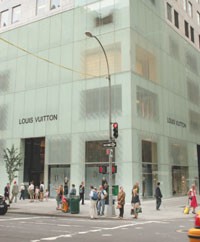
At Louis Vuitton, the goal of a flagship is to display all the label’s products together, including leather goods, shoes, jewelry and ready-to-wear, said John Mulliken, vice president, store planning and development, for the luxury brand. The company has opened stores in the most fashion-forward locales in the world — on Rodeo Drive in Beverly Hills, on the Champs-Elysées in Paris and in New York, where the 28,000-square-foot unit at Fifth Avenue and 57th Street recently has been renovated.
Steep overhead isn’t restricted to the real estate. Keeping the best and latest products in stock, maintaining the best merchandising and employing the most knowledgeable salespeople all add to the costs of a true flagship.
Reconciling the high costs with the desire for a prestigious address is difficult. Some designers can afford not to make money from their flagships. Others find creative ways to budget the expense, said Cushman & Wakefield’s Mendelson. For example, stores will write off a percentage of their real estate to advertising costs; therefore, their sales don’t have to be quite so high to justify the store.
And it’s not just designers putting these kinds of dollars in their stores. Department stores probably will remain interested in opening flagships, despite consolidation, Mulliken said.
High-end department stores must project the luxurious image for which they are known, he said, noting that Saks Inc. last year hired architect Frank Gehry to renovate its Fifth Avenue flagship. Department stores generally spend less than luxury retailers, but still spend plenty, about $200 to $300 a square foot, industry sources said.
Typical specialty mall retailers also are getting in on the flagship game, although some, like Abercrombie & Fitch, are wary of the term.
“We would be very cautious about labeling a store a flagship store from the standpoint that many times, flagships [in general] are and have been underperformers from a return-on-invested-capital standpoint,” Abercrombie spokesman Tom Lennox said.
The company’s president and ceo, Mike Jeffries, “obsesses about margins and profitability, and for us to invest in a large store in an environment such as Fifth Avenue, we must have the confidence that the store can perform as well as our other stores,” Lennox said.
Nonetheless, this month the company will unveil a 34,000-square-foot flagship at Fifth Avenue and 56th Street in a former Fendi location. The store, which will be Abercrombie’s largest, was designed by New York architect Annabelle Selldorf, whose credits include the Neue Galerie Museum here and the Hauser + Wirth Gallery in London.
Abercrombie’s executives said the Fifth Avenue store will provide positive returns because New York is an international tourist destination. The store will be merchandised differently from other sites, Lennox said, and will include products for the company’s adult and children’s brands.
Abercrombie also is renovating a store at The Grove at Farmers Market in Los Angeles, from a two-story space to a three-story, 24,000-square-foot space. The store was not considered a flagship before the renovation plans were announced.
For fiscally conservative retailers, some flagships are so valuable that it pays to own the space rather than rent, an anomaly in the retail real estate world. Tiffany & Co., for example, has a strict interpretation of “flagship” and it owns all three of its so-named properties, in New York, London and Tokyo. Louis Vuitton, by comparison, says it has 55 flagships that sell all the company’s merchandise lines.
“We have no other flagships planned on the scale [of our three existing flagships],” said James Quinn, president of Tiffany. “We wanted to secure those buildings on the long term, because we believe they will be important locations for a generation and it allows us the ability to do the appropriate renovations.”
The Tiffany flagships were selected because they were in the most important international markets, they have a striking physical presence with the broadest assortment of products and they have enormous sales potential and great visibility, Quinn said. Though the three flagships cost substantially more than the average store, productivity is foremost.
“If the store does not meet our internal criteria for investment performance, no amount of visibility makes a difference,” he said.
For some, though, visibility makes all the difference.
“When a company is looking to go public, or just get out there, you’re not going to open a store in Cincinnati,” said Jeffrey Roseman, executive vice president at Newmark Retail, a New York real estate brokerage company. “You are going to go to Times Square or Fifth Avenue.”