
PARIS — Mills exhibiting at the Première Vision textile show found that the market was being driven by two distinct and sometimes divergent consumer segments.
Exhibitors at the show, which ran Feb. 20 to 23 in the Paris suburb of Villepinte, tapped into the needs of luxury clients from emerging markets and a growing contingent of eco-conscious fashion firms from Europe and the U.S. Attendance increased 3 percent over last year, to 47,800 visitors. However, there was a slight decline in the number of U.S. buyers and many mills reported flat order-taking.
“It is very sluggish,” said Laurent Garigue, owner of the U.K. mill that bears his name, whose bestsellers included hand-pleated silks. “This is a good barometer of what life is like in textiles in Europe. Business is still being done, but it’s sluggish.”
Olivier Caillet, area sales product manager of French silk weaver Bucol, said, “Some years we’re so busy we don’t have time to eat, but this time there are gaps.”
Some buyers bemoaned an absence of novelty at the trade show, a trend they attributed to a belief that mills are opting to become less specialized in an effort to entice a wider array of customers.
“Mills are trying to appeal to everybody,” said a spokesman for the U.K.’s Burberry. “They did cotton, and now they do cotton and silk, or wool and cotton. It’s diluted.”
Garigue, for example, is going after a broad consumer base.
“Our job is to dress the elite, but we’re trying to dress everybody all the way down,” he said.
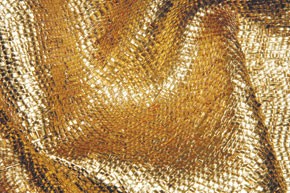
Shiny fabrics varied from plastic bag-like finishes at Italian silk specialist Taroni, to snakeskin-like gold at French wool specialist Mahlia Kent.
“It’s for the emerging markets of Russia and China, where people are getting richer and want to show off their opulence,” said Eve Corrigan, stylist at Mahlia Kent.
“It’s down to how the Chinese want to be noticed,” said Taroni’s Maximilian Canepa. “You look at guys like Kanye West in his glitzy, shiny suits. Our customers have to cater to that. It’s a huge market.”
Related Articles
You May Also Like
Buyers welcomed a retro direction in prints.
“It’s a kind of Sixties Capri,” said Monica Paolini, head designer for Betsey Johnson, who had seen such silks from French mill Forestyle Saint-Ys.
“We’re going with prints and graphics,” said Hannah Kvrarnhammar, a buyer for Sweden’s Hennes & Mauritz.
Tony Bannister, trend director of Sportsgirl, a 105-door Australian retailer, liked geometric, modern designs.
Designer Chris Benz lauded “more subtle, lighter metallics with less gold and copper.” These softer approaches included metallics blended with natural fibers, as seen at Nippon High Pile, a Japanese mill, that reported brisk sales. Its bestsellers included metallic silver foil prints on gray jersey.
Other fabrics from Japan, such as classic cottons with waterproof finishes and natural-looking synthetics at Komatsu Seiren, caught the eye of Katie Kiechel Beckford, a designer for Kate Spade.
“They did synthetics so beautifully that you wouldn’t know it was synthetic,” she said, also praising a polyester and nylon blend with a satin taffeta finish that she said made the fabric “breathable.”
Designer Yigal Azrouel also commended Japanese manufacturers’ work. “I came across some great jersey with interesting washed and sheen finishes,” Azrouel said.
Executives at Japanese knitwear manufacture A-Girl’s, which counts Gap and American Eagle among its clients, noted a resistance from U.S. buyers to its high-end lines.
“Our U.S. clients have been going for our diffusion jersey line that sells at around 5 euros to 8 euros [$6 to $13 at current exchange rates] per meter,” said Tomo Yamashita, the firm’s general manager.
Citing demand for natural fabrics, Yamashita added that heather jersey in neutral tones had been popular among his U.S clients.
Japanese suppliers tapped into growing eco-consciousness. Nippon High Pile’s offering included recycled cotton and recycled mink from Canadian fur cuts blended with Tencel. Organic cotton and banana fibers made with minimal chemicals at Nisshinbo, one of Première Vision’s 20 new weavers, reportedly drew orders from the biggest names in luxury.
“Our customers, especially in Europe, want to use organic and think of ecology,” said Junji Morohashi, head of marketing at Nisshinbo.
Buyers across the board snapped up the more eco-friendly offerings. Jigsaw Australia designer Jade Fisher was hunting for non-chemically treated materials after the production of such a line that’s set to be launched at Jigsaw U.K. this fall. Members of Betsey Johnson’s buying team said they were looking into creating an organic line, and organic mills reported scores of new, often high-profile clients. At Soktas, sales of organic cotton and blends have boomed, so the Turkish mill has been able to reduce its minimum orders to 60 meters from 600 meters, opening the door to budding designers.
“It’s a hot item,” said Seyhan Aktemur, Soktas’ product development and marketing manager. “Everyday, designers hear one more company is engaging in the organic market.”
Some suppliers said they had been dissuaded from manufacturing organic fibers because of the higher costs, smaller yields and limitations in dyeing.
“Even though everybody is talking about it, the market is still quite small,” said Uberto Ciatti, manager of Italian weaver Inseta.
Garigue said, “I broached it with the dyers in Yorkshire and they laughed at me.”
Some designers remain hesitant about organics, as well.
“Organic cotton has become a buzzword for a while now, but it’s not something we’ve officially looked at,” the Burberry spokesman said. “The question is ‘Does it feel new?’ The organic stuff sounds great, but does it feel great?”
Sean Monahan of New York-based Sea views it as a marketing strategy. “We’re saving the world, one yard at a time” he said.
Yet, designer sensibility is growing in other ways. Claire Sanson, of France’s John Galliano, said she would favor French mills in her hunt for natural materials.
“We try to remain loyal, to maintain our support so that their savoir-faire, those traditional techniques, are not lost,” she said.