
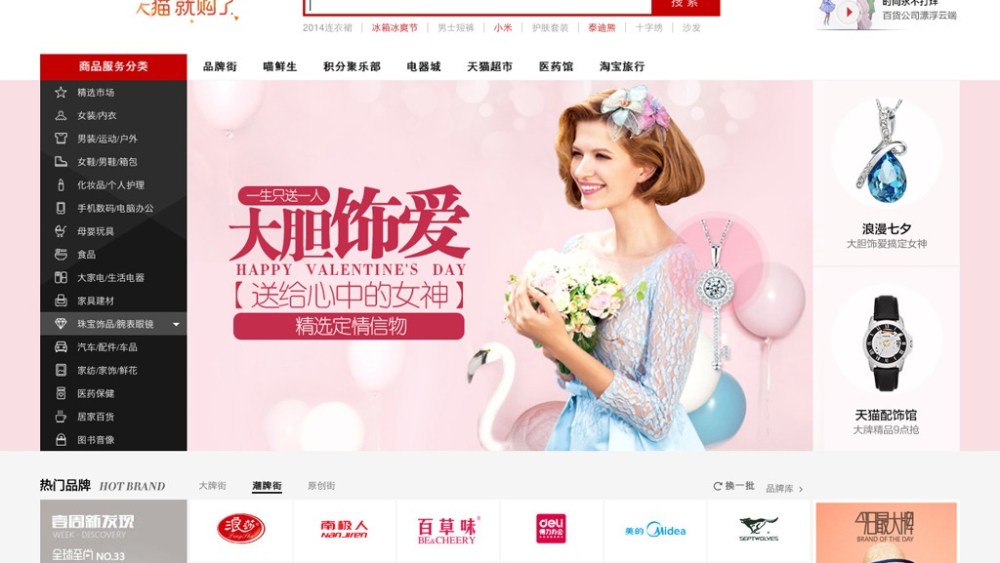
SHANGHAI — Alibaba, preparing for its multibillion-dollar initial public offering later this year, is the undisputed e-commerce leader in China — but it’s not the only player in the market.
There are a number of fast-growing competitors populating the country’s vast e-commerce landscape. China has an estimated 242 million online shoppers, giving it the world’s largest population of e-consumers in the world, according to Boston Consulting Group. The consultancy predicts that, by next year, each of those consumers will be spending $1,000 a year online, meaning e-commerce would account for $242 billion, or more than 8 percent of all retail sales in China.
Related Articles
McKinsey data indicate this trend is far from peaking. As China’s consuming class continues to expand, the e-commerce market may reach sales of 2.7 trillion yuan to 4.2 trillion yuan, or $420 billion to $650 billion at current exchange, by 2020.
You May Also Like
This potential has attracted global retailing giants from Wal-Mart to Amazon to China, though it’s
homegrown Chinese companies that have been leading the way in the world’s second largest business-to-consumer e-commerce market.
According to iResearch figures from 2013, Alibaba’s Tmall is the largest B2C marketplace in China, with a 50.7 percent share of sales, followed by JD.com (17.1 percent), Tencent (5.6 percent), Suning (5 percent), Amazon China (2.2 percent), Vipshop (2 percent), Gome (1.9 percent), Dangdang (1.8 percent), Yihaodian (1.4 percent) and Vancl (0.7 percent).
China’s second-largest e-commerce company by transaction volume is JD.com, also known as Jingdong and previously called 360Buy.com. Initially specializing in consumer electronics, JD.com has expanded in recent years to sell everything from shoes to motor oil to books, leading some to describe it as China’s version of Amazon, though 85 percent of the company’s revenues come from selling consumer electronics.
In something of a precursor to Alibaba’s IPO, JD.com went public in May. Its Nasdaq listing raised $1.78 billion and the company has a current market capitalization of about $27.45 billion. Just a few months before the IPO, Internet behemoth Tencent — the company many people believe poses the biggest threat to Alibaba’s reign as China’s e-commerce king — invested $210 million for a 15 percent stake in JD.com.
The move was seen as mutually beneficial, with JD.com taking control of Tencent’s B2C platform, QQ Wanggou, and consumer-to-consumer marketplace, Paipai. One of Tencent’s hottest properties is mobile chat service WeChat, considered a major competitor to Sina Corp.’s microblogging service Weibo and a key component of Tencent’s e-commerce strategy.
According to iResearch data, m-commerce accounted for 9.2 percent of all e-commerce transactions in China in 2013, a proportion expected to double by 2016. In comparison, U.S. mobile business last year accounted for about 3 percent, and in 2016 is expected to reach 7 percent.
L2 researcher Emma Li believes Tencent’s WeChat app, which is often compared to WhatsApp and already boasts 355 million active users, will be the “player to watch” in 2014.
“Tencent’s Weigouwu [an online-to-off-line service that allows customers to scan product codes to find additional information, save products to their shopping list and purchase via WeChat] is going to be a game changer for many retailers in China,” Li said.
“As user activity on Sina Weibo has plummeted in the last year, and with around 37 percent of Weibo users moving to WeChat, Tencent is doing everything it can to compete with e-commerce giant Alibaba in mobile commerce — and their timing couldn’t be better.”
Alibaba is making its own moves in terms of m-commerce. In June, the company completed its buyout of mobile browser operator UCWeb Inc., which operates one of the country’s most popular mobile Internet browsers, UC Browser.
According to Alibaba, the acquisition will “enable deep synergies between the companies by marrying Alibaba’s strengths in e-commerce, cloud computing and big data technology, and UCWeb’s leading market position and technology in mobile.”
Analysts who had seen Alibaba struggling against up-and-comer Tencent in the mobile space described the UCWeb acquisition as a positive move for Alibaba. “China has more smartphones than any other country plus a higher propensity to consume via mobile than other countries, including the U.S.,” Duncan Clark, chairman of BDA China Ltd., a Beijing-based technology consultancy, said at the time of the UCWeb deal.
“Tencent’s home run with WeChat has raised the stakes for all incumbent Internet players, and the acquisition by Tencent of a 20 percent stake in e-commerce provider JD.com illustrates the increasingly competitive stance of the two companies towards each other,” he added. “Anything that can drive mobile users or traffic to Alibaba will be seen as accretive in this context.”
Looking at e-commerce in China more broadly, some analysts warn that it is a difficult business in terms of the numbers.
“One of the things that is very challenging is that there are very few companies that have made the e-commerce economics work here,” said Jeff Walters, partner and managing director at the Boston Consulting Group. “Alibaba makes a ton of money from advertising, whereas JD.com is trying to make money selling products, which is a challenging proposition whether you are JD.com, or anyone else, frankly.”
For fiscal 2013, JD.com posted a net loss attributable to shareholders of $410.54 million on sales of $11.07 billion. In comparison, Alibaba’s profits for the year ended March 31 jumped 175 percent to $3.71 billion on revenue of $8.44 billion.
Traditionally, e-commerce in China has been driven by C2C business, particularly Alibaba’s most famous offspring, Taobao, the dominant player with 95 percent of C2C business (which still accounts for around 65 percent of China’s e-commerce, according to estimates from L2) flowing through its eight million vendors. In short, Taobao is more than just China’s version of eBay; it’s also used as Google is in the West as a starting point for researching products.
“The reason Alibaba can drive so much ad revenue is because when consumers start looking for a product online, they don’t go to a search engine, they don’t go to their favorite brand site, they start on Taobao,” Walters added.
And profits will continue to be hard to come by for those trailing Alibaba. Experts see the already concentrated mainstream market further consolidating in years to come, with opportunities opening up for specialist retailers with a unique aesthetic and careful curation.
“Increasingly, the market is becoming less cluttered. From the recent decision for Tencent to minimize its e-commerce operation and take control of a percentage of JD, you can see the big players will become bigger. There will continue to be strategic sell-out from the middle-sized companies, which are really being squeezed,” Kantar World Panel general manager Jason Yu said. “Over the next few years, we will have a few big players, probably less than five, dominating the marketplace. They can probably control 80 to 90 percent of the total revenue, then there will be thousands of smaller shops — they will be closer to customers, and will offer things that aren’t sold through the big players.”
There has been much talk of online-to-off-line strategies, particularly following Alibaba’s $692 million investment in department store operator Intime Retail in April.
But for Yu, the real untapped opportunity in terms of China’s e-commerce is for established brick-and-mortar retailers to take their good reputations online, particularly in sectors that have already proven conducive to the online experience, such as beauty.
“I think there is a big opportunity for off-line retailers who are strong on beauty — such as Watson’s and Sephora — to come into this market. They are starting to do e-commerce but the momentum is not really there yet. This highlights an opportunity,” he said.
Walters sees opportunity lying with Pinterest-type clones, such as Mogujie and Meilishuo, where trusted style arbiters are followed by consumers who click on products they like and are redirected to third-party sites to purchase.
“I think the general approach to merchandising, the blandness that we’ve seen with Alibaba, is one of the reasons why other sites have been rising up in the past couple of years. Particularly Pinterest-style, very commercial sites, that’s the kind of thing I think will continue to develop in China,” he said.
The main problems for any brand coming into China and wishing to forgo the existing dominant marketplaces are the challenges of generating enough traffic and the high costs of building infrastructure for a country as vast as China.
While many luxury brands are likely to open their own directly controlled e-commerce sites in China, Burberry took a different route: It became the first major luxury brand to open a virtual storefront on Alibaba’s Tmall in April.
Some of the more successful luxury e-commerce enterprises in China have followed the flash-sales model, with platforms such as Vipshop and Glamour Sales catering to consumers with both a thirst for luxury goods, and an eye for a bargain. Glamour Sales is targeting 2014 sales of $155 million, compared to $82 million last year. The company has posted an annual growth rate of 92 percent over the past four years.
Glamour Sales chief executive officer Thibault Villet sees a shift currently underway as China’s “post-Nineties” generation, now in their 20s, display different motivations for shopping online for luxury goods than their elders.
“The people who are 30, 40, or 50, those people are still citing value as the number-one driver for purchasing. Younger people are citing newness, uniqueness as key purchasing drivers, so we foresee this market is step-by-step going into the full price and we are positive about the full-price opportunity,” he said.