
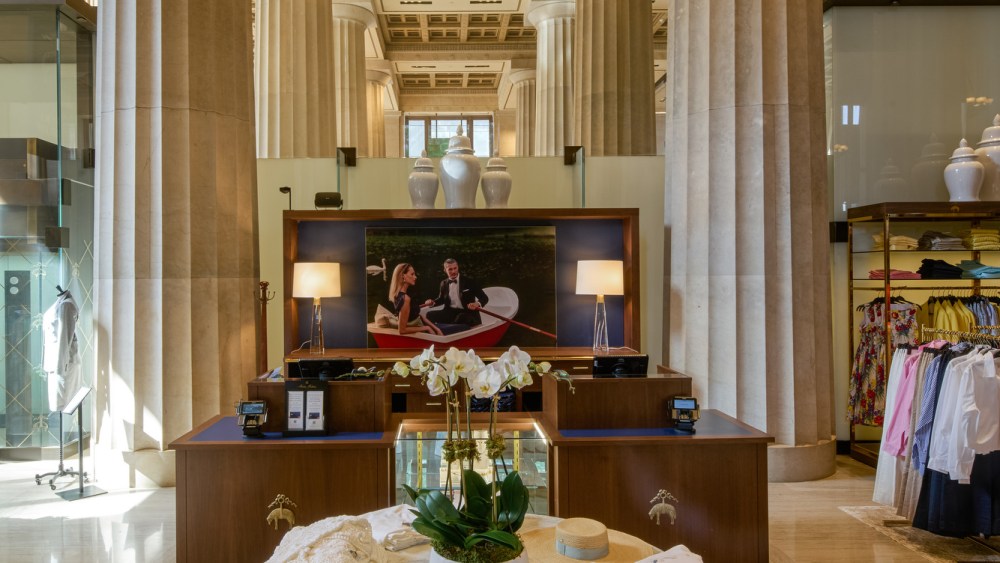
At 207 years old and the oldest retailer in the U.S., Brooks Brothers has long embraced its history. Now the company has returned to where it all began, unveiling a new global flagship in downtown Manhattan.
In 1818, 45-year-old Henry Sands Brooks opened a men’s haberdashery, H. & D.H. Brooks & Co., in a small wooden storefront on the northeast corner of Catherine and Cherry streets, within blocks of the East River and the site of the future Brooklyn Bridge, which wouldn’t be built for another 52 years. The business was later renamed Brooks Brothers in honor of his four sons.
Related Articles
For more than four decades, the company had operated a store in the Financial District at One Liberty Plaza, which had famously doubled as a makeshift morgue after the Sept. 11 terrorist attacks on the World Trade Center. But that closed in 2018 when the building it was housed in was being renovated.
You May Also Like
Now the brand is back downtown with a 10,000-square-foot, two-level space in the historic Western Union Telegraph Building at 195 Broadway. Also known as the AT&T Building, the 29-story building was designed by architect William Welles Bosworth and constructed between 1912 and 1916. It is one of New York’s first skyscrapers.
Because it’s landmarked, Brooks Brothers was limited in what it could do with the main floor, which was at one point the lobby of the building. So the team got creative, incorporating the white marble Doric columns, bronze and alabaster chandeliers and high ceilings with their inlaid grid of coffers, or sunken panels, into the store design.
The main floor is dedicated to men’s sportswear and womenswear, two growing segments of the business. Men’s suits, shirts and the made-to-measure department are on the lower level, which was completely gutted and redesigned.
“This is the culmination of everything we’ve been working on,” said Ken Ohashi, Brooks’ chief executive officer. “In less than five years, we’ve been able to completely reinvent the business.”
He said that after Brooks Brothers was purchased by Authentic Brands Group and SPARC for $325 million in August 2020, he was unable to make a financially prudent deal with Brooks’ former owner, Claudio Del Vecchio, to retain its longtime flagship on Madison Avenue and 44th Street. Del Vecchio owns the building at 346 Madison, which remains vacant.
Instead, Brooks doubled down on its other Midtown location in Rockefeller Center, which sources said is one of the company’s most-productive stores with annual sales of more than $10 million.
While Ohashi declined to provide numbers, he said the Rockefeller Center store was expanded two years ago to its current 4,500 square feet, and continues to be a strong performer.
“But we love downtown,” he said. “It’s close to where the original store was located and to Wall Street. It’s also near the TriBeCa epicenter and the Financial District is becoming a hot residential spot.”
The Financial District is also a popular tourist destination with the World Trade Center memorial and nearby Trinity Church where Alexander Hamilton is buried.
Michael Bastian, Brooks’ creative director, added: “We started at Catherine and Cherry, and over the years we followed the critical mass of the working guy as he migrated uptown.”
In addition to the Rockefeller Center unit, Brooks operates a store at 86th Street and Madison Avenue in Manhattan, which is slated for a facelift soon. All told, the company operates 141 stores in the U.S. and 334 globally.
The new flagship had a soft opening about a week ago and Ohashi said the sales are already strong. That comes without any official marketing and despite the scaffolding that obscures the main entrance on Broadway. The scaffolding is scheduled to be removed next month, the team said.
Even when the scaffolding is gone, Brooks will not be able to put its name on the exterior of the building because of its landmark status. Instead, its windows will have to tell a story, Ohashi said.
The company has more leeway on the interior. The rear of the main floor opens into the lobby and is directly across from a Nobu restaurant, where Ohashi will host a dinner and unveiling of the store to an intimate group on Wednesday night. There are two windows in that corridor which Brooks will use to display archival pieces. For the opening, one case is displaying a replica of the black greatcoat the company made for Abraham Lincoln’s second inauguration that he was wearing the night he was assassinated. An antique mirror from the same time frame is also on display.
A second case speaks to the brand’s own history with a silhouette of Henry Sands Brooks, the only remaining representation of the founder, along with photos of his four sons.
Ohashi said the new flagship is not the biggest store in the chain but is larger than most of the company’s new units. “Our new stores are generally between 5,000 and 7,000 square feet,” he said, adding that “historically, our stores have been too big.”
But at 10,000 square feet, Brooks has the space to “tell the whole story,” he said. “Half of the upstairs is women’s, which has had phenomenal growth this year.” In addition to luxury sportswear and casual menswear, the upstairs offers a vintage area along with the only site in the U.S. where customers can buy pieces from Brooks’ longtime collaboration with Junya Watanabe.
Downstairs is accessible by elevator or marble staircase and leads into what Ohashi described as a “men’s moment.” From suits and shirts to neckwear, the space offers a range of options for dressing up. The made-to-measure department offers some fabrics exclusive to the flagship, and ties have been “on fire” since the opening, Bastian said. In addition to servicing guys who are dressing up more again, at under $100 neckties are a good gift for tourists to bring home, Ohashi said.
“We’ve been focusing on what people wear to work today,” said Bastain. “We still have a very traditional person and sell a lot of suits, but they’re wearing more luxury sportswear and we’re moving with them.”
Brooks Brothers shares 195 Broadway with Anthropologie and Ohashi said he’d like to partner with the retailer because that space offers one of its largest wedding shops and he envisions opportunities to collaborate.
Overall, Ohashi said business at Brooks Brothers continues to be strong. “We’ve had four years of consecutive comp gains,” he said. “And the fourth quarter was incredible. Year-to-date, February was a little soft but we did well in March. The winners are spring fashions and women’s.”
Although womenswear is still a small business, representing just 12 percent of total sales, Ohashi believes it can continue to grow. “We’re buying aggressively for it next year.”
Earlier this year, Ohashi was also tasked with overseeing Eddie Bauer. The Seattle-based retailer is part of Catalyst Brands, which was created in January to oversee Authentic and SPARC’s Lucky Brands, Aeropostale, Nautica and Brooks Brothers as well as J.C. Penney.
Ohashi said that after running Brooks for over four years, the company is at the point where it’s more about “framework and good flow. We did the heavy lift over the past four years; now it’s about micro-tweaks and doubling down on the luxury positioning we’ve created that has really helped the business.”
He said Bastian was his first hire at Brooks after taking over as CEO and his updated, elevated designs and fabrications have led to more full-price sales, both in stores and online.
“We’re still relatively reasonably priced,” Ohashi said, pointing to the company non-iron, Supima cotton dress shirt for $118 as an example. “It offers incredible value.”
When Brooks Brothers was struggling and operating in Chapter 11 bankruptcy, the website was seen primarily as a vehicle for clearing merchandise. “It took a long time to get the full-price customer back,” Ohashi said. “But year-to-date, our margins have been the best in five years.”
“And our messaging is full price,” Bastian added.
“Brooks was flat when we bought it,” Ohashi said. “It’s important to get the vibe and the creative direction right, and I think we’ve done that.”
As a result, Brooks is in expansion mode. Ohashi said the company is opening more stores in 2025 than it has in the past two decades. New locations still on tap for this year include Red Bank, N.J., and the Stanford/Palo Alto, Calif., area.