
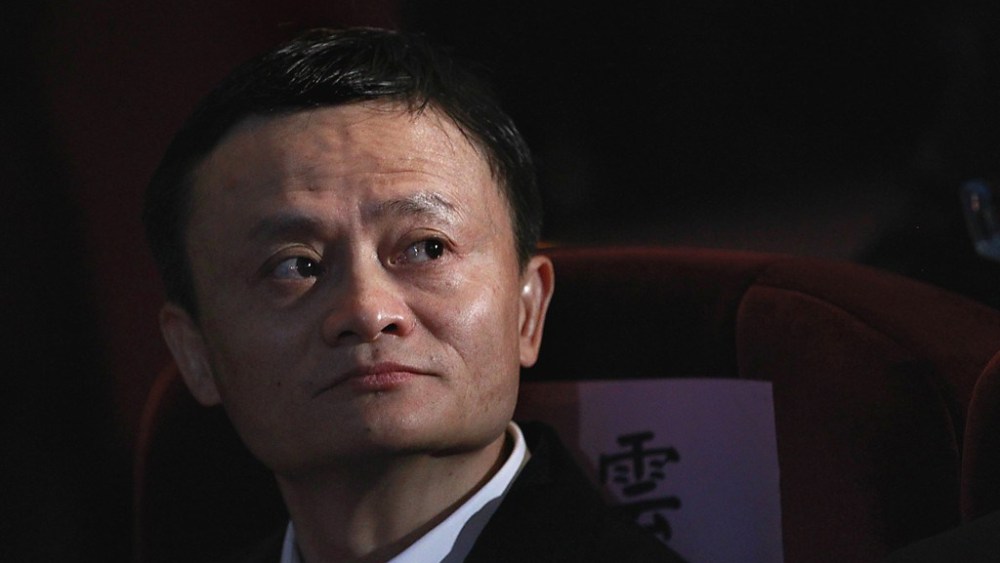
SHANGHAI — Jack Ma on Tuesday again asked brands to band together with Alibaba to fight counterfeits worldwide — but said the problem isn’t fakes, but the new structure of the fashion industry.
Speaking at an investors conference, the company’s founder and executive chairman said, “We are world-leading fighters against counterfeits. We can solve this problem better than any government or organization.…This is not a war for Alibaba, it is a war for our industry, for e-commerce. Let’s do it together.”
Alibaba has long been in the firing line for its perceived role as a marketplace where counterfeit goods run rampant and the controversy recently came to a head when the company was admitted to the International Anticounterfeiting Coalition, to the chagrin of many brand members, only to have its membership suspended shortly thereafter, along with The RealReal and Wish.com.
Related Articles
But even as Ma repeated his request that the industry work together on fakes, he seemed to express the view that counterfeits were an isolated problem and one that would always exist. Discussing the topic, he continued, “We’ve got 500 million people on our platform. If 10 percent of them are bad guys, we’ve got 50 million bad guys, if 10 percent of them are really bad guys, we’ve got five million.”
You May Also Like
Ma added, “Where there is money, there are bad guys. We don’t have police or a court, we just have a group of young people using technology to fight against them. This is a war against human instinct. Every time we sell a fake product, we are losing five customers. We are a victim of this, but we never stop fighting.
“In China, last century there were about 5,000 branded companies who control the luxury industry — they use the money, brand, quality and the channels to control. They use a lot of OEM — China is the nation with the world’s largest OEM base. At that time, they don’t have a brand, they don’t have a channel. Today the Internet has become the channel. These OEMs suddenly realized, ‘Oh my god! I can sell my own products online.’”
These manufacturers, Ma said, are the main issue. “The problem is that fake products today are better quality and [at a] better price than the real names,” he added. “They are the exact factories, the exact raw materials, but they don’t use the brand names. We have to protect IP to stop the fake products, but those OEMs are making products that are a better product at a better price, so we have to think the way of doing business has changed. We would love to work with the brand companies, but it’s not fake products destroying them — it’s this new business model revolutionizing the whole road.”
Rick Helfenbein, president of chief executive officer of the American Apparel & Footwear Association, which has been critical of Alibaba and last year called for its online marketplace Taobao to be re-listed on a U.S. government counterfeit watch list, said, “Alibaba enabled an unprecedented counterfeit problem and it is up to them to take concrete actions to fix it.”
“Alibaba can’t suddenly decide that the customers are the problem, or that the fakes are so good that they’ve earned a spot in the marketplace,” Helfenbein said. “Somewhere along the line, this nonsense has to stop. Our branded partners can only value Alibaba on what they are, not on what they pretend to be.”
Ma’s comments on counterfeits came as Alibaba said Tuesday it expects full-year 2017 revenue to grow more than 48 percent — an acceleration from the 33 percent growth it posted the previous year. The forecast is a bullish one for a company facing questions about its growth prospects and scrutiny from the U.S. Securities and Exchange Commission over its accounting practices.
Part of that growth is coming from acquisitions, but the e-commerce giant said sales would still grow more than 36 percent, excluding newly consolidated revenue from Youku and Lazada.
Speaking at the investors conference, Alibaba executives also said they expect the company’s gross merchandise volume to hit $1 trillion in fiscal 2020.
Back in March, the company said its GMV had surpassed 3 trillion yuan, or about $476 billion, with 10 days remaining in the company’s fiscal year ending March 31. In April, the company said it had become the largest retail economy in the world in terms of GMV on its China retail marketplaces. The following month it emerged that the SEC is investigating Alibaba’s accounting practices, including how it reports operating data from Singles’ Day.
Ma spent much of his stage time at the meeting downplaying the importance of GMV for Alibaba.
“People are always talking about GMV, but GMV is not what we want,” he said, going on to explain that in Alibaba’s early days, back in 2001 and 2002, the metric investors were most interested in was page views and click rates, metrics Ma believed were more relevant to web portals than the burgeoning e-commerce business Alibaba was gestating.
“Then finally, in 2005, we said, ‘OK, we’ll give you something called GMV we learned from eBay.’ GMV has never been the standard, but if the investors need it, they can have it, and later it became the standard,” he said.
Later in the day, chief financial officer Maggie Wu said Alibaba will stop reporting GMV on a quarterly basis — which it has been doing until now — and start to release the metric on an annual basis after the next financial quarter.
“Of course we are going to continue to report GMV, it’s still a very important metric,” she said, though she went on to describe the metric as not particularly important at all.
“We actually show the real value from the revenue, the margin by segment, these reporting metrics,” Wu said.
For those who might question whether Alibaba is ceasing its reports of quarterly GMV growth in order to mask revenue, Wu reassured investors that this year’s growth is on target to outpace last year’s.
“Our value proposition is moving to the next level. Over the next year we expect revenue growth to be over 48 percent year-over-year,” she said. Her presentation also revealed Alibaba’s own estimates of its current valuation, which stands at $189 billion as of June 10.
Ma spent much of his speech elaborating on the company’s data-centric vision for the future.
“We have the world’s largest retail business, but we aren’t a retail business, we are a data business. We don’t know how to make money from data today, but we do know that nobody will be able to live without data in the future,” he said at the conference, held at the company’s Hangzhou headquarters. “The difference between Wal-Mart and us is that Wal-Mart sells things, then they study data in order to sell better. We sell things because we want to collect the data. All the things we are doing, we are doing because we want the data.”
Ma outlined a 20-year plan that would see Alibaba grow to the equivalent of the world’s fifth-largest economy by 2036, increasing its consumer reach to two billion people — up from its recently disclosed tally of 423 million active buyers.
“In 20 years, we want to be the world’s fifth-largest economy, we will support a population of two billion and support 10 million businesses,” Ma said.
Alibaba would be able to do this, according to Ma, by continuing to focus on building infrastructure for e-commerce, logistics, financing, data computing and cross-border e-commerce.
Ma added that sports and entertainment are two other areas that have major potential for Alibaba.
Alibaba’s shares closed Tuesday up 3 percent to $77.77 on the New York Stock Exchange.