
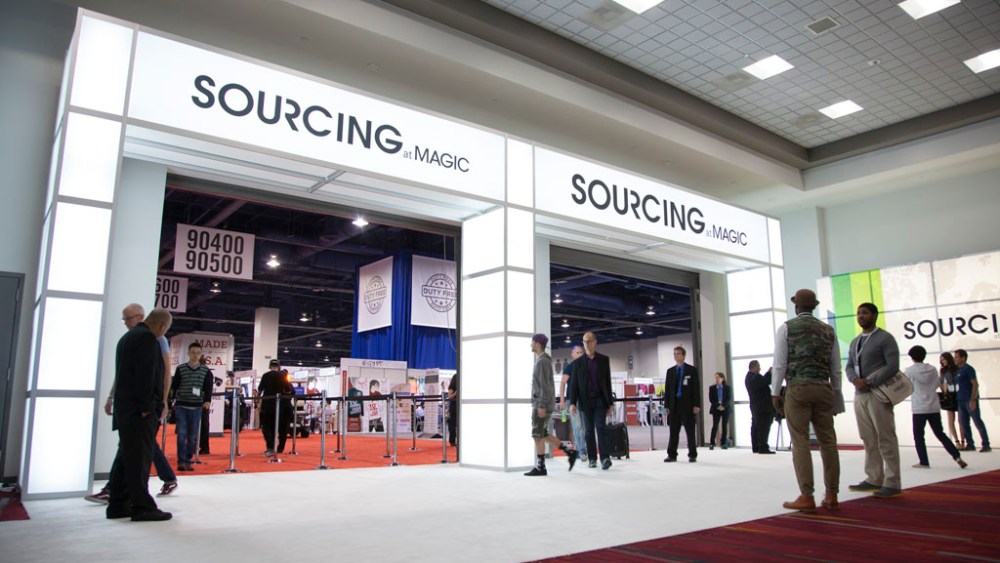
LAS VEGAS — As the global supply chain expands to various corners of the world, manufacturers at Sourcing at MAGIC said they were discovering that it’s advantageous to target niche markets by promoting features such as duty-free trade, artisanal craftsmanship, slow fashion and Made in USA production.
Against a backdrop of challenges affecting European retail and U.S. denim sales, companies that exhibited at Sourcing last month at the Las Vegas Convention Center were pursuing a slew of new opportunities. Many of them were realizing that globalization doesn’t automatically call for production runs that are bigger and cheaper, like those usually associated with factories in China.
Related Articles
“We can create specific products based on specific needs,” said Patricia Medina, a director at Mexico’s Aztex Trading.
You May Also Like
Besides benefiting from duty-free trade with the U.S. under the North American Free Trade Agreement, Aztex can also accept a minimum order of 600 pieces for novelty jeans wholesaling for $9 to $22 apiece. For instance, one customer from Hawaii requested jogger pants made of denim that can wick moisture.
For Guatemala’s Nova Creation, a full-package manufacturer that has produced tops for brands like Guess and Smithson Clothing, being duty-free under the Central American Free Trade Agreement is only the start. “Most importantly in this economy, we’re a lot closer to the [U.S.] market and can deliver a lot quicker,” said Roger Marks, a representative for Nova Creation.
In contrast, P y P Leather Goods from Colombia made its debut at Sourcing with the concept of slow fashion. It requires a minimum of 100 pieces for its duty-free vegetal-tanned bags costing $55 to $70 each. “We’re trying to make products that are not trendy bags,” said director Pablo Pacheco. “It’ll be in the market a little longer.”
In a new section dubbed Global Artisans, vendors from the Philippines, Cambodia and Nigeria highlighted the apparel, jewelry and handbags that are special to their domains. Villageworks Songkhem Co. promoted naturally dyed silk produced in Cambodia and fashioned into dresses with ruffled sleeves and other styles. Morin O parlayed both Nigeria’s duty-free status with the U.S., thanks to the African Growth and Opportunity Act, and its expertise of making snake-printed sheepskin wallets and handbags wholesaling for $25 to $115 to attract buyers. Symphony Creations Inc. from the Philippines, which creates jewelry wholesaling for $1.50 to $3.50 out of palm wood, limestone and other materials indigenous to the Southeast Asian nation, followed the money.
“Last year, we felt an increase in the market from the U.S. for natural jewelry,” said Carl Leenaerts, a director at Symphony, noting that its U.S. business doubled in 2014.
Even though the start of the Chinese New Year coincided with the last day of the fair and organizers initially expected a 10 percent decline in the number of Chinese exhibitors, many manufacturers from China still brought their best samples to Sourcing to demonstrate how they can combine trends with competitive prices. For its third appearance at the expo, Denim Supplier displayed biker-style jeans in a black acid wash that it produced for $9 a pair.
“If I were doing more basic [clothing], I would have competition from Bangladesh and Vietnam,” said Karan Manwani, a director at Denim Supplier.
The growth in outerwear gave a boost to factories that specialize in coats, jackets and knits. Worldup International Ltd. made its premiere with wool and viscose blend car coats enhanced with funnel necks and color-blocked panels; oversized sweatshirts accentuated with lace appliqué and quilted fabric, polyurethane biker jackets and other styles that have appealed to customers such as Barneys New York, Saks Fifth Avenue and Desigual. Although it doesn’t accept orders for fewer than 1,500 pieces, Worldup found a market with its styling and prices of $9.20 to $18 apiece.
Speedy delivery was a selling point for Onteks from Turkey, which can produce and deliver knitted scarves, hats and ponchos costing $3.50 to $30 within five weeks.
Domestic production continued to garner interest at Sourcing’s Made in USA corner, where exhibitors included Manufacture New York and Los Angeles’ Argyle Haus of Apparel and Beholdenim. In a sign of the growing momentum for the movement, Maker’s Row returned as an exhibitor after making its debut two years ago. Charging companies for access to its database of U.S. factories, Maker’s Row has grown its network to 6,000 factories from 1,400 since it launched in November 2012.
To differentiate itself from other Los Angeles-based manufacturers, Indie Source creates custom fabrics through a local textile mill in which it has an equity stake, noted production manager Zachary Hurley.
At The Look Group, a six-year-old full-package manufacturer in Carson, Calif., sales have grown 60 percent every season for the past couple of years through clients such as Bloomingdale’s and Dillard’s. Akay Shiraze, chief executive officer and founder of Look Group, is so bullish on the domestic market that he’s working to launch a new company called Made Here Manufacturing by June to provide services to designers who want to create non-apparel goods such as eyewear and shoes in the U.S.
“They’re all coming back,” he said, noting that overseas “prices are going up, quantities are going up.”