
HONG KONG — Designers and vendors here attempted to drum up business for the fall-winter season at the city’s recent fashion week and World Boutique trade event but economic concerns loomed in the background.
The event, which ran from Jan. 16-19 at the Hong Kong Convention and Exhibition Centre, put a spotlight on emerging Asian designers and consumers. It bills itself as the largest of its kind in Asia and the entry point to the most coveted market in Asia: China. Still, those at the event spoke about a variety of challenges designers and fashion brands are facing in the form of rising labor and rent costs and increased competition.
“In general I think 2012 will be a very tough year and everybody should be very cautious,” said Vincent Fang, chairman of the Hong Kong Trade Development Council. “But Hong Kong, because of our strategic location as the gateway to China, we still can enjoy [and increase of] about 2 percent in our clothing exports [for full-year 2012] so we’re very lucky.”
Related Articles
Although designers and retailers remain optimistic about long-term growth, they said they are worried about the upcoming year. Already, there are signs that Hong Kong fashion week and the accompanying World Boutique show are losing a bit of momentum. There were 1,900 exhibitors from 25 countries this year, down from the 2,000 exhibitors at last year’s fall-winter show. Most exhibitors were from China, Hong Kong or Taiwan with only a handful from the rest of the world. Although attendance figures were not immediately available, foot traffic on the exhibit floors was extremely light and several exhibitors voiced disappointment with turnout.
You May Also Like
Exhibitors at the World Boutique were heavy on evening wear with a lot of sequins, others showed dresses in bright colors and some color blocking plus fitted jackets in dark colors.
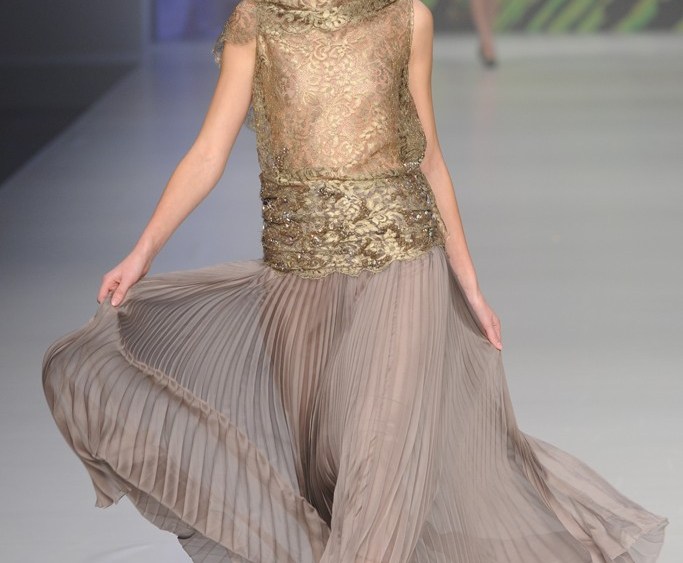
Fashion shows punctuated the four-day trade event. The opening night “Fashion Extravaganza” show on Monday featured Hong Kong-based Hidy Ng whose soft, feminine dresses featuring luxurious materials such as fur, chiffon and silk in shades of gray, pink, beige and black provided quite a contrast to the other Asian designer — Qi Gang from Shanghai. One of Qi’s dramatic dresses featured stiff wing-like sleeves that extended a couple feet from the body. Another had branches emerging from the shoulders. Also displaying at the show were Risto Bimblioski of Paris, who showed his collection featuring dark colors and was heavy on knitwear; and Craig Lawrence of London with a collection of sheer, neutral colored knitwear dresses.
The fashion show featured Grace Yu, a Hong Kong model who was also the first Asian model for Dior, and drew local celebrities such as Hong Kong actress and model Monica Chan and Lynn Dai-Lin Xiong, a Chinese model and actress.
Another highlight was a runway show/design competition featuring the work of up-and-coming designers. Mak Chuen Chi picked up the prize, winning over judges with her collection, which she said was inspired by the sea. It featured black and fluorescent yellow evening dresses mixed chiffon with neoprene in interesting shapes. As part of her prize, Mak will travel to Tokyo to work for a month with designer Atsuro Tayama, one of the competition judges.
Asian designers — particularly those from Hong Kong — face a host of challenges. For them, the growing interest in China has meant increased competition, and higher rents.
“In recent years it’s been very difficult. All the brands they come to Hong Kong. For Hong Kong designers, building a healthy business is very difficult because nowadays the rent is so expensive so you can only support a very small studio. If you have a retail shop you have to fight with H&M that kind of enterprise. It’s difficult in Hong Kong to survive,” said Kevin Yeung, chairman of the Hong Kong Fashion Designers Association, which represents about 100 designers in the city.
Hong Kong designers echoed Yeung’s sentiment.
“In 1980, Hong Kong had many seamstresses and embroiderers,” he said, but many have been put out of business, lamented Don Cheng of TiAMO, a Hong Kong-based designer of costume jewelry and accessories. Despite the high overhead in the city, TiAMO assembled a 20-person studio in Hong Kong.
Noting that there aren’t many internationally famous designers from Hong Kong Cheng said, “We are Hong Kong people. We want to do something in Hong Kong.”
Franco Yeung, founder and designer of Volare, a Hong Kong-based maker of shoes and other leather goods, complained that labor prices have skyrocketed in the last few years, squeezing profit margins.
“Profit margins are less and less but my prices keep going higher and higher,” Yeung said.
Average monthly wage for workers in Guangzhou — a key production center for Hong Kong labels — used to be about 600 renminbi, or $94 at today’s exchange rates, now it’s closer to 3,000 renminbi, or $473, he noted. While some designers, particularly large companies, are able to shift production to places such as Vietnam or India, Yeung said it’s difficult for him to do the same because his orders are small.
On the flip side of things, Taiwanese designer Fala Chien, who is looking to relocate from Vancouver to Shanghai, said she’s looking forward to lower labor costs (compared with Canada). She currently sells her apparel at two retail locations in China — Hangzhou and Wuhan — but is planning to expand in China and wants to open a studio in Shanghai to be closer to Chinese clients and manufacturers.
The fair also attracted some vendors from outside Asia; they gave mixed feedback on the show as a whole.
Mike Guimm, sales manager at Los Angeles-based WOW Couture, said it was his first time at Hong Kong fashion week and he wasn’t sure if he’d come again. Most of WOW Couture’s buyers are from the U.S. or Europe and Guimm said he was cautious about taking on Chinese buyers for fear of copying.
Ema Koja, owner of Miami-based Ema Savhl Couture, said she was pleased to have met many mainland buyers as she’s trying to expand her business in Asia but did encounter some challenges.
“We found a lot of interest in our line,” she said but “there’s not much buying power for us yet, our prices are a little bit high.”
While pleased to have met many Chinese buyers, Koja had hoped to see more Australian buyers as well but found that Australian buyers still prefer other shows.
“They are still going elsewhere, the buyers of high end goods, they are going to Paris,” she said.
Koja said the fair’s sprawling format presented another challenge as goods of various price and quality levels were scattered throughout the venue.
“When you mix lower brands with higher prices, sometimes it’s quite overwhelming for people to understand the difference because you see so much,” she said.