
The marketing message is getting personal for fall.
In a harsh mediascape marked by sharp advertising budget cuts and play-it-safe campaigns hawking discounts, change is stirring among fashion marketers. They are making appeals to the individual rather than the masses, reversing the pattern of the past 50 years. They are focusing locally and leveraging lower-cost platforms such as store settings and the Internet to reach their most passionate customers. And they are tapping into the public’s desire to escape day-to-day drudgery in the recession and indulge in fantasies — signaled by the rising popularity of vampires, video gaming and some big-budget movies, among other things.
Related Articles
“The days of big, anthemic, conceptual campaigns are over for now,” said John Gerzema, chief creative officer at Young & Rubicam.
You May Also Like
Smaller scale, closer-to-home marketing venues or far-reaching, efficient media like the Internet are being chosen as lower-cost, targeted strategies.
Regularly Tweeting into the wee hours with her 6,300 followers, Lisa Gavales, executive vice president and chief marketing officer at Express, has been experiencing unaccustomed demands on her time. Many of her followers, she said, “want a window into who’s wearing our clothes — celebrities, models — who’s shopping our stores, what’s going on behind the scenes at photo shoots.” (Express, which operates more than 550 U.S. stores with annual sales of more than $1.8 billion, also addresses these issues in videos, promotional offers and the like to 48,000 of its “fans” on Facebook.)
The second phase of Express’ fall campaign, starting in September, will spotlight the brand’s young, forward fashions — such as strong-shouldered jackets and military-inspired styles — in print and online, including the word from Gavales to her followers on Twitter, people she sees as Express loyalists.
“I much better understand who my customer is, now,” she said of her fellow Tweeters. “It’s having the conversations with the customers who want to know what’s next.”
Paragon, the century-old sporting gear and apparel institution in Manhattan, is using Twitter’s new media messaging to draw people to real-time events. The sports specialist’s Twitter page recently invited people to join in a Nike training run (“…at 6:30! Try the latest and greatest Nike shoes!”); to get discounted tickets to World Team Tennis, and it listed offers of previous days, like that of free 7.11-oz. Slurpees on 7-Eleven’s 82nd birthday, July 11 (…“for everyone! Find a store near you.”)
While enabling companies to take the temperature of “communities talking about [them] in real time,” Twitter’s burst onto the scene, Gerzema said, raises a “big concern” for marketers: “How do you keep Tweets from becoming spam?”
More broadly, he said, businesses are entering a period when their brands “have to connect on a value and values level” — by speaking directly to consumers’ personal values that are consistent with the value of the things brands are offering, such as high-quality craftsmanship, the cachet of a limited edition, or a strong ethical stance.
A Lacoste ad in The New York Times the day after this summer’s Wimbledon final, took the unusual step of congratulating the men’s runner-up, Andy Roddick, who wears Lacoste. Beneath a full-page image of Roddick on court, Lacoste said: “Congratulations Crocodile Andy. Lacoste thanks Andy Roddick for his performance at Wimbledon.”
“We wanted to show our pride and confidence in him as part of our team,” Bob Siegel, Lacoste’s chairman and chief executive officer, said of the passion in the brand’s message. “It aligned itself with what the brand stands for,” Siegel added of Roddick’s performance, citing his “sportsmanship and loyalty” to his supporters.
With a fall ad budget trending flat against 2008 and most of its ad dollars headed toward the Internet (read: young adults), Lacoste’s four-color print ad was an exception. “Lacoste’s congratulatory ad reflects a timely message as important,” noted Peter Levine, chief creative officer at Luxury Brand Forum. “That was the news of the day — and it was in a newspaper.”
A salute to a superathlete of a different sort, Olympic gold medalist Michael Phelps, is being made in a new TV spot for Subway that celebrates his individualism, a trait that dovetails with the sandwich chain’s “make-your-own” subs. Subway, a brand, like Speedo, which supports the scandal-hit swimmer, shines a light on an upbeat Michael being Michael, rather than casting him as contrite or circumspect. There are some quick scenes of the athlete’s life set against a joyous version of Sly and the Family Stone’s “Thank You (Falettinme Be Mice Elf Agin)” and a wrap-up with Phelps sitting down to have one of Subway’s sandwiches, his way.
In a tough advertising environment, print and radio have been taking the biggest hits. Ad expenditures in magazines, newspapers and radio are off 25 percent, compared with 2008, and the declines in TV and the Internet are 15 percent, said Jon Swallen, senior vice president of research at TNS.
Advertisers in the U.S. have spent about 12 percent less on their media buys this year and first-quarter spending fell a steeper 14 percent, to $30.2 billion, from $35.2 billion a year earlier, according to TNS. The slightly improving picture isn’t projected to change much through yearend. Media outlays are likely to keep decreasing at around the same pace. That would put the year-end tally at $121.6 billion, versus $141.7 billion in 2008, when there was a 4 percent decline.
No big comeback is anticipated until advertisers see a solid upswing in consumer spending and are convinced it can be sustained. “Consumer confidence and consumer spending feed ad spending, which is why we’re still in a period of weak ad spending,” Swallen noted.
In the realms of fashion and luxury, “major decreases” in ad expenditures have ranged from 20 percent to as much as 50 percent this year, said Pierre Dupreelle, a director at Millward Brown Optimor, a marketing, media and financial consultant. Advertisers in the retail ranks, by comparison, have cut their outlays an average of 23 percent, said John Puchalla, a vice president and senior analyst at Moody’s Investors Service.
The sectors’ efforts to connect with shoppers’ personal values have been popping up increasingly from brands as diverse as Cartier, Nike and Radio Shack.
In support of Lance Armstrong’s Livestrong campaign, newspaper ads appeared to coincide with the finale of the Tour de France on Sunday from Nike (“One Race Remains Unfinished. It’s about you and so many others at wearyellow.com”) and Monday from Radio Shack (“2010 Live Strong. Get Ready. Radio Shack.”)
At wearyellow.com, for example, the official site of the Livestrong campaign, messages of hope drawn along the Tour de France route can be glimpsed, as can videos of Armstrong; actor and fellow cancer survivor Evan Handler, and artist Shepard Fairey, who customized a yellow-and-black Trek Madone bike for Armstrong’s turn in the 2009 Giro d’Italia.
Looking back to 1954 to recall a hinged foldout tiger lorgnette “made on special order for the Duchess of Windsor,” a Cartier ad in The New York Times Monday suggested: “Personalize your style with a signature piece from our eyewear collections.”
“Whether it’s an outrageous heritage or a classic one,” a brand has to “mean something for you” to draw interest, said Raul Martinez, creative director at AR, an advertising and branding agency. “The outrageous vision of Alexander McQueen. Armani’s embrace of the jacket, the suited self in his fall collection. The world has changed. People expect more from a brand if they are attaching themselves to it.”
Practical considerations are shifting, as well, said Ann Mack, director of trend spotting at JWT advertising. The tug of “x dollars off” is waning. “It all starts to sound too much the same,” Mack said. “Moving forward, people will increasingly be recession fatigued.” Ideas she expects to resonate with consumers include “offering optimism, refueling hope, reinventing and reigniting.”
A lineup of eight women modeling the neoclassical fall fashions of DKNY in Wall Street’s environs — the corner of Hanover Street and Exchange Place — conjures investment dressing with an upside, for instance, in an ad spread in Elle’s August edition. Marc Jacobs’ ad in the August issue of Vogue transmits moments of joy and fun, with repeating images of people embodying a mod, swingin’ Sixties dance sensibility. And a Diet Pepsi ad in Out’s August issue takes an upbeat, all-verbal stance, punctuated by 14 Pepsi logos, proclaiming: “All for One; One for All; Fabulous; Joy; Everybody, and Together,” among other messages.
“For the past six months, many merchants and marketing executives [were] paralyzed and hiding under their desks,” Paco Underhill, a managing director at Envirosell, said of marketing inertia during the financial crisis. More recently, “people have been climbing out and facing the new world order. One-third of our population is becoming downwardly mobile, including [some] Baby Boomers, who don’t have the luxury of time.”
Regardless of economic status, fantasies can be indulged. With recession fatigue setting in and muted optimism about 2010 stirring, people have been exhibiting a taste for escapism, a mode beginning to surface in fashion ads. “The urge for fantasy and escapism is happening,” said Ron Rentel, president of Consumer Eyes brand consultancy.
That trend is reflected in fantasies like the high-grossing movies “G-Force” and “Harry Potter and the Half-Blood Prince.”
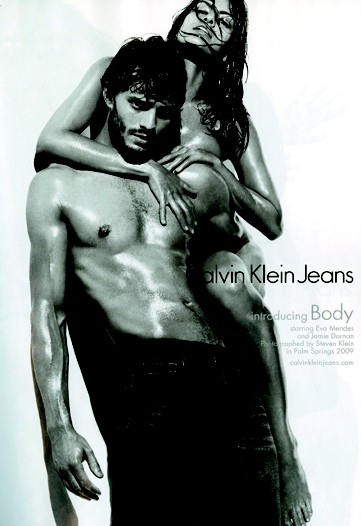
Fashion fans are invited to escape the everyday via four pages of black-and-white ads in Elle for Calvin Klein Jeans “Introducing Body starring Eva Mendes and James Doran” in provocative, wet, body-hugging poses, and in a two-page ad, also in Elle, for Dolce & Gabbana’s “The Lipstick: Creamy texture for lustful lips” worn by Scarlett Johansson channeling Marilyn Monroe, vamping against an animal-print background.
Fantasies are also brewing for Wal-Mart shoppers. A new TV spot for Wal-Mart and Fruit of the Loom underwear shows a half-dressed woman dancing in her bathroom (and presumably in her Fruit undies) to the strains of Alicia Bridges’ Seventies hit “I Love the Nightlife” — suggesting there’s still life after six.