
LAS VEGAS — Price, provenance and value dominated discussion among designers, textile mills and manufacturers at Sourcing at MAGIC last month.
More than 700 companies from 40 countries participated in Sourcing’s most recent edition, held Aug. 21 to 24 at the Las Vegas Convention Center. Sourcing unveiled a new section devoted to companies based in North, Central and South America. The Americas pavilion included 70 exhibitors from the U.S., Mexico, Peru, El Salvador, Guatemala, Nicaragua, Colombia, El Salvador, Haiti and other nations.
To highlight the importance of the trade in the Americas region, U.S. Department of Commerce’s Under Secretary Francisco Sánchez came to meet with exhibitors and attendees. According to Sánchez’s office, the U.S. is the fourth-largest exporter of textiles and apparel in the world, and the Western Hemisphere forms the largest market for U.S. textile and apparel exports, receiving more than 64 percent of such goods produced in the U.S. Last year, the U.S. exported nearly $13 billion of textile and apparel goods to the Western Hemisphere, an increase of nearly 20 percent from a year ago. Sánchez’s office expects the positive growth trend to continue in 2011.
Related Articles
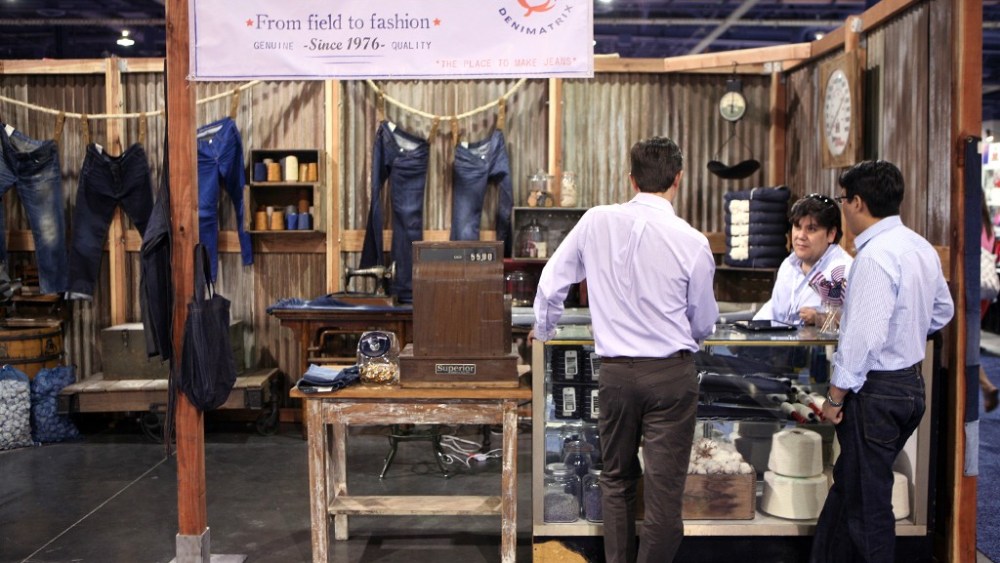
American Denimatrix, owned by a co-op of cotton farmers in Texas, Oklahoma and Kansas, hopes to benefit from that growth. Using denim fabric made in Texas, the company washes and sews jeans in Guatemala. While prices start at $15 for a pair of basic jeans, the company said it has the capability to produce fashion styles, such as waxed snake-print jeans. It said it can complete an order in as little as eight weeks, doubling the time if it has to produce fabric that isn’t in stock. Being a vertically integrated business that controls every step from the cotton fields to the sewing of the garment, it looks at ways to streamline each operation to help people who are interested in making clothes in North and Central America.
You May Also Like
“They’re looking at making garments in this hemisphere,” said Ryan Lupton, product development manager at American Denimatrix. “They want to see if we can make the price work.”
Parras, a denim mill and manufacturer in Mexico, said price is the biggest concern for its customers, which include Abercrombie & Fitch, Urban Outfitters’ BFD and Lucky Brand. Returning to Sourcing after a four-year absence to show at the Americas pavilion, the company has had to lower its prices. Fabric prices now start at $3.70 a yard and go up to $8 a yard, and manufacturing packages cost between $8 and $20 a garment.
“It’s difficult at this time because of the price of cotton,” said Grissel Ramirez Hernandez, who handles Parras’ marketing and development. “We are trying to make agreements with contractors. We are trying to develop fabrics in the price range that customers are looking for. We are trying to be creative to offer what customers are looking for.”
Keeping prices low is an ongoing challenge for manufacturers and designers. Prices of cotton, wool and silk have risen, as have costs for energy, labor and transportation. China’s Riverland, which specializes in making woven coats, cut its profit margins by 5 to 10 percent, even as the cost of materials increased 10 percent. Parkdale, a yarn producer based in Gastonia, N.C., expected the price of cotton to stabilize later this year and in early 2012. India’s AP Fashions tried to adjust prices by using polyester, which costs 75 percent less than silk, in the ruffled and appliquéd sundresses it makes for customers. Burlington Worldwide, a supplier of synthetic fabrics, wool and wool blends from Greensboro, N.C., said wool prices have gone up as much as 20 percent.
“Customers are struggling with whether to stay at 100 percent wool or look at blends,” said Peter Baumann, Burlington’s senior vice president of merchandising.
Exhibitors brought their latest and newest offerings to Sourcing. Denim North America, a denim textile mill based in Columbus, Ga., and a first-time exhibitor, offered cotton denim with black filling at $5 a yard and a stretch fabric called EverFlex at $5.50 a yard. Hong Kong’s Capital Kingdom Ltd. highlighted texture in a cotton slub blend and a cotton dobby woven in sharp black and white waves, both priced at $2.20 to $2.50 a yard. Buhler Quality Yarns, based in Jefferson, Ga., displayed MicroTencel blended from Tencel and Supima cotton. Indonesia’s Bless, another new exhibitor, hoped to catch the trend for snakeskin bags and statement jewelry with its rings, necklaces and bags made of materials ranging from Bali shells and rose quartz to Indonesian python, crocodile and cowhide. Prices range from $10 for rings to $125 for python clutches encrusted with natural stones.
Aside from price, which remained a priority, specialization was also important as designers strove to add value and offer high quality in their garments.
“We were looking for vendors in terms of their specialty,” said Gloria Brandes, chief executive officer of young contemporary line BB Dakota in Costa Mesa, Calif., who returned to Sourcing after discovering a reliable knit maker there last February. “We were looking for knit vendors, crochet vendors, embroidery.”
Peru’s Comercial Distribuidora Ariana S.A.C. understood the importance of showing specialty knit products at its debut as a Sourcing exhibitor. Counting Rag & Bone and Custo Barcelona as clients, the manufacturer appliquéd traditional Peruvian fabric in a star pattern on a cotton knit shirt. Requiring a minimum of 200 units, it charges $7 to $15 a garment.
“Ten years ago, you could bring your [basic] T-shirts and polos” to the show, said Karina Montes Romero, commercial manager. “Now, people are looking for fashion and the added value in the garment.”
Aware of the complexities of creating a fashion line, Jen Roye and Patrick Knowles began offering design services at their sourcing company Vertical by Design International this year. Participating at Sourcing for the first time, the San Francisco-based company hoped to attract customers who want to do private label or launch a line using their in-house design team and network of some 20 factories in China. Roye, who previously designed for Levi’s and Pacific Sunwear of California, specializes in denim but she also offered pieces such as a melton wool cape and polyurethane biker jacket at Sourcing. Prices run from $14 for a pair of rigid denim jeans to $22.20 for the cape.
“This was an opportunity to leverage all my experience as a designer and give support to designers,” Roye said. “Our customers know they can talk about their design to another designer.”