
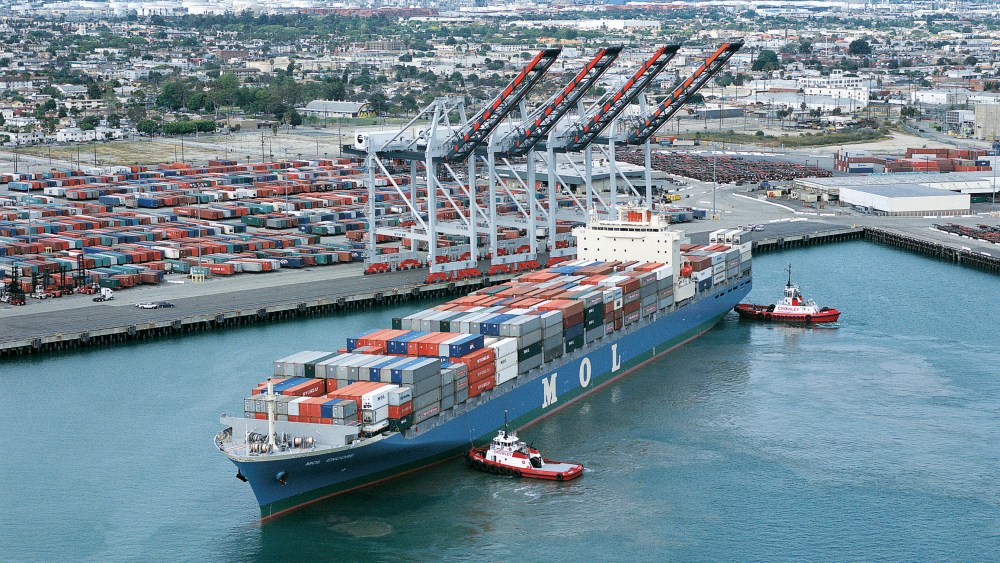
Cargo imports at the nation’s major retail container ports is expected to increase 4.6 percent during the first half of the year over the same period last year as the nation’s economy improves and retail sales continue to grow, according to the monthly Global Port Tracker report released Thursday by the National Retail Federation and Hackett Associates.
“This is very much in line with what we are forecasting for retail sales and consumer spending this year,” said Jonathan Gold, vice president for supply chain and customs policy at NRF. “Retailers try to balance inventories very carefully with demand. So, when retailers import more merchandise, that’s a pretty good indicator of what they are expecting to happen with sales.”
Related Articles
Ports covered by Global Port Tracker handled 1.58 million Twenty-Foot Equivalent Units in December, down 3.8 percent from November as the holiday season came to an end but up 10.2 percent from December 2015. That brought 2016 cargo volume to 18.8 million TEU, up 3.2 percent from 2015, which had grown 5.4 percent from 2014. One TEU is one 20-foot-long cargo container or its equivalent.
You May Also Like
January was estimated at 1.59 million TEU, up 6.6 percent from a year earlier. February is forecast at 1.53 million TEU, down 0.6 percent from last year; March at 1.43 million TEU, up 7.8 percent from last year; April at 1.56 million TEU, a 8.2 percent gain; May at 1.66 million TEU, rising 2.3 percent, and June at 1.65 million TEU, a 4.3 percent increase.
Those numbers would bring the first half of 2017 to 9.4 million TEU, up 4.6 percent from the first half of 2016. That would be almost three times the 1.6 percent growth seen in the first half of 2016 over the same period in 2015.
The cargo numbers come a day after NRF forecast that 2017 retail sales — excluding automobiles, gasoline and restaurants — will increase between 3.7 and 4.2 percent over 2016, citing job and income growth and low debt that show “the fundamentals are in place.”
Cargo volume does not correlate directly to sales because only the number of containers is counted, not the value of the cargo inside, but nonetheless provides a barometer of retailers’ expectations.
“The U.S. is well placed in 2017 and is likely to outperform most of the rest of the developed economies,” Hackett Associates founder Ben Hackett said. “If the infrastructure investments promised by the new administration come about, we can expect stronger growth than in 2016, but that assumes good relationships with U.S. trading partners and no recourse to trade barriers that would result in a tit-for-tat response.”
Global Port Tracker covers the U.S. ports of Los Angeles-Long Beach and Oakland, Calif.; Seattle and Tacoma, Wash, on the West Coast; New York-New Jersey; Hampton Roads, Va.; Charleston, S.C.; Savannah, Ga., and Port Everglades and Miami, Fla., on the East Coast, and Houston on the Gulf Coast.