
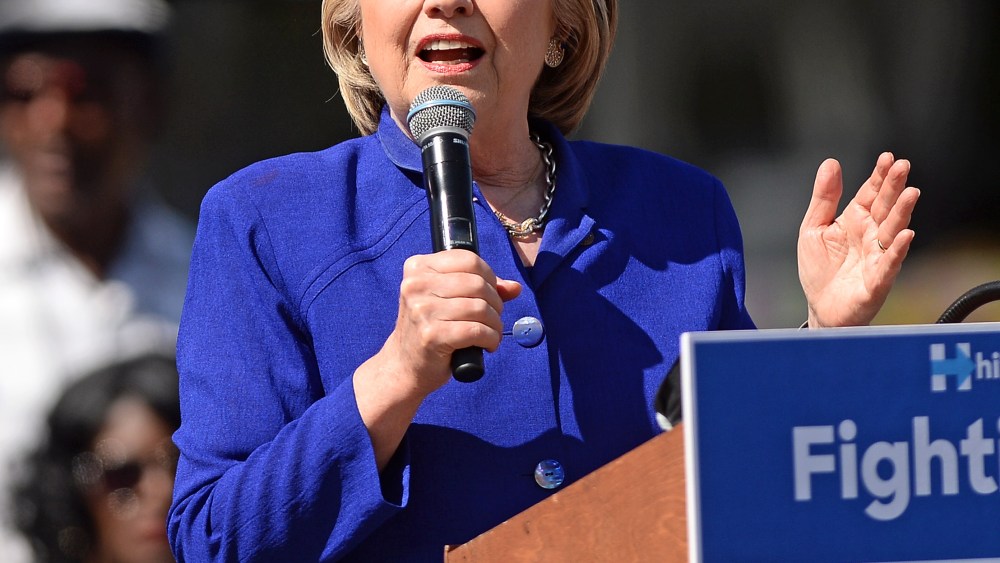
WASHINGTON — Hillary Clinton, the presumptive Democratic presidential nominee, pledged to appoint a special trade prosecutor to fight unfair trade practice Monday at a campaign rally in Cincinnati.
Clinton, who was joined at the rally by Sen. Elizabeth Warren (D., Mass.), also reiterated her opposition to the 12-nation Trans-Pacific Partnership trade deal.
“We will defend American jobs and American workers by saying ‘no’ to bad trade deals like the Transpacific Partnership and unfair trade practices like when China dumps cheap steel in our markets or uses weak rules of origin to undercut our carmakers,” she said. “I am going to appoint a trade prosecutor who will report to the president so we are going to end the abuse of our markets, our workers, our people.”
Related Articles
A key pillar of her jobs plan has centered around cracking down on unfair trade and countries that intentionally undervalue their currencies to gain an unfair trade advantage. China, in particular, is often accused of undervaluing its currency.
You May Also Like
The Obama administration currently has a team at the U.S. Trade Representative’s office, as well as other tools, to go after illegal trade practices at the World Trade Organization and has brought and won several cases against China in particular at the WTO.
But a position of a designated trade prosecutor who reports directly to the president does not exist.
“We are going to compete and win in the global economy by not letting anybody taking advantage of our workers, not China, not Wall Street, not anyone,” Clinton said.
Interviewed separately on the future of free trade policy, Rick Helfenbein, president and chief executive officer at the American Apparel & Footwear Association, said, “What she is saying is that sometimes these deals get negotiated properly, but they don’t get enforced properly,” in comparing Clinton’s stance on trade with that of presumptive Republican presidential nominee Donald Trump, who has said on the campaign trail that “stupid” and “incompetent” people have negotiated bad trade deals and that he or his team would negotiate better deals if he is elected.
Helfenbein noted that Clinton is not blaming past trade negotiators for trade deals.
“Secretary Clinton is saying we need a trade prosecutor [because] maybe a trade deal wasn’t perfect — because no trade deal is perfect — and maybe we should spend more time enforcing trade deals,” he added. “Those are two entirely different positions.”
In a key policy speech in March where she rolled out her jobs and wage plan, Clinton said “enforcing trade laws means dealing with one country above all — China.”
She said China was “by far the worst rule-breaker in the world” and noted that the country dumps cheap products in the U.S., subsidizes state-owned enterprises and discriminates against American companies.
Clinton opposes TPP, a trade deal that she supported when she was Secretary of State under President Obama.
Trade ministers signed TPP in early February and it now must be ratified by the 12 countries. TPP includes the U.S., Australia, Japan, Mexico, Canada, Vietnam, Malaysia, Peru, Singapore, Chile, Brunei and New Zealand, and aims to remove barriers to trade to encompass nearly 40 percent of the world’s gross domestic product if enacted.
Clinton has repeatedly said on the campaign trail that all trade deals must pass a three-part test for her support: create U.S. jobs, raise wages and improve national security.