
NEW YORK — Accessory Network Group finally has LeSportsac Inc. in the bag.
After nearly six months of industry murmurings, the New York-based, privately held licensing and manufacturing company said Friday that it has signed a contract to buy LeSportsac, the 31-year-old brand known for its whimsically printed, utilitarian nylon ripstop handbags.
Accessory Network is buying LeSportsac under a newly formed affiliate company, Brand Science LLC, with plans to significantly expand LeSportsac by exploding its number of freestanding stores and adding new product categories such as watches and footwear.
The purchase was made in alliance with Itochu Corp., a Japanese conglomerate with yearly revenues of $100 billion that owns the distribution rights in Asia for brands such as Lanvin, Paul Smith and J. Crew. It is the first linkup between Accessory Network and Itochu.
Although neither Accessory Network nor LeSportsac would disclose the amount paid, industry sources said it was in excess of $100 million. LeSportsac is estimated to have annual revenues of $100 million. In 2005, the brand experienced 20 percent growth.
“LeSportsac is on a roll right now,” said Abe Chehebar, the chairman and chief executive officer of Accessory Network, who also will be ceo of Brand Science. “There were other parties bidding and the negotiation process for the company was long. LeSportsac was looking for a company [to acquire it] that was going to benefit the seller the most, but also maintain and grow the business.”
Under the contract, Brand Science will acquire all the assets of LeSportsac and will manage the worldwide operations of the brand, including directly servicing its existing markets in North America, South America, Europe and the Middle East. Itochu will distribute the product line throughout Asia and the mid-Pacific territories. The management, including chief operating officer Steve Jacaruso, and design teams at LeSportsac will continue to operate, develop, design and market LeSportsac product out of its studios in the Garment District here.
“We’re not looking to send in a SWAT team,” said Chehebar. “We see them running as their own business. They have a great team in place and we would like to assist them where it makes sense to assist.”
Related Articles
You May Also Like
LeSportsac was founded in 1974 by Melvin Schifter, who died in 1997, and his wife, Sandy, who owned a majority stake in the company up to the sale. Their son, Tim, a minority stakeholder along with his sister, Lisa, joined the company in 1980 as a sales associate. In 1991, Tim was promoted to president. He added the ceo title in 1998.
In 1996, under Schifter’s direction, the brand began updating the basic nylon ripstop line with fashion details such as prints. The LeSportsac business was further invigorated again in 2002 when Schifter began collaborating with designers such as J.Mendel, Diane von Furstenberg and Jonathan Adler for the creation of signature collections. Its partnership with Gwen Stefani on L.A.M.B. for LeSportsac handbags, which hit stores in fall 2003, has been a successful step for the firm, with industry sources saying the L.A.M.B. brand has earned $35 million.
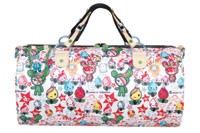
In August, LeSportsac announced the collaboration for a new line featuring the anime-inspired brand Tokidoki. The plan is for a collection of 20 handbag silhouettes using ripstop nylon and featuring a cast of cartoon characters. The line, which will bow in stores in February, is estimated to do $10 million in wholesale volume in its first year. LeSportsac also collaborates with illustrators such as Sara Schwartz and artist and Whitney Biennial exhibitor Assume Vivid Astro Focus.
“Four years ago, we started a program to reposition the company,” said Tim Schifter, who recused himself from the day-to-day operations of LeSportsac during the summer so as not to be in any possible conflict with the sale of the business. “[The program] was a whole coordinated effort to turn the brand on to a new, younger consumer in the U.S. I am thrilled with the outcome for the brand. It’s a high-visibility company and there were a lot of bidders, but we wanted a company that could build on the foundation that we have established.”
Sandy Schifter said she began considering selling LeSportsac about two years ago due to her interest in retiring.
“Accessory Network is a good fit,” she said. “They wanted to keep all the employees and run the company the way it’s being run. There is so much potential in the brand, and Tim did a good job with collaborating with Stefani and hooking the younger group. I know there is a lot more like that that can be done.”
Chehebar said the appeal of LeSportsac lies in its potential for retail opportunities. It currently has five stores and 300 points of sale for wholesale distribution in the U.S. and 50 countries worldwide.
“We think we can dramatically grow the stores,” Chehebar said. “We are already looking at locations. What we have seen is that, when there are company-owned stores for a brand, it actually makes the brand more interesting for the department stores.”
Chehebar said part of the retail rollout would be exploration into other categories for LeSportsac such as watches, casual footwear and cold-weather accessories.
“LeSportsac is known for bags, but it’s also known for whimsical fashion, reliability and quality,” said Chehebar. “It’s like Coach or Kate Spade, but more affordable, and the retail marketplace does not have a moderately priced purveyor of accessories.”
Price points for LeSportsac average between $40 and $60, although some silhouettes can retail for upward of $200. Chehebar said he intends to keep the prices steady, but added that he could see additions of designs in leather or capsule collections with other celebrities, artists or designers, including selections that cost upward of $400.
“We want to extend the brand into other materials and other categories, without losing the main equity of the brand,” he said. “Other categories are incremental to the business.”
Ken Landis, chief operating officer of Accessory Network and Brand Science, said the acquisition of LeSportsac was a strategic move for the company.
Accessory Network, which is approaching its 30th year in business, holds more than 40 licenses, including animation licenses for various Disney and Warner Bros. properties, and designer licenses for better handbags and hats for Calvin Klein and handbags for Ghurka. Industry sources estimate the company’s worth at $200 million.
“We have developed the business over the last few years,” said Landis. “It’s not just important for us to have a range of categories, but to be in every distribution channel. Ghurka, Calvin Klein accessories and now LeSportsac fits in perfectly with our portfolio of brands.”
Brand Science is a new step for Accessory Network in targeting various distribution channels. Although it was formed for the acquisition of LeSportsac, Chehebar hopes to use it as a platform for acquiring other brands with similar distribution channels.
“It will be a separate company [from Accessory Network],” said Landis. “It will have a different team in place. The only areas where we might leverage the infrastructure is in the areas of, say, accounting. LeSportsac is a brand with enough critical mass and if you have sufficient critical mass, it certainly gives us more credibility to have more brands under our belt.”