
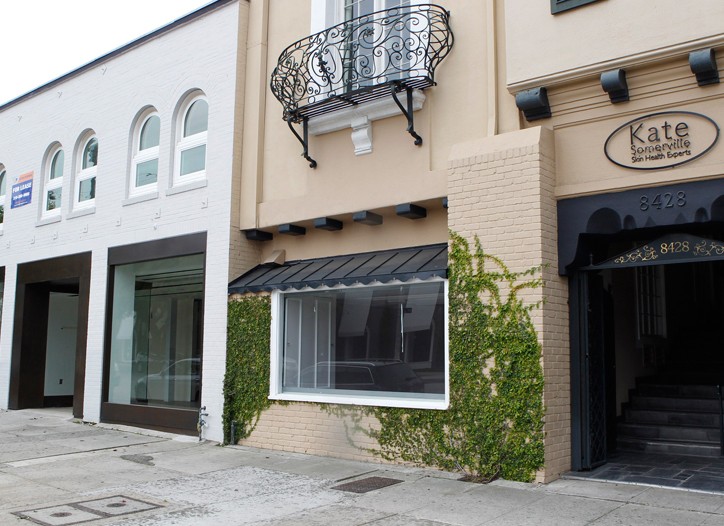
LOS ANGELES — The retail map here has been completely redrawn as multiline boutiques and stores from small labels have disappeared.
With retail nationwide exhibiting signs of health as the recession eases, the comparable weakness of Southern California specialty stores has been remarkable for its persistence and its ability to hobble even stalwarts of the shopping scene. Blue Bee, the former Santa Barbara touchstone that once had six stores lining State Street before unceremoniously closing earlier this month, and iconic Los Angeles retailer Lisa Kline, which has gone from four stores to soon consolidating into a single men’s location on Robertson Boulevard, are the latest postscripts on this prolonged period of local retail decay that has sparked questions about the future of stores vital to cultivating the SoCal style that’s been exported around the world.
Related Articles
If and when Southern California specialty retail fully revives, the list of the L.A. retail dead, stricken down by noxious competitive and economic forces, will be gargantuan. Among the many names of departed multiline stores that at one time thought it was meaningful and lucrative to introduce fashion labels to Angelenos and tout L.A. fashion to others are Tryst, Aero & Co., Magenta, Publik Park, Yellow, Presse, Diabless, Fred Segal Fun, Fred Segal Flair and Tracey Ross. The difficulties of retailing in Southern California, though, aren’t isolated to local multibrand stores.
You May Also Like
Companies big and small, devoted to a single brand or dozens, have exited the market. Recent departures include Foley & Corinna, Petro Zillia, Costume National and Salsa Jeans. And, as retail chains’ balance sheets have largely improved, at least two based in California — Anchor Blue and No Fear — have gone bankrupt. Anchor Blue closed stores for good, but No Fear expects to reorganize and continue operations.
Southern California specialty retail has been slammed by a milieu of competitive pressures from retailers as diverse as Forever 21 and Zappos.com, a reliance on casual lifestyle apparel with unsustainably high pre-recession pricing and a debilitating economic downturn with a tight grip on the region that’s yet to let up. “So many stores have closed in the past year,” said Nony Tochterman, designer of Los Angeles-based Petro Zillia. “I don’t think we are out of the red. We need to reinvent ourselves and find a different way to do business.”
After 15 years heading her namesake multibrand women’s store on Robertson, Kline knew in her gut she should move on. She said women have changed how they shop as they’ve become pickier and inundated by choices, turning the old school multiline women’s boutique into a relic. “Business is good. That’s not really the reason,” said Kline, who has plans to enter women’s in a new, undisclosed capacity. “My business decision comes from an instinct I have that it’s just time to do something different in women’s.” Speaking of conventional multiline boutiques in L.A., Mark Goldstein, owner of Madison Et Cie Inc., which has stores under the Madison, Diavolina and Madison Gallery nameplates, sounded a similar note, saying, “You have to be really excellent at what you do to make it work right now. I don’t think that that business model is a great business model today.”
Those Los Angeles multibrand retailers that have stuck it through have transformed. M. Fredric streamlined by not renewing leases on three stores, but co-owner Fred Levine is adding back stores and working on two leases now. Belle Gray has only its Sherman Oaks store after shutting a Calabasas unit. Kitson hired Greif & Co. to explore strategic alternatives, although the investment bank’s president and chief executive officer Lloyd Greif underscored Kitson is profitable and not weighed down by a heavy debt burden. Confederacy is switching its allegiance to men’s, like Lisa Kline’s store.
“That model really works,” said Kline of men’s retail. “It has not changed like the women’s business, probably because it isn’t as saturated. There are not many men’s retailers in L.A.”
The recession that has affected everyone has been especially brutal in California and has seemed endless to retailers dependent on consumer spending. Southern California got a head start into doom and gloom with the housing crash beginning as early as 2006 and the subsequent three-month strike by the Writer’s Guild of America from 2007 to 2008. The state has been slow to the recovery party, with the most recent reported unemployment figures showing a rate of 12.2 percent in February, taking the string of months with 12 percent or above unemployment in the state to 18. The national unemployment rate in February was 8.9 percent.
“L.A. was hit earlier than a lot of places with the writers’ strike,” said Lesley Grosvenor, manager of the Planet Blue store in Malibu. “It caused a [dip] in business and it followed with the economic meltdown, so we have been down for longer than most cities.”
A persistently jittery entertainment industry hasn’t helped matters. High-end stores need the sector’s success to pad the wallets of well-to-do customers in the “biz,” as entertainment is frequently called in L.A. Box-office numbers actually were good in 2009 and 2010, the largest and second largest annual takes on record. The numbers, however, belie a hazier picture, with Hollywood playing catch-up as the Internet and TiVo wreak havoc on traditional business models.
“We haven’t seen a big comeback in employment yet,” said Nancy Sidhu, chief economist in The Kyser Center for Economic Research at the Los Angeles County Economic Development Corporation, speaking about the entertainment sector. “Entertainment companies are definitely more active, but they are also watching their pennies. They haven’t got a lot of people on staff and some of the independent [contractors] that I have talked to are working more than one gig, whereas in the old days, they were working one.”
Jeannine Braden, co-owner of the Brentwood Country Mart shop Post 26 and former owner of Fred Segal Flair, said the main reason for Fred Segal Flair’s closure was the entertainment industry’s struggles. “Those [entertainment industry] people are more risk-taking in their style, so when those people stop shopping, it also changes our buys,” she said. “California needs to get their productions back here for us to recover.” Whitney Briggs, a manager at M. Fredric, offered, “When the entertainment industry is going well, the stores feel it. And it’s not just the actors, it’s the camera guys, the craft service, it’s everyone.”
California’s laid-back style might have contributed to the troubles of local multiline stores, as well. The retailers that purvey it believe denim and T-shirts will always be casual wardrobe staples in L.A., but the exorbitant prices that characterized them during the boom years weren’t possible when formerly lavish shoppers came back down to earth. Denim, one of the first apparel categories to get butchered by the consumer pullback, hasn’t rebounded entirely — and may never again be the sales engine it was at L.A. stores, which have been thinning out and reducing prices in their jeans assortments.
“Denim sales have been soft for a while,” said Braden. “I’d rather sell chic and ageless clothing, put my money into beautiful pieces, not denim.” Levine added, “For the past year or two, denim has been soft compared to where it has been. Denim is always important. It is just a question of how much new denim does the customer need to have.”
At M. Fredric, the sweet spot for denim prices has dipped from $200 before the recession to between $140 and $160. T-shirts that had commanded $50 to $60 are today being bought for $20 to $50. Levine said he has been able to keep his average transaction amounts about even by increasing items per purchase. “We do a lot more than we did two years ago in driving business because we know we have to do more volume if we are going to have a more moderate price range,” he said.
Competing on price has seldom been a winning formula for L.A. boutiques — and being forced to do so because of a recessionary trend for thrift opened them up to new rivals such as online and fast-fashion retailers. Like never before, stores were seeing customers flee for cheaper merchandise. Even if they lowered their prices, Southern California boutiques had trouble generating volume because they are predominantly driving destinations without much foot traffic even during the economic heyday, let alone during the Great Recession.
“We are more of a casual city, and I think that before people were spending more money on casual items, more money on sweats and T-shirts,” said Camille Joseph-Jordan, manager of the boutique Milk. “People realized that they couldn’t spend $60 on a T-shirt or $100 on sweats, and stores like Forever 21 and H&M did really well because they can do that really cheap.”
Just because locally based multiline stores have closed, it doesn’t mean no one is entering the retail scene. The companies that are coming are simply different. Often, they aren’t based here, aren’t in fashion or gain margin by vending their own brand. Some examples: Stript Wax Bar is taking over the Petro Zillia space, furniture concept Blu Dot is headed to a former Fornarina store, and Norwegian jumpsuit brand OnePiece will occupy a shop on Robertson previously home to accessories brand Surly Girl.
It is these kinds of shops that have kept Robertson Boulevard in high demand, and are store by store re-tenanting Melrose Avenue, which still has blocks where vacancies almost equal filled locations. Rents on Melrose Avenue west of Fairfax Avenue have actually gone up to $6 from $5 a square foot monthly during the worst of the recession, although they are nowhere near the $10 a square foot monthly they were during flush times, according to Chuck Dembo, a retail real estate broker with Dembo Realty. Discussing rents on the street, Dembo said, “I think things are going to remain steady. People are still cautious.”
Southern California multiline stores that have stayed afloat and very rare newbies in the genre (Thvm Atelier in downtown L.A., for example) could benefit from the fallout of their retail peers. They’ve strengthened their business models to operate more efficiently and distinguish themselves from the field to pinpoint their customer base. And they stand to attract customers loyal to closed stores when those customers shop elsewhere. Goldstein is starting to detect mild growth. “I feel like L.A. is underperforming heavily,” he said. “There will be growth. It is creeping back.” Jeannie Lee, owner of the boutique Satine, has already seen a sales bounce of 30 percent this year. “It is a different market than it was before the recession,” she said. “It is a market that is ready to spend on something discerning.”
Kline doesn’t think multiline women’s boutiques will totally vanish from L.A.’s retail repertoire. “There’s that boutique customer,” she said. “There is someone that wants and needs attention, and wants the boutique to pick for them.”