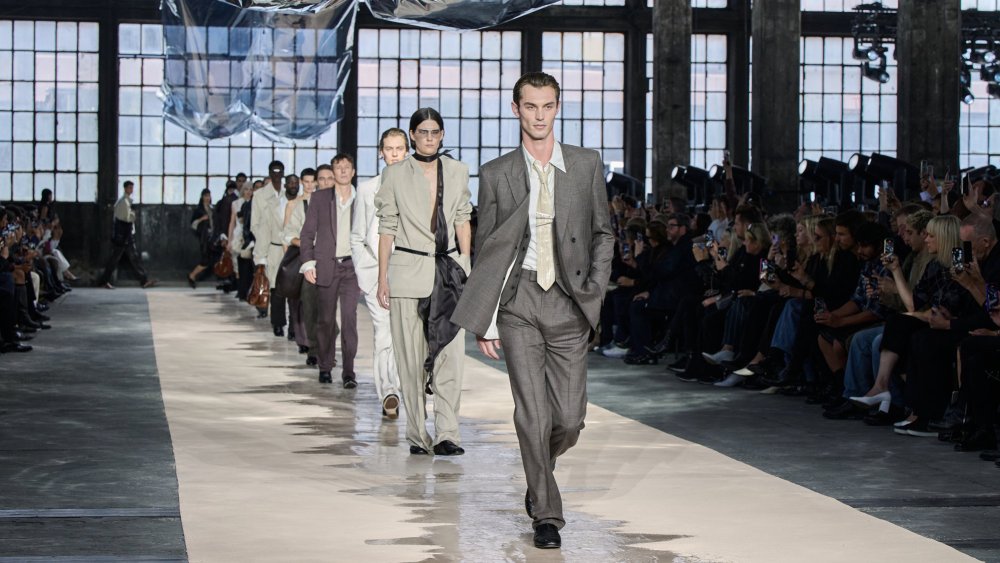
The strategy that helped Hugo Boss increase sales so spectacularly when it was first launched will be updated soon.
On Dec. 3, the German menswear specialist plans to give an update on the strategy, named “Claim 5” and first instituted by chief executive officer Daniel Grieder when he took on the top job there in 2021.
Hugo Boss’ chief financial officer Yves Müller wouldn’t be drawn on what that update might entail. “We are going to keep you in suspense a little longer,” Müller said during an online press conference in Germany Tuesday morning.
Related Articles
Analysts suspect the update or any new strategy will be more about sustainable, profitable growth rather than the previously spectacular sales.
You May Also Like
For a while it looked like Claim 5’s extravagant marketing spend, star-studded celebrity campaigns and improved product lines were going to see Hugo Boss reach its stated ambition of generating 5 billion euros in sales by 2025. During 2022 and 2023, the company’s growth rocketed, averaging 20 percent a quarter.
But over the past two years the German marquee brand has been forced back down to earth. During 2024, sales grew 3 percent over the whole year.
This year, the German menswear specialist’s sales growth has hovered around zero, falling and rising only one or two percentage points every quarter. During the third quarter this year, Hugo Boss sales fell 1 percent, in currency neutral terms, and totaled 989 million euros. That put them slightly below market consensus.
“The third quarter was satisfactory given the circumstances,” Müller conceded. “The still-subdued consumer sentiment in many parts of the world is hindering our sales growth. But we have our costs well under control and are improving our profitability.”
The result over the first nine months of the year: a 1 percent dip in sales, in currency neutral terms, and sales worth 2.99 billion euros.
“A currency-adjusted decline of 1 percent [in the third quarter] is, of course, not what we had envisioned,” the executive continued, adding that there were a number of factors that explained this.
One issue was the fact that “our wholesale partners did not call up sales amounting to tens of millions of euros in the third quarter as originally planned,” he said. “They postponed them to the fourth quarter.”
Those sales will only be reflected in later accounting, Müller explained. He also noted that October had already started well for the brand so that, along with that “catch-up effect,” the last quarter of the year should be positive. Hugo Boss was “cautiously optimistic,” he added.
Additionally the appreciation of the euro against the U.S. dollar, which had lost 6 percent in value over the third quarter, was also hurting the company, Müller said.
On the back of the third-quarter results, Hugo Boss confirmed guidance for the year but also warned that results would likely come in at the lower end of the range it had predicted. That means sales for all of 2025 will come in closer to 4.2 billion euros than the 4.4 billion euros at the upper end of the forecast. Last year, the company generated revenues of 4.3 billion euros over the full year.
The good news for Hugo Boss in the third quarter was the improvement in earnings before interest and taxes, or EBIT. They only fell 1 percent, in currency neutral terms, and came in at 95 million euros. The improvement is the result of “strict cost management” for most of this year so far, executives said.
Market analysts from the likes of JP Morgan, Citibank, Jefferies and RBC all noted that third-quarter EBIT was better than expected and welcomed Hugo Boss’ focus on profitability.
For the full year, the company said operating profit would land between 380 million euros and 440 million euros, albeit at the lower end of that range.
In the third quarter, sales of the company’s flagship Boss menswear did not change, in currency neutral terms, compared to the same period last year. The more formal line, which accounts for about four-fifths of all sales, brought in 764 million euros between July and September. During the three months, the company launched a collaboration with star athlete David Beckham and held a fashion show in Milan.

Boss womenswear sales fell 9 percent, in currency neutral terms, to hit 67 million euros. Sales of Hugo, the company’s more casual and sporty line, fell 5 percent, to 158 million euros.
Hugo Boss said the decreases in those product categories were partially the result of “streamlining product assortments and refining distribution activities.”
“We want to more clearly define our profile for Boss womenswear and Hugo,” Müller explained further. This meant that in some stores, where it wasn’t doing as well, Boss womenswear was replaced by Boss Green, the men’s loungewear offering, while at other sites, womenswear was expanded. However the net result was a small reduction, the executive stated.
Hugo Boss saw a decrease in sales in its largest market, Europe, the Middle East and Africa, over the third quarter. There sales dipped 2 percent, in currency neutral terms, to 641 million euros.
“The consumer climate in important markets for us — such as the U.K. and China — is still causing us difficulties,” Müller admitted. “We were not able to fully compensate for significant losses in these countries through growth in markets such as the U.S., Germany and France.”
In Asia-Pacific, Hugo Boss sales decreased by 4 percent, with the decline mostly driven by lower demand in China.
Experts at the research company, Third Bridge suggest that Chinese consumers do not see Hugo Boss the way it wants to be seen, regardless of its efforts to reposition itself. “Despite the brand’s push toward a tech-infused lifestyle and sportswear image, Chinese consumers still view it primarily as a formal menswear label,” researcher Yanmei Tang wrote in a note.
Additionally, Hugo Boss products are sold for roughly over double the price in China than elsewhere in the world, the researcher pointed out.
In the Americas, Hugo Boss sales rose by 3 percent, currency neutral, and this was due to small, sequential improvements in the U.S. market, the company noted.
Hugo Boss had already taken measures to deal with uncertainties around tariffs and customs going into North America, Müller told WWD. This included sourcing from Europe and inside the U.S. and getting products into the country before tariffs hit.
Hugo Boss will also eventually be increasing prices — everywhere, not just in America — in the fourth quarter, Müller added. Increases will be in the low- to midsingle digits.
“This means we have the effects resulting from the customs or tariff discussions relatively well under control, to the extent that we do not expect any significant effects for 2025,” he concluded.