
MIAMI — Some 20 to 30 years ago, Stephen’s Restaurant in Hialeah, Fla., was packed with New York garment executives who had relocated their businesses to the industrial city northwest of downtown Miami.
Today, employees of nearby trucking and tile companies fill its seats, evidence of Miami’s transition from a thriving fashion center to an economy fueled by luxury condominium sales and pricey cocktails at boutique hotels.
June Wolfe, president of the South Florida Manufacturers Association in Pompano Beach, Fla., said high insurance costs, taxes and wages sent fashion firms fleeing for more cost-effective territories like Haiti, Central America and China. She said South Florida’s increasingly exorbitant cost of living makes it difficult for workers to find housing.
“Someone earning $8 an hour can’t afford to live here. The average cost of a home in Boca Raton is $482,000,” said Wolfe, estimating there remained about 525 apparel and textile firms among the 15,000 manufacturers in Florida. “A third of the 525 is based in South Florida because owners prefer its weather and retirees often strike up new ventures here.”
But many companies are beating the odds and maintaining South Florida as a home to a small but vibrant apparel manufacturing community.
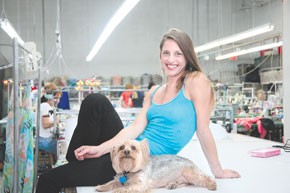
Miami’s easy but vibrant lifestyle attracted Mario and Stacy Frati, owners of Sweet Pea by Stacy Frati, a contemporary women’s line of mainly nylon mesh tops and dresses in Hialeah. The company produces 12 collections and 1.4 million pieces annually, and has generated monthly sales increases since being launched in 1999, and the couple has done everything possible to keep as many steps of the process in their hometown.
In 2006, they purchased a 100,000-square-foot print-and-dye factory in North Carolina, where they were the biggest customer, after it threatened to close due to outdated machinery and loss of business. They’ve also had to outsource sewing to Central American countries such as El Salvador when the manpower was no longer available locally.
“Fifteen years ago, we would have had five factories here asking us for more work. Now, I’d rather wait two weeks for overseas shipments than hire someone locally who I don’t know will still be in business next week,” said Stacy, though admitting she misses the days of running over to a sewing contractor if a problem arose or turning around reorders in three days for Bloomingdale’s and Nordstrom.
Related Articles
You May Also Like
This year, the company plans to move from a 40,000- to a 90,000-square-foot factory here to house design, cutting and inspection operations by 48 employees, many of whom are mothers and daughters, or husbands and wives.
“Since our fabric is so fragile that it takes one year for someone to become an expert cutter, many of our people have been with us from the beginning,” she said.
Tricia Fix, founder of the eponymous women’s wear collection, estimated she was one of five contemporary designer manufacturers left in Miami. Relatively new to the industry, having introduced the line in 2002, Fix reported she learned Miami’s specialties were activewear and resortwear. But she was determined to settle here.
“Miami is a great safety zone, since I’m from Tampa and didn’t want to pay New York prices or move across the country to Los Angeles,” said Fix, who is surprised more designers don’t consider the city as a option. “There are great contractors here. We have the ability to be taken seriously as a fashion center.”
Based in a live-work loft on the Miami River, along with a full-time sample maker and a part-time pattern maker, she outsources to local cutting and sewing contractors to produce 1,500 to 3,000 items monthly for accounts including Nordstrom, Macy’s and Dillard’s. Fix, who visits her cutter daily, said proximity was paramount to achieving the quality control necessary for her colorful, vintage-inspired prints in silk and chiffons valued by the celebrity set.
“I tried outsourcing to New York, but clothes came back smelly and stained, and I’d hate to send orders to South America in fear the fit would be totally off,” she said.
Though Miami is able to keep up with her demand, Fix worries she’ll outgrow its workforce, especially as new generations leave the family trade.
“I hope to have longevity here and would even consider buying my own machines and factory, but it really depends on how big I want to get,” she said.
Offy Fashions, Fix’s sewing contractor in Hialeah, holds onto skilled laborers by paying higher wages, according to owner Susy Obrador. She pays $6.50 to $10 an hour, compared with the local industry’s wage of $6.40.
“I thought about moving to the Carolinas, but I prefer staying here because there’s a larger labor pool,” said Obrador.
The company, which makes 20,000 to 25,000 garments annually, turned down two major projects in the last year due to short staffing. She said there had been a drop in local fashion companies in the last eight years, and a huge shift since the company was started in 1992.
“I’ve learned what I can handle and try to make do,” said Obrador.
Camille Russler, owner and chief executive officer of Ever After Purple by Renato Armijo, a Miami eveningwear collection featuring European fabrics, said though many skilled seamstresses had retired, enough remained to create her high-quality gowns that retail from $600 to $2,600.
“We work with a team of six seamstresses in nearby Kendall because it’s the only way to ensure expert production,” she said.
The firm, which has made 1,000 dresses annually in four to 10 weeks since its debut in 2005, plans to expand into wholesale this year, beginning with Kleinfeld in New York. Russler chose to set up shop here in the belief that Miami’s wholesale fashion sector has high potential.
“We have more retailers, but there’s new blood every year,” Russler said. “I see a solid group of designers trying to grow a fashion community.”
Melanie Silverman, vice president of Rose Taft Couture, a special occasion line in Miami Lakes, Fla., said the company’s niche for once-in-a-lifetime dresses saved it from having to skimp on costs by outsourcing overseas. Since 1968, when founder Rose Taft relocated her five-year-old business from New York to Miami for the tropical setting, all production has taken place here, from design to handwork such as sewing in zippers and beading.
“The economy doesn’t affect us because our customers have prepared years to spend,” she said of the $2,000 to $6,000 gowns. “We can afford to own the best machines, rent a 20,000-square-foot factory, where we’ve been situated the last 15 years, and pay our employees five times the amount they’d make overseas, which is why we have many third-generation staff members.”
Manufacturing locally enables the firm to fill orders for 5,000 gowns in 150 styles annually, in three days to six weeks. Silverman said its 50 seamstresses are Caribbean and South American immigrants.
“We never have a shortage of workers and have to turn away people on a daily basis,” she said, adding that she felt Miami’s fashion moment would come around again.