
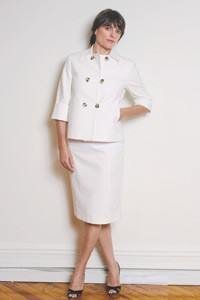
NEW YORK — First they had a Theory, now they have a Premise.
Seeing potential in the recovering bridge market, Link Theory Holdings Ltd. will launch a new line, called Premise, for spring retailing.
“I see a huge opportunity in the bridge marketplace,” said Andrew Rosen, Theory’s president and
co-founder. “For a long time it was stale, but a lot has happened in the last 12 months. When I walk into Saks and Bloomingdale’s, I feel a lot of energy in the bridge area. Bridge is poised for a lot of growth. The customer is there, she just hadn’t had the clothes.”
The bridge market has struggled in recent years as the work force became more casual and it faced increased competition from the booming contemporary floor. Mainstay resources like Ellen Tracy and Dana Buchman tried unsuccessfully to incorporate a more contemporary look into their traditional lines, but they have returned to their core.
But Rosen, who cofounded Theory a decade ago, said now is the time for the bridge department to go through the revolution that contemporary experienced in the Nineties.
“The customer needs new, exciting clothes to stimulate her. We offer a different point of view that is very relevant for that consumer — more sophisticated and modern. I think there is a shift from older, traditional bridge brands to brands that have a more interesting point of view,” he said.
“Our inspiration was from the Theory core,” said Elizabeth Calderone, president of Premise and former director of Theory retail. “We were starting with the same aesthetic; however, this line is geared toward ‘Theory grown up.'”
Premise is an entirely separate brand and company from its contemporary reference point, and it will not be marketed on a shared heritage with Theory.
The line has its own design team, led by creative director Caroline Belhumeur, who came from White + Warren Cashmere, where she was design director, and before that Wilke Rodriguez, where she worked as design director for men’s.
The new bridge collection channels the Theory aesthetic but offers more generous fits and luxurious fabrics. Like the Theory contemporary line, the color palette is neutral and embellishments are minimal. Instead, the style comes from cut and fabric.
Related Articles
You May Also Like
The collection includes pencil skirts, tailored suits, A-line trenches and dresses, lots of shirting, taffeta black pants and little cardigans. Theory’s core has always been suiting, and while Premise will certainly offer that staple, suits may take a backseat to occasion pieces.
Wholesale prices average around $115, though items will retail from around $125 to $495. Orders are not yet finalized, but Neiman Marcus, Bloomingdale’s, Saks Fifth Avenue, Nordstrom and high-end specialty stores will carry the line for its spring launch.
Calderone projects first-season wholesale volume between $4 million and $6 million, but she expects business to grow much larger. Neither she nor Rosen would quantify how large they expect it will become. Competing bridge lines, such as Ellen Tracy and Dana Buchman, had sales of $200 million to $300 million a year at their peak in the Nineties.
“I believe that the contemporary customer, as we all do, grows up,” said Stephanie Solomon, vice president and fashion director of women’s ready-to-wear and accessories at Bloomingdale’s. “The Theory customer is bound to grow up, and this is an easy transition. As we get older, our bodies change, and I don’t know if that contemporary customer is going into Ellen Tracy right away. Eventually she will, but she will go to Premise first.”
Solomon agrees that the bridge department, which Bloomingdale’s now calls New View, is experiencing a growth spurt, and that lines such as Premise provide the necessary fuel for that floor to flourish.
“This line presents an opportunity for the New View customer that hasn’t been there before,” she said. “The Theory business is a niche business with a great following from our contemporary customer. This is filling that niche for our New View market. It’s cool working-girl, citified clothes — something that has always been necessary for our New View customer.”
Playing on the Theory concept, Rosen first sought Proof as the line’s name but could not acquire rights to it, so he went for Premise. The collection has been in the works since February, but the idea for it started two years ago in Japan, where Theory went public in 2005 on the Tokyo Stock Exchange.
“In Japan, they have been running this business for a while, under the Theory Lux label, for a customer who couldn’t fit into Theory but who wanted that Theory aesthetic,” Rosen said. “But I was a bit uncomfortable [that] they were doing it under the name Theory Lux. This is a separate thing.”
The Japanese bridge line has been doing almost $50 million in combined wholesale and retail volume. In the first phases, the collection will transition in Japan as Premise for Theory Lux but will ultimately be simply Premise worldwide.
As reported, Rosen is being sued by his former Theory business partner Elie Tahari for $180 million in damages. Tahari alleges that Rosen defrauded him into selling Theory in 2003 at a price that did not reflect the firm’s value. Rosen would not comment on the suit or whether he planned to countersue.