
Highlighting its focus on innovation and sustainability, manmade cellulose fiber producer Sateri recently unveiled a new generation of eco-friendly fibers at China’s biggest yarn exhibition.
From March 11-13, the 2025 International Yarn Exhibition (Yarn Expo Spring) took place at the National Exhibition and Convention Center in Shanghai. At the show, Sateri, a leader in the textile industry, showcased its latest sustainable fiber innovations, including Sateri Lyocell fiber, the EcoCosy® fiber series and FINEX® recycled fiber.
Related Articles
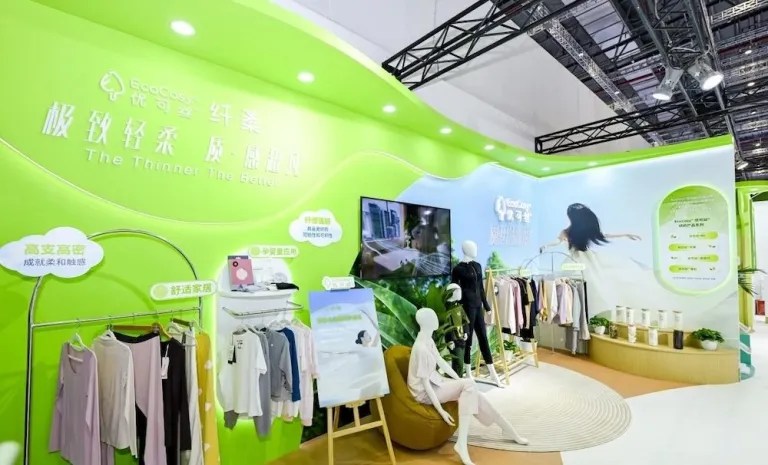
As part of its commitment to driving sustainability, Sateri also partnered with 15 downstream yarn companies to establish the Sateri Fiber Alliance Pavilion. This collaborative space highlighted a multi-dimensional product matrix, technological advancements and scenario-based applications, bringing to life the company’s vision of “empowering a green future with technology.”
“Sateri’s sustainable product portfolio attracted significant interest at the exhibition,” said WenBin Huang, senior sustainability manager at Sateri. “Guided by market demands, we continue to push the boundaries of innovation in sustainable fibers, focusing on green development while strengthening our brand’s influence through responsible and forward-thinking products.”
The first innovation presented on the show floor was EcoCosy®. Since its launch in 2019, Sateri’s EcoCosy® fiber brand has continuously evolved to set new standards in sustainability with a sustainable managed plantation that made sure all our products are OEKO-TEX® certified, ensure everything is free from harmful substances and produced responsibly This helps offer consumers confidence in their purchases.
In 2021, the product line transformed into EcoCosy® 2.0, a wood-sourced fiber recognized for its “eco-friendliness, superior quality and versatile applications,” according to Huang.
Now, in 2025, Sateri has introduced the next phase of EcoCosy® with a renewed brand identity and an expanded product matrix for both textile and non-woven applications. Among the key innovations is EcoCosy® Thin Soft, an ultra-fine fiber engineered for modern yarn spinning machines and evolving consumer demands. This fiber is both finer and stronger, enhancing fabric texture while maintaining durability.
“EcoCosy®delivers a cloud-like softness, breathability and lightweight feel—features highly sought after in home and children’s apparel,” Huang said. “Additionally, its adaptability to high-speed spinning processes improves production efficiency, offering a dual breakthrough in texture and performance.”
The next innovation shown was Sateri Lyocell. With its environmentally friendly attributes and collaborative full-chain development model, Sateri Lyocell is a “key player” in the global lyocell market, according to Huang. In fact, as its investment plans unfold, Sateri Lyocell is set to reach an annual production capacity of 400,000 tons in 2025, making it one of the world’s most influential lyocell fiber producers, Huang said.
“With exceptional uniformity, strength and spinnability, Sateri Lyocell supports multiple spinning processes, such as compact spinning, vortex spinning and open-end spinning,” Huang said. “When blended with cotton, lyocell enhances lightness and skin-friendliness, while blending with viscose improves flexibility and shape retention. These innovations reinforce Sateri’s role in advancing fiber technology while promoting sustainability across the textile supply chain.”
Sateri also introduced fibrillation inhibition solutions at both the fiber and fabric stages. At the fiber level, its CL series cross-linked Lyocell Fiber controls fibrillation at the source. The CL Series offers deep dyeing performance, chemical resistance and maintains cross-linking efficacy through post-dyeing finishing—all without formaldehyde.
At the fabric stage, Sateri offers a post-crosslinking solution in collaboration with Demei Chemical’s Lyocell Fiber Lock Technology. This in-bath cross-linking process, applied during dyeing, significantly reduces fibrillation in lyocell knits while preserving hand feel, color consistency and fabric strength.
The last innovation shown was Sateri’s FINEX®, a recycled fiber technology that is “revolutionizing the circular economy by transforming post-consumer textile waste—such as old jeans, T-shirts and other garments—into high-quality fiber,” according to Huang.
Through proprietary cellulose reconstitution technology, FINEX® initiates a sustainable industrial cycle of resource, product, consumption and recycled resource. Now certified under the Recycled Claim Standard (RCS), FINEX® fibers can incorporate up to 50 percent recycled content, making a significant impact in reducing waste.
“As an active member of the China Association of Circular Economy (CACE), Sateri collaborates closely with value chain partners to drive industry-wide adoption of circular production practices,” Huang said.
To learn more about Sateri, click here.