Rally wants to bring rare collectibles into the hands of the masses, turning a market that was historically restricted to a small pool of wealthy clientele into an accessible space where fans dictate the prices and can buy shares of these rare finds.
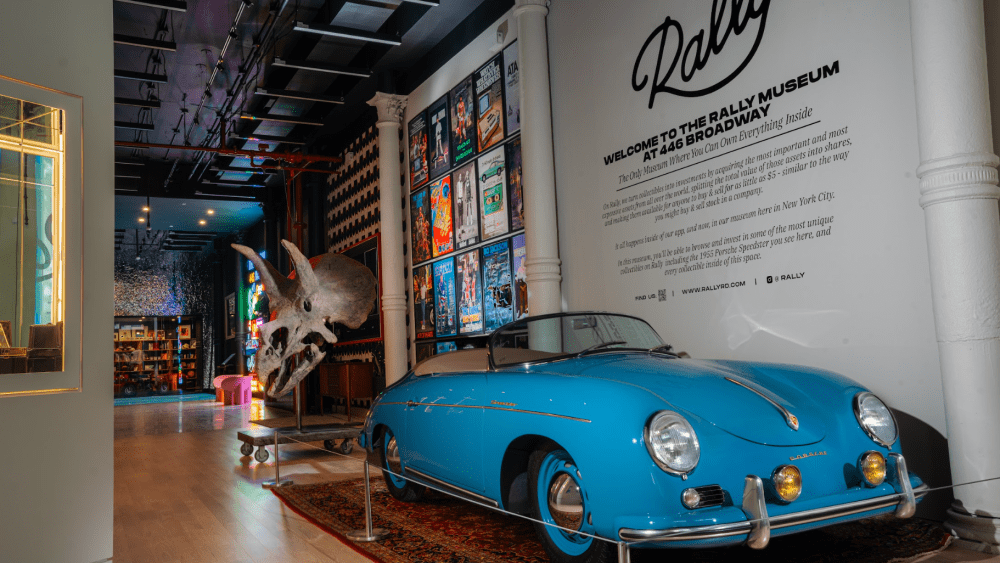
The investment platform launched in 2017 aiming to democratize ownership of rare collectibles across a variety of categories, such as classic cars, watches, sports memorabilia, fashion accessories, literature and others, by allowing customers to purchase shares of the items. Since launch, Rally has grown its offerings list to more than 450 rare finds, some of which are showcased at the company’s new SoHo museum-like storefront located at 446 Broadway in Manhattan.
Related Articles
“Our thought process was that everything on Rally triggers nostalgia or has a story behind it,” says Rob Petrozzo, Rally’s cofounder. “We wanted to do our best job to tell that story in the most tangible, possible way.”
You May Also Like
Petrozzo explains the SoHo museum is set up in a timeline format, starting with the entrance that showcases a 60-million-year-old dinosaur skull. In the middle, visitors will find a turquoise 1955 Porsche 356 Speedster sitting in front of glass cases that house pieces like a Hermès Faubourg Birkin bag, a first-edition copy of “Harry Potter and the Philosopher’s Stone” and a complete set of the 1990s Chicago Bulls championship rings. The space is rounded out with a make-your-own NFT station at the back.
“We’ve been really successful in a lot of different categories and bringing a lot of these collectibles to the masses in a way that I think a lot of the auction houses have had trouble doing,” Petrozzo continues. “It’s always one person buying one asset and, for us, we syndicate it to thousands of people individually who own it now.”

While Rally’s rare items are valued at hundreds of thousands — if not millions — of dollars, shares are typically priced at under $50 to make ownership more accessible. Petrozzo explains that the process begins with an item being introduced to the Rally app through the platform’s version of an initial public offering where Rally puts a price on the collectible. During the IPO process, Rally allows users to purchase up to 10 percent in shares of the asset so that one individual doesn’t have a controlling interest in the item.
Once the IPO is filled, the item enters Rally’s secondary market where users can buy and sell shares of each item like the stock market, which can change the value of that collectible.
If an individual acquires majority ownership of an item, they can propose a buyout to buy all the shares and take physical ownership of the collectible. Petrozzo says this has happened many times since Rally launched, naming items like a first edition Apple iPod, which sold for $29,000, and a first edition 1940s Batman comic book, which sold for $2 million.
“Our position has always been that thousands of individuals in the future will be way better at pricing the things they care most about than one or two people at an auction who are bidding on something,” Petrozzo says. “The super wealthy have always been the ones that price these assets and they price it based on their mood in some cases. If there are two to three people in a room who really want something, it can really drive the price of something up millions of dollars over what the estimate was.”
As interest in Rally continues to grow, Petrozzo has many growth plans for the platform. The cofounder believes the platform will double its offerings by the end of 2024 and has plans to continue expanding into different categories. Rally most recently moved into real estate, with its first listing being baseball icon Mickey Mantle’s childhood home, and is furthering its presence in the wine category.
For Rally’s fashion offerings, Petrozzo states the platform will continue to showcase one-of-few pieces from major fashion houses and memorable looks that have stuck in the cultural lexicon, like fashion worn by celebrities or public figures.
Rally’s SoHo museum will remain a focal point for the company, as it’s a way for the platform to engage with fans in an experiential format.
“We’ll be using this space to educate and also create entertainment around [the collectibles],” Petrozzo says. “If you like what you see, you can actually leave with equity in what you just experienced. That’s what the future looks like for us.”