
Can Pandora A/S hang on to its charmed status as one of the jewelry sector’s hottest companies, or could the days of rapid growth and healthy payouts to investors be numbered?
That’s the question investors seemed to be asking Tuesday as shares in the Danish jeweler tumbled 6.76 percent despite the company reporting soaring profits in the fourth quarter, capping off another bumper year.
Days after another jewelry giant, Tiffany & Co., ousted its chief executive officer Frederic Cumenal over “disappointing recent financial results,” Pandora reported that net profits had jumped 52 percent year-on-year in the three months to Dec. 31, while sales of 6.6 billion kroner, or $957 million, represented an increase of 16 percent.
Related Articles
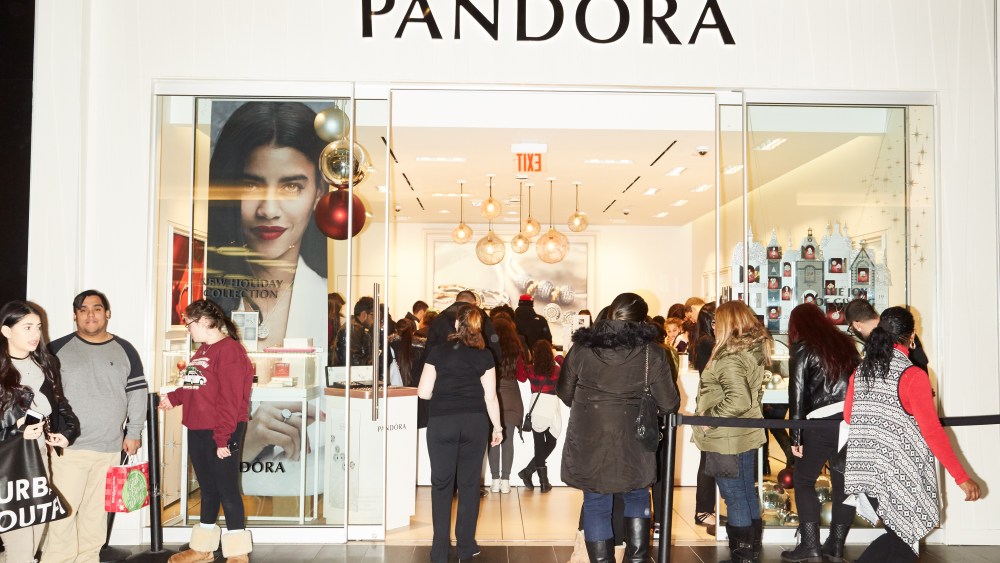
The Copenhagen-based firm that specializes in stackable, collectible charms has shifted its strategy from emphasizing wholesale distribution to own-retail in 2016, cutting 1,140 points of sale and opening 336 concept stores. Pandora has also reconfigured its product and marketing strategy to emphasize stylish jewelry concepts for which customization with charms is a bonus rather than the main selling point.
You May Also Like
Related Story: Danish Jeweler Pandora Marks New Direction
“Consumers feel it’s an open and welcoming place,” ceo Anders Colding Friis told WWD about the shift to Pandora retail stores. “I think we need to consider ourselves being inclusive where some other jewelry stores would be exclusive.”
Tuesday’s results seemed to validate that strategy: In 2016, Pandora crossed the threshold of 20 billion kroner in revenues, posting sales of 20.28 billion kroner, or $3.01 billion, an increase of 21 percent year-on-year. Net profits grew 66 percent to 6.03 billion Danish kroner, or $896 million, the company said. All dollar rates are calculated at average exchange rates for the period in question.
Friis said, “2016 was another great year for Pandora, where we significantly improved our global branded presence.”
Pandora’s board of directors proposed to pay out dividends of four billion Danish kroner, or $574 million at current exchange rates, as well as initiating a share buyback of 1.8 billion kroner, or $258 million, meaning around 28.5 percent of 2016 revenues would be returned to shareholders. “The charm is that we can grow and generate cash for investors,” Friis told WWD.
But growth is expected to slow to single digits in the first quarter of 2017 as the company will face a tough comparative following 2016’s bumper year. “Our growth in ballpark figures will be the same,” Friis said. “But as the business becomes bigger the percentage growth becomes somewhat smaller.”
The company predicted growth of between 13 and 18 percent for 2017, while higher commodity prices and a headwind effect from currencies could see earnings before interest, taxes, depreciation and amortizarion margins shrink to 38 percent from 39.1 percent in 2016.
Cuts to wholesale distribution caused fourth-quarter revenues to shrink 3 percent in the Americas region — and that process may not be complete. “We will continue optimizing our network,” Friis said. “The biggest chunk was done in 2016. Will there be some small changes? Yes.”
Despite the company’s more cautious projections for the year, Pandora is likely to keep its edge on competitors, according to analyst Frans Høyer of Jyske Bank. “Pandora is vertically integrated, which makes them different from players like Signet, who are retailers and not nearly as much in production….Increasingly they have become a retailer as well, so they get to capture the full profit at both ends.”
A capital-light business model has assisted Pandora’s growth, according to Høyer. Production — most of which is in the brand’s factory in Thailand — relies more on hand-finishing rather than big machines, and the company leases rather than owns its retail stores.
Høyer said the company may need to invest more in I.T. and smart distribution to prevent markdowns, and should also invest in staying competitive in terms of lead time. Due to the scale Pandora has achieved, however, challengers would find that “the barriers to copying their model are enormous.”
Pandora plans to push ahead with expanding its network in 2017, opening around 275 concept stores. Half of new stores will be located in the EMEA region, while the rest will be split between Asia Pacific and the Americas. Forty stores will open in China alone, according to Friis.
The company will open its first concept store in India the first quarter of 2017, and plans to open 50 stores in that market over the next three years through a partnership with the Pan India Charms & Jewellery Company, which the company unveiled in January.
For Vincent Grégoire, head of lifestyle at the trend forecasting agency NellyRodi, Pandora remains in touch with the “spirit of the moment” with its unpretentious appeal. “The girly, do-it-yourself aspect of the charm bracelet concept remains very impactful, it brings women together,” he said, while the affordable pricing and frequent updates to the product offer draw on the codes of fast fashion.
“This brand takes the drama out of buying jewelry — as well as the guilt. The positioning is very accessible, women can permit themselves to buy it on an impulse, the way they would a piece of home decor,” Grégoire said. “It’s about treating yourself.”