
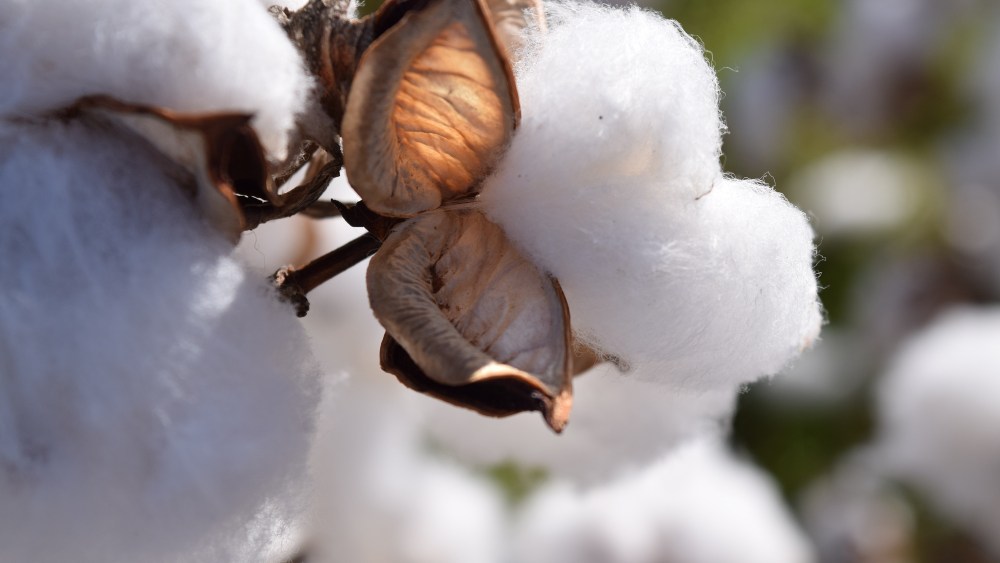
Cotton has come a long way in the fashion industry – and organizations such as the U.S. Cotton Trust Protocol are pushing the fiber forward into cleaner, greener pastures to help brands and retailers meet established and emerging sustainability targets.
Created as a response to meet a growing demand for transparency, the U.S. Cotton Trust Protocol launched in October 2020, and within the first year has since seen 450 mills, manufacturers, brands, and retailers join its initiative, alongside 1.5 million bales of U.S. cotton entered in its system. Built on three key pillars, the Trust Protocol promises to hold continuous improvement central to U.S. cotton production by exclusively offering measurable, verified data for brands, retailers, and broader stakeholders; and remaining the world’s first sustainable cotton fiber to provide a fully transparent supply chain for its members.
Related Articles
For U.S. cotton producers, the Trust Protocol is a voluntary program that is aligned with the U.N. Sustainable Development Goals (SDGs) 2025 sustainability targets and initiatives.
The Trust Protocol measures and verifies U.S. cotton’s sustainability progress in six key sustainability metrics inclusive of land use, water use, greenhouse gas emissions, soil loss, soil carbon and energy use. Brand and retailer members have access to this aggregate year-over-year data, which provides the critical assurances needed to show that the cotton fiber in their supply chain is more sustainably produced with lower environmental risk, the organization said.
In U.S. Cotton We Trust
While regenerative agriculture is still being widely defined across the agriculture industry, the process aims to positively influence bio-sequestration, biodiversity, ecotoxicity, climate resilience, water systems, micronutrients, and ecosystem services, the Trust Protocol said. “Regenerative agriculture builds upon the positive environmental impacts of sustainable practices. It goes a step further and aims for net positives, as opposed to simply having a neutral impact on the environment, regenerative practices aim to better the land,” they noted.
While regenerative agriculture may be a new focus for the fashion industry, it was ubiquitous among U.S. growers long before it had an official name, according to the Trust Protocol. In fact, over the past 35 years, U.S. cotton growers have reduced soil loss by 37 percent, used 79 percent less water and 54 percent less energy, reduced greenhouse gas emissions by 40 percent, and land use by 49 percent, all for the sake of fostering an enduring positive impact.
“Continuous improvement is central to the Trust Protocol and the U.S. cotton industry, with producers constantly looking for and implementing new techniques and innovations as sustainability is a moving target,” the organization told WWD.
Practices such as conservation tillage and the growing of cover crops have helped soil health and increased soil carbon levels – and U.S. cotton growers have been implementing these techniques for several decades. Only more recently have these practices been grouped into a manner of farming called “regenerative agriculture.”
The Trust Protocol identified five concepts as key to regenerative agriculture: keep the soil covered, minimize soil disturbance, maximize crop diversity, maintain living root in the ground, and integrate livestock.
Nathan Reed, a Trust Protocol grower from Arkansas, told WWD that he likes to think of growers as the original environmentalists. “We make our living off the land, and we want to maintain the land so that our kids and grandkids can carry on our legacy. A lot of the time, growers’ goals align with environmentalists’ goals. As growers, our goal is to conserve resources so that we can maintain our land. We’re invested in sustainability day-in and day-out and are always looking to the latest technology to improve our practices.”
Focus on the Fiber
It follows that cotton growers are currently focused on taking a “whole-farm” approach to sustainability, the Trust Protocol explained, emphasizing that the land is their livelihood, and growers do everything in their power to take care of it, and see it prosper.
“One of those areas is a focus on biodiversity, which promotes plant, animal and microorganism interaction above and below ground. This includes setting aside in-field corridors and buffer zones bordering cotton fields that are allowed to grow back wild with native plants,” the Trust Protocol told WWD.
“These create natural habitats and food sources not just for bees, butterflies and small birds like quail, but also for larger species like deer. Implementing field borders with perennial grasses allows pollinator species to thrive and improves the habitat quality for adjoining cotton-farmed areas which is beneficial for the crop itself. Typically, farmers will set aside land that is less efficient, or with more challenging terrain, which in turn allows them to focus more efficiently on the most appropriate land for cotton production.”
In addition, U.S. cotton farmers are increasingly adopting minimum-and no-till practices. “Minimum and no-till systems improve soil structure by leaving it intact, and not turning the soil over also improves its carbon retention, reducing the greenhouse gas impact of cotton farming. Combined with minimum-and no-tilling practices, the use of cover crops also contributes to sequestering carbon dioxide from the atmosphere. The land is covered in plants all year round, doubling its sequester potential.”
The Trust Protocol explained that cover crops are hugely beneficial to biodiversity and soil health in other ways, as well as reducing other inputs.
“The roots of cover crops like radishes help break through compacted soils, and earthworms, which are provided with shade and food from the cover crops, loosen and naturally aerate the soil. This in turn allows for better water absorption and much less run-off. Species like hairy vetch contribute important nutrients for the following season’s cotton crop, and the spring-flowering crops are a boon for pollinators.”
U.S. growers are also utilizing precision agriculture technology to help their sustainability efforts go even further. “Today over 60 percent of U.S. cotton growers use precision agriculture technologies throughout the cotton growing season including GPS receivers, multi-spectral images and ground-based sensors; these gather farm-specific parameters including soil conditions, nutrients and water availability,” the Trust Protocol told WWD.
And regenerative agriculture’s momentum of late aligns well with brands’ and consumers’ significant shift toward sustainability and concerns about fiber origin – and the needs that arose from that notion are what eventually led to the Trust Protocol’s founding. “They understand that the raw materials in their products, where those materials come from, and the growing practices used to produce them are essential in reaching sustainability goals and commitments.”
To learn more about the Trust Protocol, please visit the website at trustuscotton.org.