
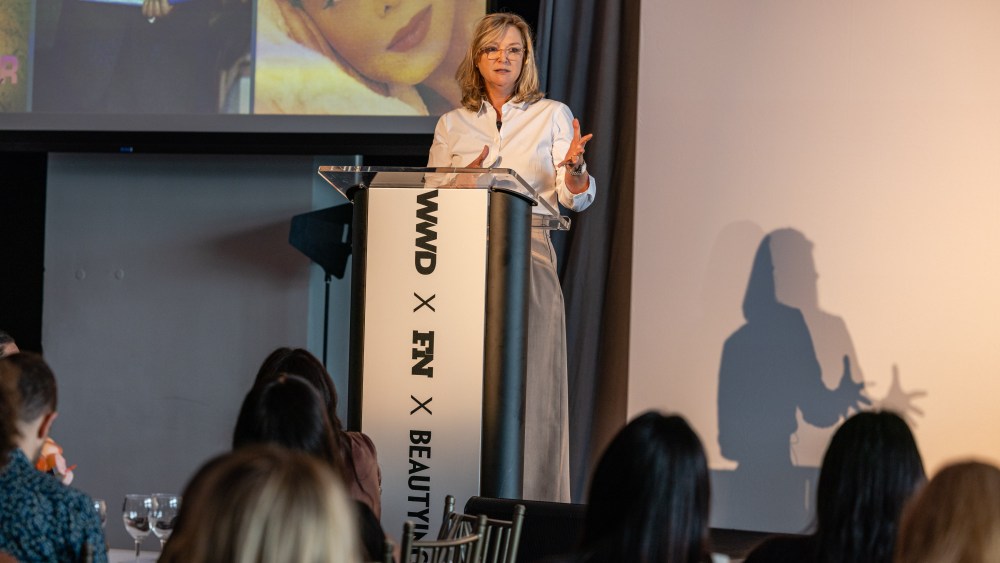
Peggy Elsrode, president, Americas at Dyson, brought the audience at WWD’s Women in Power event back to the ’90s. It was a time, she said, when she worked at a company with only three other women — and they were forbidden from wearing pants.
Fast-forwarding to 2020, Elsrode once again found herself as the only woman in the room, as the lone woman in senior leadership and the highest-level female at Dyson.
Unfortunately, this is not an unusual circumstance. Today, while 48 percent of the U.S. workforce are women, only 24 percent of C-suite positions are held by women. In August 2022, the Fortune Global list showed only 4.8 percent of CEOs are women.
You May Also Like
Related Articles
So, why aren’t there more women in leadership?
The reason, Elsrode said, is a set of unequal standards. Women and minorities are held to higher and sometimes impossible standards, with expectations to do more to prove yourself to be on the same level or playing field as male colleagues, while still being viewed as having less potential.
“This is incredibly frustrating when you’re asked to over-deliver your entire career,” said Elsrode. “But when it comes time for the next step, and that promotion is viewed on potential [even when] the track record far exceeds many other counterparts.”
Drawing on her own experience, Elsrode said that every time she had to over-deliver to be on par. Even recently, she said, when her results showed record-breaking P&L, a senior leader remarked that it “must be a fluke.” Not only was it a “rude comment to make, but one that diminished the hard work that the team had put in to receive those results,” she said.
Some businesses have been slow to hire female executives, and Elsrode noted “one of the issues is that business leaders need to navigate better between the balance of confidence and competence,” or the “how good you think you are versus how good you really are.”
It is important to note, she said, the different leadership styles of women, who are often described as having less command and control. Women also often bear more family responsibilities, preventing them from bringing their whole selves to work, Elsrode noted. This is a must for women, yet it’s impossible for many corporate environments, she said.
With so many companies upholding old standards with mostly males in leadership positions and business doing seemingly fine, Elsrode raised the question: why should there be a change? The answer, she said, that it could be so much better.
“Having diversity in senior leadership increases productivity and creativity. It improves performance and staff retention, and it boosts collaboration. And there’s an exponential increase in the pace of change and disruption in the world. In a recent survey of men and women, women were more transformational, they’re more collaborative and less authoritative — which is excellent when you need to make more historical shifts,” she said.
Moreover, society’s communication is also changing. Even movie cuts are faster. People are speeding up shows and audio books to get through them more quickly, she noted.
Women are better at communicating more often, with stronger clarity, more openness and honesty,” said Elsrode referencing research data. “Technology and innovation will continue to disrupt every aspect of the economy. Diversity and leadership bring new perspectives, and new perspectives bring new ideas and new ideas for new innovation.”
How can change be found despite the obstacles facing women? According to Elsrode, the answer lies in unleashing the power of empowerment.
“Empowerment is more collaborative versus controlling, and when you’re empowered you cannot avoid your feelings,” said Elsrode, who is a proponent of leading with empathy. One small way she puts this into practice is by empowering women who are becoming working mothers by helping to take the anxiety out of the circumstance, acknowledging that the life change is not a problem, but a power.
“This is a power that we have and that empowerment is within,” said Elsrode. “The real change and strategy always moves where your mind-set moves. [What] we need to do to make a change is to broaden our spectrum of what we think a powerful leader is.”