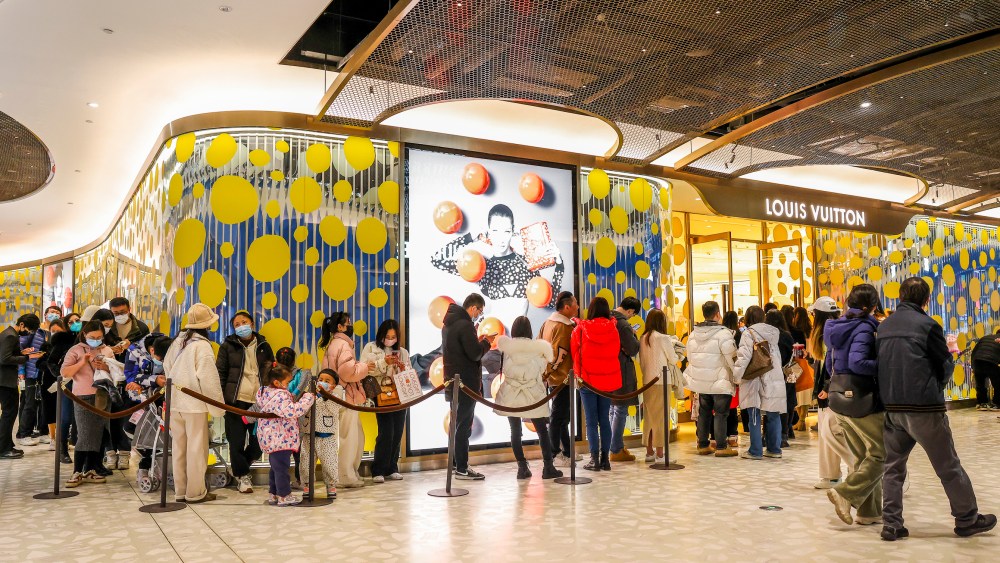
SHANGHAI — In contrast to most predictions that expect China to begin 2023 with a U-shape recovery, the country’s luxury retail got off to an excellent start this year and it was well reflected in first-quarter results for the main luxury conglomerates.
LVMH Moët Hennessy Louis Vuitton, the world’s largest luxury group, saw its overall first-quarter revenues rise 17 percent year-over-year, doubling analysts’ expectations.
LVMH’s shares soared to a record high on Monday, which led the luxury giant to become the first European company to surpass $500 billion in market cap.
You May Also Like
Related Articles
“We registered some pretty nice pick-up in China, which bodes well for the rest of the year,” said Jean-Jacques Guiony, chief financial officer of LVMH, who characterized China’s luxury sector recovery as normalizing at “a fairly high level.”
“We are extremely, extremely hopeful and should benefit from a strong push from mainland China in 2023. Certainly in fashion and leather, but probably as well in jewelry,” Guiony added.

The company’s fashion and leather goods division registered double-digit growth in the China market, but categories such as cosmetics still “remain under pressure” as the middle class begins to rationalize spending.
With limited outbound flights and extended visa wait times, the return of Chinese tourists abroad has yet to crystallize in the first quarter, but the company is already seeing signs of recovery.
“The offshore business last year was about 15 percent of the global mainlanders cluster, and it’s now at 20 percent. So it grows at a fast rate,” said Guiony.
Guiony said LVMH’s mainland China business remains a key focus for the brand. Its anchor brand Louis Vuitton is gearing up to open its first Hainan flagship this year and will likely open another mega-store in Beijing’s Sanlitun shopping district.
To further boost its ties with China, Bernard Arnault, chairman and chief executive officer of LVMH, met with Wang Wentao, China’s minister of commerce, at Dior’s Avenue Montaigne flagship in Paris last week.
During the meeting, Arnault reiterated the group’s commitment to China and his confidence in the strength of the Chinese economy, underlining the importance that this market holds for LVMH. It was also revealed that LVMH will participate in the sixth China International Import Expo to be held later this year in Shanghai, between Nov. 5 and 10. The company has been an active participant in the fair since its inception.
There also have been reports in local media that LVMH is planning to move more regional headquarters of its maisons to Shanghai in the coming decade and focus more on fast-developing major Chinese cities like Chengdu, Zhengzhou and Wuhan.
At Hermès, a good Chinese New Year and the return of Mainland shoppers to neighboring regions, including Singapore, Thailand and Australia, helped boost sales in Asia, excluding Japan, by 23 percent year-over-year in the first quarter. Revenue rose 23 percent year-over-year to 3.38 billion euros during the period.
“We see good momentum in China and we see good momentum in the U.S.,” Hermès CEO Axel Dumas said during the brand’s annual shareholders’ meeting. He described a “long-term strategy in China” and gradual expansion into new cities “in a stable and respectful manner. I think this stability helps us in forging ahead. We are not managing the group by quarter.”
Even before borders reopened and the rest of the industry faced major headwinds due to COVID-19 disruptions, the French luxury house enjoyed double-digit growth in Asia in the fourth quarter of 2022.
Brunello Cucinelli, which is seeing “decidedly positive” trends in China, saw its revenues in Asia surge 56 percent to 74.3 million euros in the first quarter, representing 28 percent of total sales.
China represented 12 percent of total sales in 2022, but Luca Lisandroni, the company’s co-CEO, is already calling 2023 a “golden year” for the China market.
At Compagnie Financiere Richemont, which will release its full-year 2023 results on May 12, its core jewelry division is expected to grow by 18 percent, driven by China’s reopening and growth in Europe and the rest of Asia, according to Barclays.
The company’s lead brand Cartier has been actively hosting major exhibitions in Hong Kong and Guangzhou in a bid to educate the audience while selling big-ticket items to affluent customers who are eager to get back on the social calendar.
Kering is also recovering in the period. Sales in the three months to March 31 inched up by 2 percent in the first quarter, as its star brand Gucci, which is in a transition period, logged a modest gain amid a decline in revenues in North America and a gradual recovery in China.
The group is planning to host a slew of events to boost its presence in China this year. This week, Gucci is launching an immersive exhibition at Shanghai‘s West Bund to showcase its 102 years of heritage and era-defining classics. Kering’s other brand Bottega Veneta, meanwhile, will stage a repeat show of its fall 2023 collection in Beijing on July 20.
Based on Bain & Co.’s estimate, China will likely return to 2021 sales levels between the first and second half of 2023.
How quickly the China market rebounds will continue to play an important part in luxury players’ growth story.
According to a recent report by PwC, China’s luxury market is set to reach 816 billion renminbi, or $118.3 billion, by 2025, accounting for more than 25 percent of the global market.
Barclays, meanwhile, said that big spenders will be the main driver of luxury sales growth in China, as the expanding middle class begins to economize due to challenging economic outlooks.
As China aims to keep spending onshore, Hainan’s growing importance as the country’s duty-free paradise will play an increasingly important role for major luxury players.
“We are moving from this world where Chinese were buying abroad to a world where they buy abroad and a little bit tax-free in Hainan,” said Jonathan Siboni, founder of luxury consulting agency Luxurynsight.
Luxury players such as Richemont, Kering, Prada, Burberry and Moncler have already set up a retail presence in Hainan’s wholesale channels, but the city plans to adopt an independent customs system in 2025, which will allow luxury brands to open directly operated duty-free stores on the island.
“Brands need to manage their supply chain, inventories, and pricing carefully to avoid cannibalizing the duty-paid market elsewhere in China or diluting brand value,” cautioned Barclays.
Upcoming national holidays, including Labor Day in May and Dragon Boat Festival in June, will likely mark the gradual return of Chinese tourists abroad.
“Soft luxury could benefit the most from a resumption of travel towards Europe, as prices in Europe tend to be around 25 to 40 percent cheaper than in mainland China,” according to a recent Barclays report.
For luxury players, the China recovery story will continue to play a crucial part. According to Morgan Stanley, Chinese spending on luxury goods will exceed 20 percent of overall luxury sales this year.
Sustaining the growth in the China market meant securing loyal high-spenders whose demand for luxury goods has yet to be satiated.
According to Bain & Co., the top 2 percent of customers account for around 40 percent of luxury sales, with the trend more pronounced in the China market.
An increased focus on clienteling, which can range from exclusive trunk shows and curated events to celebrity meet-and-greets that succeed in making the clients feel like superstars, will fuel high-net-worth individuals’ spending.
Mytheresa, for example, feted the launch of four capsule collections from its debut China Designer Program, featuring Susan Fang, Di Du, Jacques Wei, and Xuzhi Chen, in Shanghai last week. The German retailer hosted its VIP clients and media partners at an intimate dinner at Bulgari Hotel in Shanghai.
Luxurynsight’s Siboni also noted that “there is the revenge of pleasure-seeking, which means Chinese shoppers are ready to engage with new categories such as fashion jewelry and homeware. Instead of buying luxury with the intention to stand out, luxury will start to fit into their daily life more.”
For some high-spenders that reside in lower-tiered cities, shopping online, a habit adopted during extensive COVID-19 lockdowns, might be here to stay.
Top luxury brands, including Louis Vuitton, Tiffany & Co. and Dior, have signed on to work with JD.com. A mini-program embedded with the JD.com app provides a similar shopping experience to brand-owned e-commerce channels.
“The shopping habit that really differentiates these small-town young people from their first-tier peers is that they are more traditional in their shopping habits. They care about gifting more, so they are more likely to buy for their wives and girlfriends,” said Kevin Jiang, president of international brands at JD Fashion Business Group. On JD.com, more than 50 percent of luxury shoppers are young male shoppers who live in third-tier cities.
Siboni thinks luxury players need to quickly adapt to the rapidly evolving commercial real estate landscape to stay on top.
“Brands need to readjust their retail strategy both in terms of cities in China and within major cities because the city landscape is changing very quickly,” said Siboni. “New assets, owned by the likes of Wangfujing and Bailian, are popping up fairly quickly, which follows the government’s initiative on building a consumption-led economy.
“In a few years, a shopping mall might not be trendy at all in 10 years’ time. A shop at street level can engage more customers and communicate more content to them than a store within a shopping mall ecosystem,” Siboni added.
Pop-ups also proved to be a successful format for testing new retail locations during the pandemic in China.
“Luxury brands such as Louis Vuitton and Chanel have been putting a lot of investments in the pop-up format, especially investing in installations, the styles of the store, and the approach,” said Dickson Szeto, founder of TX Huaihai in Shanghai. Since this year, requests for pop-up initiatives at TX Huaihai reached a record high for the second quarter of 2023.
“There are two kinds of pop-ups, one for only display, the museum exhibition types; the other kind, we really want to sell out something. The latter can definitely benefit long-term leasing,” said Szeto, who dropped clues on two “economically justifiable” pop-ups that include Reebok and Kusikohc.
At TX Huaihai’s Beijing spinoff, The Box, a pop-up for “guochao,” or Chinese streetwear brands, and a Tsutaya Bookstore opening will officially launch by the end of this year.
For Eric Young, owner of Shanghai’s fashion boutique LMDS, which counts luxury VIPs and Chinese celebrities such as Fan Bingbing and Jin Boran as frequent customers, the local fashion retail market’s comeback will be gradual.
“There is no doubt that fashion consumption has recovered in all aspects compared to 2022, but there is no so-called ‘revenge consumption.’ 2022’s trauma and the impact of the economic environment, I think a real rebound won’t happen so quickly,” said Young.
“We face a new and unfamiliar feeling coming out of the pandemic; we are seeing new faces, and hopefully we will discover more fashion lovers, both local and domestic and foreign travelers,” Young added.
SND’s Will Zhang thinks that new market needs will need to be met as people start to socialize again. “Shoppers will be drawn to less practical stuff again, such as exaggeratedly shaped dresses, 3D-printed shoes, various unique and novel items, and even wallets as they start traveling abroad again,” said Zhang.
With the country reopening, local retailers like Zhang and Young made their first buying trips abroad in March to reconnect with European brands and seek out new talents.
According to Joor, a digital wholesale management ecosystem, wholesale orders placed by Chinese retailers for European brands during the January to March buying season spiked 58 percent compared to the same time last year, with wholesale transaction volume increasing by 61 percent in the same period. The average order volume reached 35,000 euros per store, an increase of 28 percent compared to last year.
Based on Joor data, brands that most benefited from the return of Chinese retailers include Montblanc, Thom Browne, Maison Kitsuné, Vivienne Westwood, Fear of God, Diane von Furstenberg, Lemaire, MCM, and The Row.
Alongside unisex apparel, childrenswear has become the category exhibiting the fastest growth year on the platform.
For European designer brands, “the Chinese market is expected to be a growth engine for the luxury fashion industry this year,” remarked Kristin Savilia, Joor’s CEO.