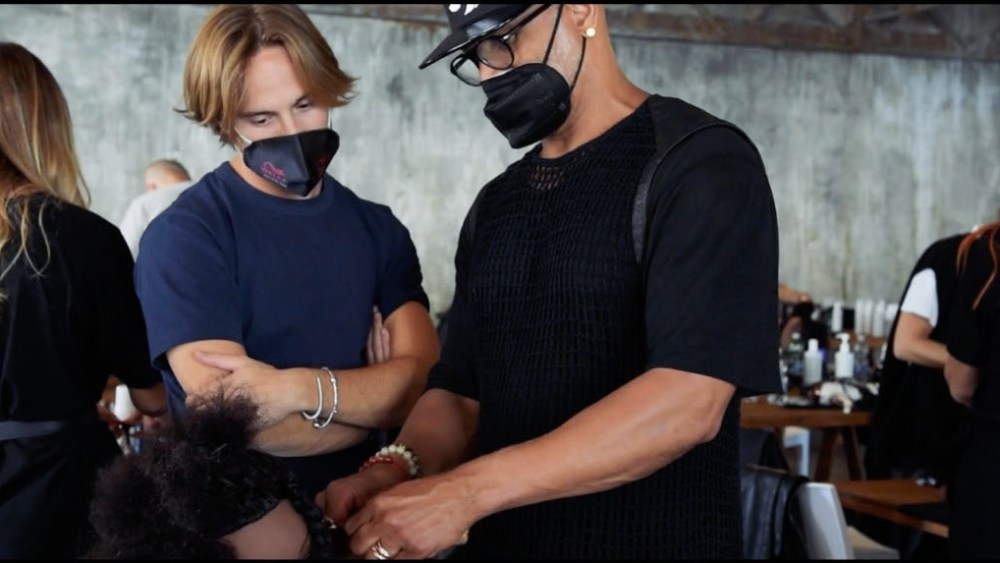
As part of a longer-term commitment of increasing diversity and inclusion in the industry, Camera Nazionale della Moda Italiana (CNMI) teamed up with its hairstyle partner Wella and Show Division global leaders in backstage artistic support to launch two days of training for fashion hairstylists, in September, during Milano Fashion Week. Organizers described the “Inclusive Backstage Master Class” as “high-level training for professional hairstylists on the care and styling of Afro textured hair.”
The Master Class project is a component of the CNMI’s Diversity & Inclusion roadmap, which was launched in 2019 as part of the organization’s Manifesto of Diversity and Inclusion. The aim of the roadmap is to provide “active services for fashion companies while raising awareness on diversity issues among consumers.”
Related Articles
The Inclusive Backstage Master Class training project was designed for professional hairstylists who work in fashion and the goal was to provide “technical and style knowledge for the treatment of various hair types, with a particular focus on Afro textures.” The initiative was organized by CNMI in collaboration with Wella, the official hairstyle partner of Milano Fashion Week, and Show Division.
The program was a resounding success.
Carlo Capasa, Chairman of CNMI, said Fashion Week “is a very important moment that we can use to spotlight a fundamental topic such as inclusion through practical activities like backstage styling” and noted that with the release of the organization’s Manifesto in 2019 “we recognized the crucial role of training in arising awareness. The Inclusive Backstage initiative was born to promote an inclusive evolution of beauty and fashion.”

President of Show Division. Courtesy Image.
The context of the initiative is framed by data showing that nearly 42% of the models on the runway for the Spring 2021 collections were black, yet there is a lack of hair stylists trained to work with these models. Organizers said the project helped update the skills of fashion industry professionals while aligning with “a new scale of values comprising inclusiveness, respect for people and the environment.”
Celia Sears, Founder and CEO of Show Division, praised the partnership and said her organization is “laser focused on ensuring diversity and inclusion backstage. The fact that we see many of our principles reflecting into the Camera Nazionale della Moda Italiana Diversity and Inclusion Manifesto is proof that change is possible. The addition of specific backstage education programs for the management of Afro hair represents a paradigm shift that makes diversity and inclusion less arbitrary and more fluid,” she said.
President of Camera Moda
POWERED BY:
Putting Fashion
Diversity and Inclusion Into Practice
Camera Nazionale della Moda Italiana, Wella and Show Division partner to train fashion hairstylists specifically in caring for Afro textured hair. Stefano Guindani
For Wella, the project simply aligns with the company’s daily mission. Marco Vurro, Director of Communications of Wella, said inclusion and diversity “is a mantra that guides Wella every day and in our global vision.”
“Hairs brings us to do our best to make them healthier and more beautiful: a goal that is possible to reach only by focusing on the identity, culture and characteristics of the person we are working with,” Vurro said. “Inclusive Backstage offers us a further opportunity to share and bring our corporate culture also on the catwalks of the prestigious Milan Fashion Week.”
The Program’s Origins
When asked what the impetus behind the creation of the project was, CNMI’s Chairman Capasa said it is traced by toe the diversity and inclusion roadmap and challenges facing the fashion industry regarding DE&I. Capasa said the partners of the project each played different roles. “CNMI, as project leader, supported the project from a financial point of view, as well as the realization and the final communication to our members,” Capasa explained. “Show Division, as technical expert of the project, brought the trainers for the course, while Wella, as official partner of the Milano Fashion Week, brought 40 Italian hairstylists and provided all hair product for the course.”
Show Division approached Camera Nazionale della Moda Italiana about hosting a program based on seeing first hand backstage hairstylists willingness to improve their skills and technical knowhow when it comes to textured hair. CNMI was happy to embrace the project and teamed up with its official hairstyle partner Wella to launch two days of training session hairstylists, who would be working backstage during this past September’s Milano Fashion Week.
Addressing An Age-Old Issue
Sears said the launch of the Inclusive Backstage Master Class was long in coming and addresses “an age-old issue of professional hair and makeup artists who lacked the basic skills on working with Afro textured hair and darker skin tones.”
“The backstage experience for models of color is extremely disheartening more often than you may imagine and given my background as a woman of color and as a former model, I wanted to make sure we could offer a viable solution to the challenges that these young models continually face, challenges that have gone unnoted for decades,” Sears explained.
Sears said the biggest challenge fashion brands face when it comes to diversity and inclusion “is understanding what the most effective and implementable strategies are to achieve truly sustainable diversity and inclusivity goals, while giving those who they have put in the position to manage these goals, the power to do so. Understanding the importance of following through on a consistent basis with a brand’s set goals is key to any strategy’s success.”
For its part, the Inclusive Backstage Master Class also addresses “the need and desire for backstage artists to build core competency and personal proficiency in Afro textured hair and deeper skin toned make up. These Master Classes can actually help solidify a brand’s diversity strategy while promoting a culture of inclusion, making Brand values and intentions clear,”. Sears also hopes other Fashion Weeks across the globe will implement the program.
Regarding whom should take the class, Show Division’s Educational Director Marta Cottarelli, said, “Any professional hairstylist or make-up artist that presently works backstage or would like to improve and enhance their skills when it comes to textured hair or darker skin tones. Artists also begin to learn the history of textured hair and the correct approach.”
“Being a two-day session, what we aim to achieve is artist confidence and basic competence when working with models of color,” Cottarelli said. “What that translates to is if a model of color were to sit in a Master Class graduates chair, the artist would feel more confident and have a semblance of an idea in terms of what to do and how to do it.”
Cottarelli said the expected outcomes from the hairstylists who completed the master class “is that they feel confident enough to work on a model with textured hair making the model feel secure knowing her hair will be treated in the right way and without damage. Hairstylists will also broaden their skill set in a way that they can use these skills outside of the backstage setting.”
Just the Beginning
Capasa said fashion brands are facing countless challenges and CNMI addressed the issue of diversity and inclusion by asking its Associates to answer a survey designed to discover strengths and weaknesses of the sector. “Many fashion brands are already dealing with this subject since it is a strategic opportunity for the business in terms of reputation and welfare; some of them have even hired diversity managers and appointed specific boards on the topic,” Capasa explained. “New generations of consumers are asking companies to be more and more attentive on issues such as the protection of workers’ rights, the enhancement of diversity and social inclusion. As highlighted by this study, two thirds of consumers think that brands today can do more to solve the social gaps than governments can actually do. Therefore, fashion brands today have a greater responsibility compared to the responsibility they had in the past.”
For its part, Capasa said CNMI takes a more holistic approach by “giving to all our members the opportunity to embrace new inclusive projects in their strategies. In fact, in 2019 CNMI hosted its first Including Diversity event, which was attended by numerous fashion brands. The second edition of the event will take place in Milan, at the Piccolo Teatro Grassi on Dec. 20, 2021.
Before the start of the Inclusive Backstage course we informed all fashion brands of the possibility to hire trained professional hairstylists to treat afro hairs during the backstage of the September Milano Fashion Week.”
When asked how this program will evolve, Capasa said, “I think we are just at the beginning of a long journey. For the Milano Fashion Week in February 2022, we are scheduling the second edition of Inclusive Backstage, in which the experts provided by Show Division will train 40 new hairstylists selected by Wella.”
Capasa said CNMI looks forward to “imagine together with Wella and Show Division new projects that will accompany us towards the end of the roadmap drawn up more than three years ago.”
“Moreover, we would like to expand more and more the collaboration of hairstylists engaged in this project and why not, encourage others international Fashion Week to do the same,” Capasa added.