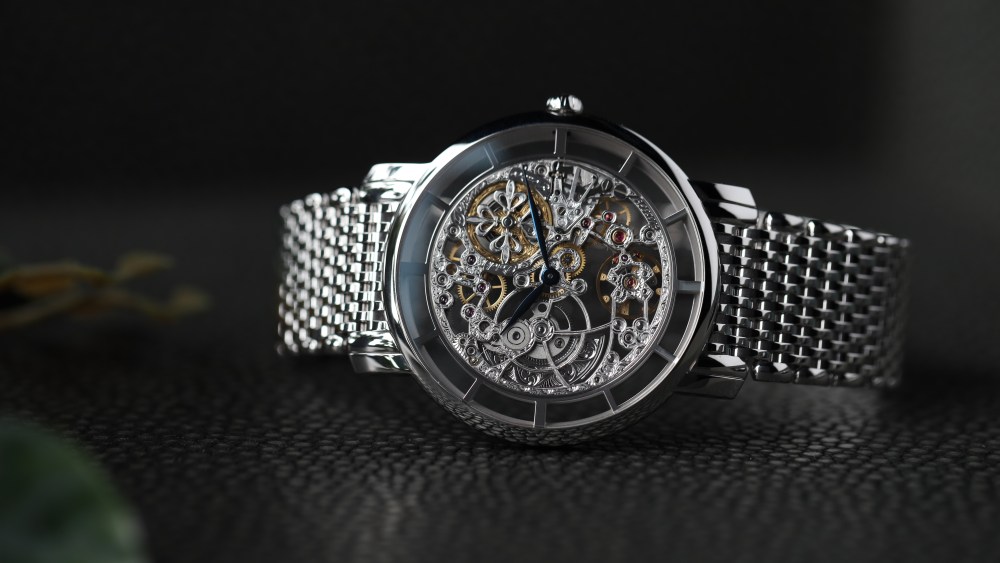
The worlds of art and watchmaking share many similarities — the time, skill, aesthetics and emotions involved in both give rise to natural parallels. Not to mention each industry boasts enthusiastic collectors, making crossovers and collaborations inevitable.
In the past two years, the demand for new and secondhand luxury watches reached an all-time high, and despite a meteoric rise in prices, the market continues to present an opportunity for long-term appreciation and market diversification.
Related Articles
But the market may be beginning to normalize. Morgan Stanley’s most recent quarterly report on the secondary watch market, with data contributed by WatchCharts, shows a decline in prices across all Patek Philippe and Rolex watches of 8 percent and a quarter-on-quarter drop of 7 percent for Audemars Piguet.
You May Also Like
The overall performance for the top three brands is significantly distorted but mainly due to the current flood of pre-owned models available in the market.
Nevertheless, current industry trends continue to produce watches collectible for their rarity — an old world set of skills that combines micro-engineering prowess with the talent of a master jeweler or an artisan.
Still, in the world of high horology, it’s no longer enough for a watch movement just to be ultra-precise or to have impressive complications — watches must be beautifully decorated inside and out, including finely finished movement components, perfectly polished cases and gorgeous dials.
With a higher level of luxury as well as an emphasis on craftsmanship, top luxury watch brands continue to emphasize the importance of art-driven timepieces, with métiers d’art becoming increasingly significant to watchmaking as well as a factor in driving change to the traditional rules of watchmaking.
Elaborate artistry, embellished engraving, enameling and jeweling represent only a minuscule amount of the métiers d’art techniques, but now decorative crafts have evolved with new twists on the old methods and expanded with additional crafts, such as marquetry, updated gem-setting techniques, gold granulation and micro-mosaics.
Métier d’art is part of a long tradition in Swiss watchmaking, and top watch brands showcase their expertise in artisan crafts by producing limited-edition timepieces with highly decorative dials each year. The techniques and visuals implemented vary greatly, often reflecting an important historical accomplishment, an interpretation of an artwork, or an image related to a luxury brand’s heritage, offering a fertile ground for watch brands to let their creativity loose and introduce techniques that are new to the measurement of time.
Only a handful of brands invest considerably in the production of rarefied métiers d’art creations. Among them are some of Switzerland’s oldest and most revered names, including Vacheron Constantin, Patek Philippe, Jaeger-LeCoultre, Audemars Piguet, Blancpain and Jaquet Droz. But newer independently owned brands are now marking their territory in the art watch arena, such as Minase, Jacob & Co., Christophe Claret, Louis Moinet and Purnell.
But over the past decade, the watch industry has witnessed incredible growth in the concept of presenting the dial as art, and even though it’s a space that represents no more than two inches in diameter, it has become a home for artists and artisans to reinterpret techniques and timeless themes.
A few notable releases this year in the art watch market include:
- Bulgari’s limited-edition of eight one-off timepieces created in collaboration with the Chinese French artist Wang Yan Cheng — a 44mm Octo Roma in black titanium with a black onyx middle case, a skeleton flying tourbillon movement and sandblasted surfaces;
- in its first art collaboration with a contemporary artist, Zenith’s linked with Felipe Pantone for the Defy 21 Felipe Pantone, boasting multicolored bridges in metallic rainbow tones via a three-dimensional PVD and silicon particles process;
- Hublot’s Classic Fusion Takashi Murakami Sapphire Rainbow, and
- the recently released 50-piece limited series Jacob & Co. Opera Godfather 50th Anniversary, which combines the world of ultra-high-end watchmaking with the complexity of a mechanical music box, playing the film’s theme music and incorporating 13 of the movie’s scenes, in the same narrative order.
With the New York watch auctions quickly approaching, Phillips will host The New York Watch Auction: Seven on Dec. 10 and 11 and the auction house has rolled out a preview of the lots that will be up for grabs, including a Cartier London Crash in 18-karat yellow gold, circa 1970; a rare F.P. Journe Tourbillon Souverain in platinum with salmon dial, circa 1999, and a unique Patek Philippe Calatrava in 18-karat yellow gold featuring a newly deciphered Egyptian hieroglyph dial specially made for legendary photographer Helmut Newton, circa 2002.
TimeForArt will be introduced as its own dedicated chapter of the Phillips New York Watch Auction: Seven, marking the first time an auction will solely support contemporary art and artists alike, with 100 percent of the proceeds going directly to the nonprofit’s efforts to support artists through their exhibitions, public programs, education and community engagement.
Featuring 17 watches in the TimeForArt auction, these pieces are either unique collaborations with world-renowned artisans or by leading contemporary artists, with lots such as a C by Romain Gauthier Platinum Edition timepiece and world-renowned enamel artist Anita Porchet; a De Bethune Hourglass in collaboration with Marc Newson, and a Chopard L.U.C Quattro Spirit 25.
Here, WWD speaks to a few organizations and tastemakers on the state and future of the art watch market.
Company: Phillips Watches
Name: Alexandre Ghotbi
Title: Head of watches, Europe and Middle East
WWD: What is the current state of the métiers d’art market? What maisons are the most sought after?
Alexandre Ghotbi: Metiers d’art can go anywhere from guilloché to gem-setting, enameling or any other decorative arts. And depending on the specific art, the market is very high. Rolex and Patek Philippe are the most sought after.
WWD: With the current rise of watch brands creating more métiers d’art timepieces, has the focus shifted to a new era of exclusivity?
A.G.: High horology has always been about exclusivity, the metiers d’art add an extra level of desirability and panache.
WWD: With brands shifting from multi-piece collections to small scale collections or even just one-of-a-kind pieces, do you think the future of the market is shifting to bespoke watchmaking?
A.G.: High horology started as bespoke and some of the most fascinating watches to have been created in the 20th and 21st centuries were special commissions. Bespoke only may be a bit difficult but offering personalization definitely seems like a route to explore.
WWD: With more and more timepieces emerging in three-dimensional format with cases that resemble objects rather than watches, and with movements that are skeletonized, layered and tiered, are we witnessing the birth of an “interior” métiers d’art renaissance? And is this the future of art watches?
A.G.: I love this analogy and would agree with you that that we can now include movement architecture as a metiers d’art.
Company: Antiquorum
Name: Romain Rea
Title: Chief executive officer
WWD: What is the current state of the métiers d’art market? What maisons are the most sought after?
Romain Rea: The métiers d’art are so intertwined in the process of creating and manufacturing watches that it is difficult to consider them as a separate element. In my experience, most of the clients fascinated by the métiers d’art will buy them on the first market, brand new. Usually, the métiers d’art will shape a watch in such a sensible way it is a very personal timepiece. Indeed on the secondhand market, including auctions, the peculiar and unique character of these pieces makes them more complex to sell. The buyers will usually purchase them out of passion and not for speculation.
WWD: With the current rise of watch brands creating more métiers d’art timepieces, has the focus shifted to a new era of exclusivity?
R.R.: In the same way that we hear the term independent watchmaker everywhere nowadays, the qualification métier d’art could be perceived as just another marketing argument. Between tradition and innovation, the métiers d’art are those pieces of craftsmanship that are repositories of the demands of the fine arts.
If to oppose “exclusivity” to “mass-production” in several hundred pieces, it depends on the brand and on the model: they do not aim the same purpose depending on the watch. Some manufactures have made the métiers d’art their signature. For instance, the enamel by Patek Philippe or Vacheron Constantin, the incredible gem setting by Van Cleef & Arpels.
WWD: From engraving, enameling, miniature painting or guilloché, which techniques see more demand?
R.R.: Painting on enamel is the most delicate technique to apprehend but in the current state of the market it is the guillochage, which is the most sought after, mainly because many watch brands are producing guilloché dials. Proof that it is in the air of time, it is interesting to note that during the last exhibition at the Salons Patek Philippe, a craftsman carried out demonstrations of guillochage.
WWD: Many artisans occupy a field in which many skills were otherwise destined to disappear forever. Do you feel watch brands are doing their part to preserve the spirit of the artisans creating métiers d’art pieces?
R.R.: Yes, a great effort is being made by many manufacturers to preserve and develop this know-how. They are also trying to internalize this craft more and more.
Patek Philippe has always wanted to promote and preserve its know-how within the manufacture or with independent craftsmen. Around 2010, Vacheron Constantin also made great efforts in this direction; we had the chance to present on November 2011, in our Geneva auction, two beautiful copies. On the other hand, the high jewellery workshops (gems setting) have continued to work in the field of watch decoration as shown by the Kalla, or the famous Audemars Piguet rainbow bezel. All these elements have allowed this know-how to be perpetuated.
WWD: With more and more timepieces emerging in three-dimensional format with cases that resemble objects rather than watches, and with movements that are skeletonized, layered and tiered, are we witnessing the birth of an “interior” métiers d’art renaissance? And is this the future of art watches?
R.R.: In the age of new technologies, it is necessary to show and amaze. Most customers want to be able to admire their watch with their childlike eyes.
Company: Watchbox
Name: Mike Manjos
Title: Chief trading officer
WWD: What is the current state of the métiers d’art market? What maisons are the most sought after?
Mike Manjos: There is a growing appreciation for the métiers d’art across the collectible watch market, as collectors take note of handcrafted details that represent both ancient techniques and contemporary interpretations. Patek Philippe has long been recognized for its mastery of rare handcrafts, extending from enamel works to engraving, guilloché, gem-setting and marquetry, and strong market values reflect this appreciation.
Independent maisons are keeping many of the métiers d’art alive, and the rise in interest in both handwork and the independent category has been profound. Kari Voutilainen’s superlative guilloché techniques and works of lacquer art have caught the attention of the collecting community, as has Rexhep Rexhepi’s handwork and the unique open-worked dials of Akrivia. The historic engraving technique of tremblage as seen on dials by Moritz Grossmann is spectacular, and the fumé dials of H. Moser & Cie. are altogether stunning — uniting “old world” craftsmanship with modernity.
WWD: With the current rise of watch brands creating more métiers d’art timepieces, has the focus shifted to a new era of exclusivity?
M.M.: We’re witnessing a new era for exclusivity in general, not just limited to the métiers d’art. Collectors are seeking exceptionally unique, complicated and rare pieces — moving beyond those that have occupied the highly visible spotlight. Hand-finishing, superior craftsmanship and the opportunity to meet the watchmakers and artisans who create these extraordinary timepieces are recognized by Watchbox’s collecting community as increasingly important considerations.
WWD: From engraving, enameling, miniature painting or guilloché, which techniques see more demand?
M.M.: Engraving and enameling are among popular techniques, bringing to life some of the most gorgeous dials across the watch category. Patek Philippe’s World Time references with cloisonne enamel dials have consistently enamored collectors from the 1950s through the present day. And when we look to the archives, vintage Patek Philippe Reference 2526 models unite technical prowess with grand feu enamel, resulting in a historically important and beautiful piece adored by collectors worldwide.
WWD: Many artisans occupy a field in which many skills were otherwise destined to disappear forever. Do you feel watch brands are doing their part to preserve the spirit of the artisans creating métiers d’art pieces?
M.M.: Leading independent watchmakers and major houses are helping to preserve these skills, adhering to rigorous standards of craftsmanship and often combining traditional and artisanal methods of watchmaking with contemporary style. Small production numbers and an unwillingness to compromise quality — both in design and in movement finishing — means that these pieces can be quite expensive, and there is a growing market for them. Looking at the “Artistic Crafts” and “Jewelry” categories of the recent edition of the GPHG reinforces that the spirit of artisans creating métiers d’art pieces is alive, supported by manufactures both large and small.
Patek Philippe is the ultimate champion for traditional handcrafts and the preservation of artistic skills, welcoming collectors and enthusiasts to discover the distinct qualities of hand-finishing, decoration and pure artistry. They maintain a commitment to education and preservation of generations of craftsmanship through the Patek Philippe Museum, and ongoing exhibitions and storytelling to highlight the extraordinary talent of artisans today.
WWD: With more and more timepieces emerging in three-dimensional formats with cases that resemble objects rather than watches, and with movements that are skeletonized, layered and tiered, are we witnessing the birth of an “interior” métiers d’art renaissance? And is this the future of art watches?
M.M.: A watch is an incredible vehicle for self-expression, and collectors are increasingly turning to the independent sector and elite manufactures to discover pieces that are rare, complex, technically innovative and exquisitely artistic. When you purchase the work of an independent watchmaker, or the complex and less-than-traditional designs by an established brand, you are buying into a specific philosophy of design and timekeeping. This is true if you are purchasing a piece from a brand’s current catalog, or from the rich archives available across the secondary watch market. Think about the sculpted cases of late 1990s Roger Dubuis, the Cartier Crash, and De Bethune’s distinct DB28 Kind of Blue case with articulated lugs and a brilliant flame-blued titanium construction. These are stunning representations of “art watches.”
A conversation about artistry and creative watch design is not complete without considering creative watchmaking; immaculate finishing, unique movement architecture, chronometric precision and reliability. This is the future of elite watchmaking of the highest caliber.

Reference – 33222
Reference: 148-TT-21-GF-RU