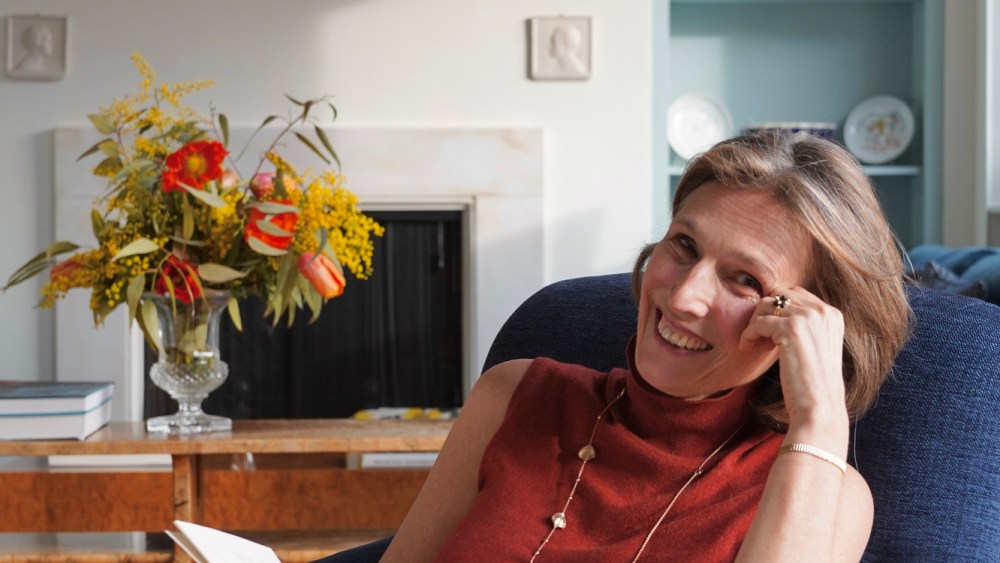
Sophie Bouilhet-Dumas didn’t set out to launch a jewelry brand.
In fact, you could say her three-year-old label Mira Stella is a precious offshoot that sprouted from the lush garden that surrounds her family’s Normandy property.
After all, it’s a passion for plants that runs through the veins of this scion of the family that founded French silversmith Christofle and who also has the legendary architect Gio Ponti as a great-grand-uncle.
Related Articles
“I was just lucky to grow up with a mother who was very much into gardening and had made her own garden — as did my grandmother in Belgium,” says Bouilhet-Dumas, who is married to Hermès artistic director Pierre-Alexis Dumas.
You May Also Like

“That’s also why the brand is called Mira Stella, the first names of these two ladies in my family where we are sensitive to and passionate about flowers and nature.”
That long-held love comes across in her collection’s 18-karat takes on softly veined hydrangea petals, minute lemon-shaped sea kale seeds, flax pods shaped like tiny hazelnuts or the seeds of garden orach, a plant considered the “spinach of Antiquity.”
Priced between 350 euros for a single earring and up to 7,200 euros for long necklaces strewn with multiple motifs, Mira Stella designs are made in France using recycled gold from certified mines. Diamonds, semiprecious stones and precious woods like ebony are used as accents.
Most recently, Bouilhet-Dumas introduced a motif taking cues from oak bark, for textured rings that she feels could also catch the eye of male client.
A Growing Passion
At the root of the jewelry brand is the work she’s been doing for the past 15 years with English paleobotanist Mark Brown in a slice of land amid Normandy’s rolling fields.
“I had already worked on the project with my mother and had a list of plants and trees we were looking to plant [because] where we had to recreate shadows and create the right conditions to be able to grow flowers from this land that was very open and windy,” she recalls.
But the next step eluded her, which is when Brown’s name came up, suggested by her mother-in-law, the architect and interior designer Rena Dumas.
The English botanist was familiar to Bouilhet-Dumas. She’d discovered his work through “Jardins des Champs, Le Souffle de la Nature,” a 1999 book in which he shares his love for nature and advice for creating a wild garden.
Although he has designed some remarkable ones across Europe, including his own five-acre paleobotanical paradise in Normandy, don’t call him a “garden manager” or “gardener,” as his preference remains botanizing, snooping around woodlands and other preserved spaces for the local wildlife.
“It’s just been a personal taste of mine, I’ve always preferred the wild,” Brown says. “My earliest memories as a toddler are of wildflowers and when I was nine, I met Susan Cowdy, who was a fabulous figure in the world of botany and English natural history.”
After a promising initial conversation, the first hurdle for Bouilhet-Dumas and Brown working together wasn’t plant-based.
The botanist was open to the project but as he didn’t drive — and still doesn’t — he felt that cycling to and from the property might be tricky given the wind-swept expanses between his home and hers.
“So we called him back and told him we had a motorbike that we didn’t use,” Bouilhet-Dumas says. With that out of the way, he was on board.
Step by step, the garden took shape, with Bouilhet-Dumas and Brown working through ideas and areas.
There’s a section of the garden that was inspired by stained glass, much like the two remaining windows found in a 19th-century chapel that the family renovated. Another is an evocation of the sea and sky of Saussemare beach, filled with fond memories for the jewelry designer.
There’s also one of the two meadows he created thanks to a friend’s wildflower seed mix — and specimens he’d found while botanizing — that has turned into “a sea of orchids,” the tiny kind that thrives in Normandy’s climes.
Elsewhere, she wanted crimson flowers to evoke the red of the region’s traditional brick buildings and the works of artists such as British painter Walter Sickert and the Euston Road School of Art tradition.
“Mark is a genius,” she enthuses, describing how they’d achieved the effect in a spot that had a challenging profile of being dry and exposed to the North.
The Idea of Jewelry Germinates
There’s another thing she credits him for: pushing her to give those jewels of nature a more permanent shape.
Although she had previously worked on ceramics as artistic director of British porcelain house Thomas Goode and created objects for Hermès, Burberry and Paul Smith, it wasn’t something she’d given serious thought to.
“The more the flowers thrived, the more I could see jewelry and would often tell Mark they’d be beautiful as jewelry,” she recalls. “And I remember him telling me ‘well, do jewelry.’”
So off she went to a Parisian jewelry atelier, armed with her sketches and very soon, specimen of petals and seeds to be more exact in shapes and sizes.
Charmed as she was by initial prototypes in 2015, the newly minted jeweler was still reticent about the idea of launching a brand. At first, they were sold by word-of-mouth.
It was the plants themselves that changed her mind.
“I was worried that a project like this might divert me too much from the garden,” she confesses. “But it was the opposite, because I’m sublimating [shapes from nature] and it pushes me to learn more about the history of plants.”
Take hydrangeas.
With dozens of varieties in her landscape and a love for those soft rounded petals, Bouilhet-Dumas was curious to know how they had evolved. The “Angiosperm Phylogeny” website, a platform developed by the Missouri Botanical Garden, offered her everything she wanted to know — and then some.
More than 80 million years old, the entire family grew out of North America, somewhere in the woodlands of the Northeast, to more recent varietals that have evolved all the way to Northern China, Vietnam and South Korea.
Immortalized in the form of a 20-meter-long border in Bouilhet-Dumas’ garden planted in evolutionary sequence, “it’s a fascinating example of how much nature can actually conquer the world, not through human beings but just through the wind, birds and animals,” she says.
This delight at lifeforms at once so ancient, dainty and ephemeral colors the Mira Stella universe. That much is evident in everything from the poetic visuals to the nuggets of information about the plants that accompany each design.
After launching online, the brand has put down roots with a 270-square-foot boutique in Paris’ sixth arrondissement open in December 2022.
Now the Mira Stella herbarium is about to undertake its own world spread.
Earlier this year, the brand landed in Japan, where its delicate aesthetic has found resonance, at two retailers, including the Art and Science department store in Tokyo.
Next up is the return journey across the Atlantic for those gold hydrangea petals and cohort, with a weeklong pop-up at Gabriela Hearst’s Madison Avenue store in New York City starting Nov. 12.
“We know each other, and she likes my work very much and the idea that it’s giving homage and honor to nature done in a very respectful way,” Bouilhet-Dumas said of the Uruguayan designer. “She thinks we have a lot of values in common, in the way we are proceeding with our brands.”