Even by today’s standards, one can hardly get more multicultural than Melinda Zeman, founder of contemporary fine jewelry brand Boochier.
Born in the U.K. to a Chinese mother and Ghanaian father, raised in Hong Kong and educated in the U.S., Zeman has “basically been all over,” she said with a laugh.
The thirtysomething graduate of the University of Southern California even converted to Orthodox Judaism ahead of her marriage to Jonathan Zeman, the son of business tycoon Allan Zeman and now the chief executive officer of multisector corporation Lan Kwai Fong Group.
Related Articles
Jewelry wasn’t initially part of Zeman’s plan. She studied communications at USC before returning to Hong Kong and working in real estate and later in marketing. In fact, “if you’d asked 10 years ago, I would have said no, that’s crazy,” she admitted.
You May Also Like
Unable to find a contemporary jewelry brand that would have the same precious-meets-playful quality she hankered for, she sketched her own designs and brought them to life with the help of a family friend. These initial pieces caught the eye of friends, who asked her to make versions for them and soon enough Zeman got to the point where it could turn into a business.

But for this mother of four children aged between 4 and 12, the real turning point was her growing desire to build a brand that would reflect jewelry’s sentimental and emotional value, as well as tell her story.
Having moved to Hong Kong at the age of 5 after her parents divorced, Zeman lived an “amazing childhood” in a very large family, where Lunar New Year gatherings could include up to 100 people, between her grandmother, her mother’s seven siblings and lots of cousins.
“Hong Kong is a very homogeneous society where everyone is Chinese and being the only non-Chinese-looking person in my family, I did feel somewhat out of place because I just looked so different,” she recalled, describing how she felt the “odd one out” due to having wavy hair and being darker-skinned than her relatives.
A child of the ‘80s and ‘90s, Zeman grew up on a staple diet of MTV and historic Chinese dramas. But there was a lack of representation in films and the broader media, where shows offered Chinese acting talent and advertising focused on Caucasian models.
A dive into “the black hole of Google” to find others who bridged the gap between her cultures turned up Guillaume Boucher, a 12th-century French silversmith who traveled all the way to China. He became the not-so-unlikely namesake for the brand.
“I fell in love with his story, the fact that it had this strong East-meets-West component and that he was a silversmith bringing European craft to China, especially at that era,” she said, explaining that she’d swapped in the double-O to make the name less French and more playful.
Launched in 2019, Boochier further solidified a year later when mutual friends introduced her to Véronique Geiger, a Colombian-Austrian creative strategist, who became creative and brand director after a few conversations left them feeling “like we’ve known each other for a lifetime.”
Initially sold at Joyce in Hong Kong, owing to the pandemic, the label made its first international foray last July, with trunk shows in Paris and London. That netted Boochier spots at Dover Street Market in London and New York. It is slated to debut at the retailer’s Los Angeles outpost as well.
Also congruent with her multicultural and international upbringing is her desire for Boochier not to be typecast as “a Hong Kong-based brand,” preferring to see it as a label that’s “not rooted in one particular location.” If she ever opened a flagship, it would be in London, New York or even Tokyo, she added.
Instead, Boochier is a celebration of “difference and uniqueness,” which Zeman felt would resonate in “today’s world [where] so many people share a similar story to [her].”
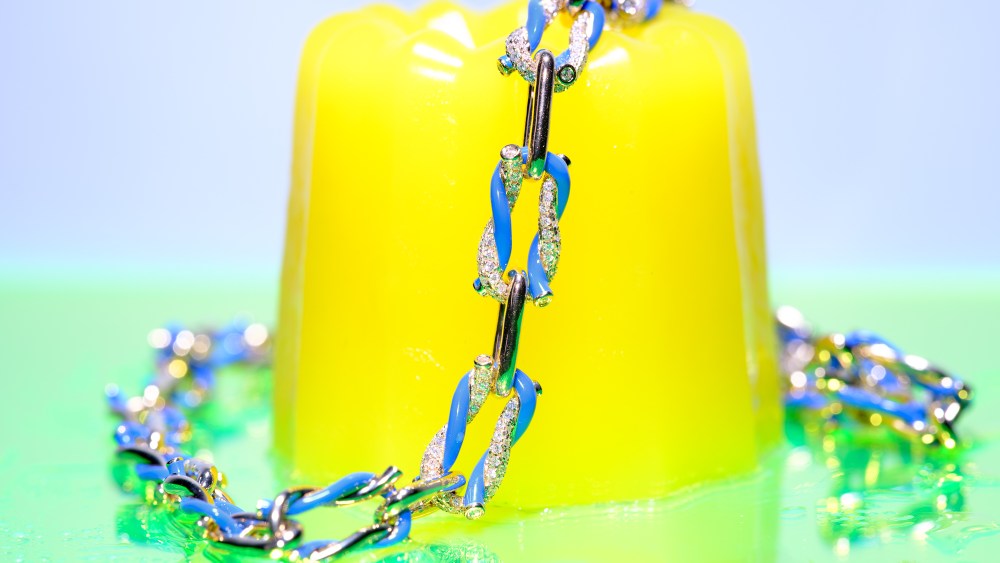
Its poptastic palette nods to her dual heritage as “Chinese and Ghanaian cultures are both extremely colorful cultures,” helping telegraph positivity and zest for life, while 18-karat gold, Akoya and South Sea pearls or diamonds make precious these designs inspired by slinkies, Fruit Loops and ’90s bead necklaces.
Diversity and representation also underpin her vision, but for Zeman, “it’s not about race anymore, it’s about many different things,” including challenging “what a fine jewelry client looks like, which today is essentially anybody.”
Though her designs nod to vintage toys or confectionery, they’re a metaphor for her blended family heritage but also about “the inner strength, that childhood resilience” Zeman wants to celebrate.
“Growing up, it was so easy to see my difference as a weakness [that] left me feeling like I was trying to suppress who I was because I didn’t want to be, look or act different and stick out like a sore thumb,” she confessed.
That’s why she wants to celebrate “all these different ties that come together and weave throughout our lives to make us unique,” which has been materialized as two contrasting metal strands twisted together in the Ties collection.
Likewise the Slinkee range, which owes its name to the supple spring that can perform a number of tricks, including “walking” down stairs. “Its bouncy [shape] nods to our ability to bounce back from everything life throws our way,” Zeman said.