
PARIS — In light of a growing product offering, good old artisanship proved key at accessories salon Premiere Classe, which wrapped its four-day run at Porte de Versailles on Monday.
At neighboring jewelry fair Bijorhca, it was affordability that drove sales up as much as 50 percent.
Premiere Classe saw an influx of new brands this season, up 74 percent from 229 in July 2014, when the last summer edition took place, to 400 this month.
“We were specifically shopping for new designs for our museum expansion and museum store reopening late spring 2016,” said Jana Machin, director of SFMOMA’s Museum Shop.
Machin noted that although there seemed more emphasis at Premiere Classe on accessories and shoes this time, “through the combination of Premiere Classe, Bijorhca and Maison et Objet, there [was] plenty of newness.”
Related Articles
“The Cuboid collection by Shimell and Madden is high on our list for consideration,” she said of the British newcomer duo, which was part of the “Not Just A Label” corner of the fair. Machin added that she was impressed with Shimell and Madden’s clean, geometric lines, textured gold work and Art Deco aesthetic.
You May Also Like
“Another line that we liked was Melissa McArthur. Her designs are simple, feminine and yet contemporary. We especially liked the designs with the large pearls,” Machin revealed.
With the fair moved to September, only a month away from its October edition at the Tuileries gardens, some buyers queried deplored they had no budget left at this point, while others lauded the timing, which for once did not collide with the French sales period, usually set for July.
Visitor numbers shot up 12 percent to 41,198 versus July 2014, driven mostly by France, up 13.5 percent, but also Germany, Spain and Italy.
Jennifer Cuvillier, style director at Le Bon Marché, said the September part of the trade show “is always very important for us as it is the kick-off of the season,” but acknowledged that although the timing didn’t matter to the French department store, “the show was kind of quiet.”
“We didn’t see many international buyers,” which however created “great work conditions and time” to interact with the brands, she noted.
Among the key trends Cuvillier observed a smooth transition of “the winter gypset” trend into the summer. “We liked all the embellishments, embroideries and beading that you could find in all accessories categories, from sandals to scarves, jewels and bags. It’s a very salable and great summer theme.”
Nadia Dhouib of Galeries Lafayette’s accessories and jewelry department cited “bucket bags, tote bags and clutches, printed or with fringes, and with messages” as the most prominent bag trends for next summer. As for jewelry, she singled out bracelets with messages to be worn together in gold, pink, silver and neon, Art Deco designs and fur or feathers on earrings and key rings, listing Bénédicte, Mya Bay, Zubi, Une à Une among new discoveries.
The craftier the workmanship, the more traffic it spurred at the stands.
Dragon, which lends its exquisite leather weaving to such brands as Chanel, Dior and Hermès, was in for a 40-percent plus in sales vis-à-vis last year, thanks to its hand-woven totes, bags and baskets.
“I have the utmost respect for the women who work with us in India,” said founder Craig S. Wright, showing off the artisanal details on its best-selling item — the so-called Bamboo Triple Jump basket, prized at 128 euros, or $143 at wholesale. “We cut the straps, dye their edges, the leather is bonded, waxed and heated — that’s a lot of work to process before the weaving even begins. People see this as a direct contrast to the mass production in China.”
He said it was mostly boutique hotels that have emerged as his customers. “They go after accessories and they buy all year long,” he said.
Experienced manufacturers proposing their own lines was in vogue at both Premiere Classe and Bijorhca. “We’ve been manufacturing shoes for the past 35 years. Having our own product allows us to show off our savoir-faire and expand the company,” explained Charlie Machado, who runs a French-Portuguese shoe manufacturing business in the second generation.
Avellino, the newly founded brand, offered a series of novel constructions such as cork wedges covered with leather in such a way that made them look like a wood, only much lighter.
Machado said buyers like to work with a company like his, because they know he will deliver. “Many brands have been producing in China, especially their second lines, but they can’t do in Asia what we do, and it’s starting to get expensive. We have lately been approached by brands more than usual.”
French shoe start-up Panafrica meanwhile has taken its production to Africa, hoping to revive the continent’s wax textile industry, which it says has been hijacked by the Chinese. “Genuine wax textiles originate on the Ivory Coast and in Ghana, which is where the journey of our shoes start; they come with a unique technique and the patterns are printed on real wax,” explained Vulfran de Richoufftz, who cofounded Panafrica with Hugues Didier.
The sneakers are a truly African product, handmade in Morocco and socially conscious. “With every pair sold, we equip one child for school with pencils, a blackboard and a backpack,“ said de Richoufftz, suggesting that the reason why authentic design has been trending lately, is “that people are no longer buying a product, but the history behind it.”
“There are a lot of new kids on the block. We are looking for higher-end product for Neiman Marcus, and so we appreciated the shoe section this season, which clearly is stronger,” said Pauline Savin of Lambert and Associates. “But in general, we are aiming for Premiere Classe in the Tuileries in October, where we find more interesting product than here,” she said, echoing other participants’ strife with the fairs’ register divide.
“It looks like we are too high-end for this show,” stated Hsuan Pai of Wal & Pai, a newcomer to the fair, whose meticulously worked footwear made in L.A. sporting a clean, minimalist aesthetic done in soft napa or Italian calfskin attracted much attention but remained below expectations in terms of sales. “Not sure if we’re coming back,” she said. “Our shoes retail between $355 and $495. If you count a 30 percent import tax on leather shoes in Japan, for instance, it gets iffy for people.”
“The shoe market is very tough at the moment,” weighed in Patrick Carton, who launched his own brand Un’Chrome, offering a range of styles, done in monochrome designs from the sole to the eyelets, a niche he spotted having worked as a shoe agent for 27 years. “The most successful price segment is between 100 euros and 250 euros retail. And that’s in France. The Germans spend less. If you go too low, you risk competing with the internet and outlets, if you go to high, you are marching into luxury brand territory, which will outspend you on marketing and outshine with their name. There is also more choice than ever.”
Tala Doueihy, senior buyer at ABC in Lebanon, agreed. “Lebanese women spend big on luxury brands — but those with a name. Here, we are looking for medium-priced products, bags and shoes, and we haven’t seen that much in this price category. The new brands here are very fashion-forward, [and so is the price]” she said.
Danish bag company Interzoo came with a whole range of products to meet both high-end and mass market needs. “What’s interesting is that people are buying into the lower-end for women, while high-end works best for men. I think it’s because the men’s market is not as saturated,” explained Jay Tong, the brand’s director, proposing playful Neoprene clutches for women at around $60 retail and masculine, multifunctional hybrids, including sporty-chic canvas backpacks that could be converted into briefcases, selling for $250 to $400.
In both fairs’ jewelry sections, fine fantasy items were in high demand, while the diamond business continued its downward trend.
Sylvain Roy, managing director at Facet Elixir, a diamond specialist with 25 years of market experience, put it like this: “Look at the prize. Diamond jewelry, on average, retails at 1,300 euros. On the mass market, custom jewelry will trade for 50 euros. They are up 40, 50 percent. We will maybe grow 10 percent this year.”
Roy said his company launched its own line Sweet Paris to boost its growth, citing minimalist design, rose gold and open rings as the most salable trends. “The best markets are currently North and South America. In France, fine jewelry lost between 3 and 5 percent this year,” he said.
At Bijorhca, bohemian, gold-plated bracelets adorned with semi-precious stones at Au Fil de Lo generated a 50-percent spike in sales, while BDM’s feline brass collection, including multiband rings and chain earrings, were selling well into the European market. “Affordable pieces set at around 50 euros are indeed our bestsellers,” a representative of the brand told WWD.
Janet Yang, owner of Dazzling in Taiwan also singled out Alcozer & J for their antique-looking jewelry, which is hard to find in her country, she said. “It looks like Bulgari,” she smiled, adding that she preferred the jewelry offering at Bijorhca over Premiere Classe, which she deemed too expensive for what it was. “We pick the high-fashion stuff at showrooms, not here,” she explained.
Visitor numbers at Bijorhca were up 21 percent to 13,447 versus Sept. 2014, driven by international guests, up 38.5 percent, mostly from Asia, the U.S., Canada and the Middle East.
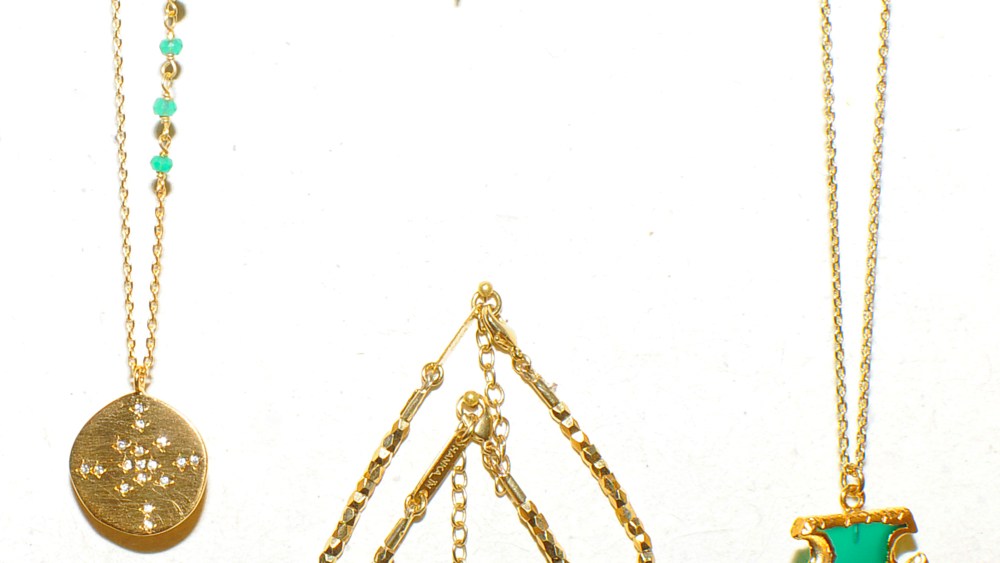
At Premiere Classe jewelry brands also counted among the busiest stands. Paris-based Hanka In had to refuse new accounts, eager to keep the balance between healthy expansion and guarding the exclusivity of its gypset-style product. “We are not accepting more than two points of sales per area,” explained Katia Hasbanian, who founded the brand with her sister Vanessa in 2008, reporting a 30 percent jump in sales vis-à-vis the previous year.
“Our line retails between 60 euros and 300 euros, so it is very popular, but we have no interest in inundating the market. We prefer to keep the quality,” she said.
Among the brand’s bestsellers, which are stocked at United Arrows in Japan and Birdy in Paris, are cascading necklaces, multiple gold-plated chains featuring semi-precious stones such as labradorite, tourmaline and quartz or little medallions mixed with rubies and pearls, which Hasbanian said sell particularly well in the Japanese market.
Les Nereides, a 35-year old fantasy bijoux veteran, meanwhile, was busy expanding its second line N2, with shop openings planned in Paris, Hong Kong and Bangkok before year-end, in addition to new venues added in Sydney and Seoul earlier this year.
The jewelry trend continued into the hat section, as some exhibitors combined both to great commercial success. “In the first year, I sold six hats; the year after: 800,” observed Alice Rafaheral of the young start-up Monstro Diva, which adorns its gypsy-style wool felt hats with old coins from the Kuchi tribe in Afghanistan, and Colombian wrapped yard necklaces.
French hat-maker Big Aristote, which made it into Le Bon Marché, Fenwick and The Corner three years within its launch, collaborated with tribal high-end jeweler Camille Enrico to give its uniquely large-brimmed hats (3.7 inches), all handmade in Andalusia, a bohemian, nomad spin.
“There is a real momentum for hats. We get a lot of interest from Germany and Hong Kong,” enthused Louis Bompard, the brand’s founder, who named each model in his unisex collection after and NBA player. Cue: Z-Bo, Drexler, Sir Charles or Big Aristote.
Big brims, some of which were dipped in gold or silver, were also trending at Mühlbauer, the historical Austrian hat-maker, who opened its second freestanding store in Vienna earlier this year.
“There have been massive structural changes in retail over the past years, especially in our core markets Germany and Italy, where many independent multibrand stores had to close, so we lost a great deal of our business. But we are growing again at about 30 percent per annum,” said Klaus Mühlbauer, who manages the family business in fourth generation.
The milliner is eager to add more flagships to its business model to regain direct control over sales, eyeing Paris and Tokyo as possible locations. “Asia in general is very strong. We have won big customers in China for the first time. While the weak euro is conducive to our business with the U.S.,” he added.