The gap between Pride collections and collections that truly and meaningfully support Pride is wider than it may seem. And for big corporations that might backpedal their commitments when the going gets tough, the lesson is in building support from the core.
That’s what clothing brand JCRT and artist Nayland Blake are doing with a new collaborative collection called ATDM, which launches Wednesday.
With just four styles — two T-shirts and two camp collar shirts — and nearly zero waste thanks to tapping Resonance’s AI-driven no inventory manufacturing platform, the partners plan to raise more than $30,000 for the Transgender Law Center to fight the anti-LGBTQ bills that have been rearing their heads in recent months.
Related Articles
“ATDM is a new brand we’re starting and we sort of rushed it through and we’re launching it through JCRT mainly because we felt so inspired by all the negativity that’s going on and how this minority of people are threatening domestic terrorism, basically, against all these stores and brands, and people are sort of backing down and giving in, which is only emboldening them,” said Robert Tagliapietra, who cofounded and codesigns JCRT alongside Jeffrey Costello. The aim is for 100 percent of profits from the sale of the new collection to go toward supporting the community that has supported them over the years, he said.
You May Also Like
For Blake, an interdisciplinary artist whose work pokes at prejudice against same-sex love, among other things, the current climate called for a collection like this.
“I think what we’re seeing is actually the desperate death throes of the new right in part because they got teed up with a Supreme Court that they felt like they could sort of do something with by the Trump administration. And so what we’ve seen at the state level is all of this legislation that is basically trying to demonize trans and queer people in advance of having to admit that having controlled the White House and Congress, they were unable to do anything,” they said, noting that several recent anti-LGBTQ bills, like the attempted ban on drag in Tennessee that was deemed unconstitutional, haven’t held up in the courts despite earnest efforts from those who support it.
“For us, this project is about not sounding a retreat. It is about mutual support. It is about queer people, creating culture and support and pleasure for each other and as a way of actually raising money to combat this stuff in the courts.”
And clothing, Blake said, can have so much power in supporting the cause.
“A huge place of inspiration in my work is growing up on the streets of New York and seeing the way that various cultures express their connection and joy through fashion at the street level. This is my favorite time of year, summer in New York, because everybody looks so sexy. People get out and I love browsing the stalls that are out on 14th Street and whatever the weird fashion item of the summer is,” they added. “It’s great to be part of that dialogue and for people to be able to see each other. And it’s the thing that’s lovely about things like Pride marches. It’s about visibility. It’s about seeing that you’re not the only person, that you’re not alone, that there are other people that you could potentially connect with. So, clothing to me is all about that.”
In many ways, it makes sense to keep sustainability linked with activism as both are centered on supporting causes to sustain a better future.
With Resonance, JCRT was able to use its tech platform to make the product on demand without the need for the kind of scale that could lead to waste. All fabrics they’ll use for the collection are organic.
“What I’ve seen over the course of the six years that we’ve been working [on JCRT] is that our customer loves this. They love to know the impact that they’re making on the planet with each purchase. They love to understand that the human capital that is working on their clothes is not being mistreated, but they’re actually being treated well and that we’re, through this, transparently showing what the impact of the printing is, what the impact of the dyes are, what the impact on everything is,” Tagliapietra said. “And, on top of that, I think one of the ethos that we’ve really believed in here is just the idea that it’s such a leveling of the playing field, for young brands, for big brands, for everybody because you’re not making wasteful inventory. You’re able to think freely in it and create a new brand like this off of an idea without a lot of capital and a lot of overthinking and, to me, that’s a beautiful thing. It’s much like pure art where you’re just really trying to express what’s going on in the cultural zeitgeist and put it out in the universe.”
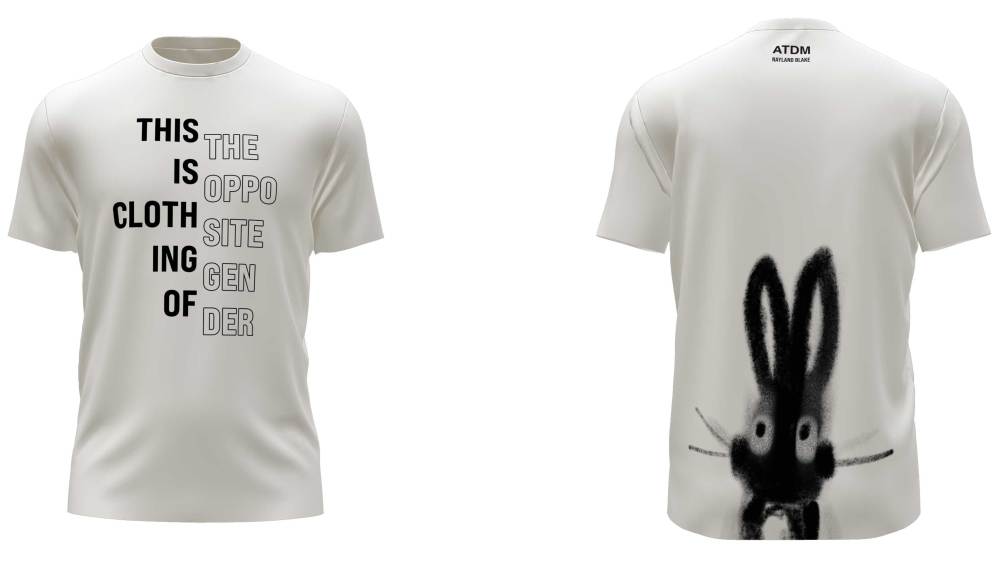
Each piece in the made-to-order collection features a spray paint-effect bunny by Blake and the phrase, “This is clothing of the opposite gender,” a jab at Arizona’s Senate Bill 1026 which, again, targets drag. Some of the language in the bill that wants to ban drag shows targeting minors defines the show as “a show or performance for entertainment at which a single performer or group of performers dress in clothing and makeup opposite of the performer’s or group of performer’s gender at birth.”

The aim, in this world where fashion has become increasingly fluid, according to Blake, is to tackle what it even means to dress in clothing of the opposite gender.
“This idea of gendered clothing is part and parcel of this attempt to deny people bodily autonomy,” they said. “So I wanted to come up with a piece of clothing that directly addresses the absurdity of it, in essence, the shirt says ‘go ahead, arrest me,’ but then you’re going to have to tell me what is the opposite gender that this is clothing of.”
With this collection, JCRT is soft-launching the ATDM brand, a play on the classic museum label — Artist, Title, Date, Medium — which will build on its collaborations with other artists, like Scooter LaForge and Ragged Kingdom. The ATDM and Nayland Blake capsule is available for purchase at Jc-rt.com, with prices ranging from $95 for a T-shirt to $165 for the camp collar shirt.
But bigger than this individual collection is the message its creators want it to send — both to corporations that haven’t gone into Pride with confidence to put their money where their rainbow collections are, and perhaps to smaller brands that want to tackle support authentically.
“The thing that people get confused about with the corporate Pride thing is that actually corporations are the slowest moving, they’re the last to get it. They’re the last ones that come on board with it because they’re the most frightened. The truth is that it’s always the people who are leading it. It’s always the people who have an emotional connection with each other who are leading this,” Blake said. “So it’s like, do I wish Target did better? Yes, I do. But I don’t expect them to do better because I know that they’re a big scared corporation. I can’t sit around and wait for them to do better. I can do what I have power over in the moment.”