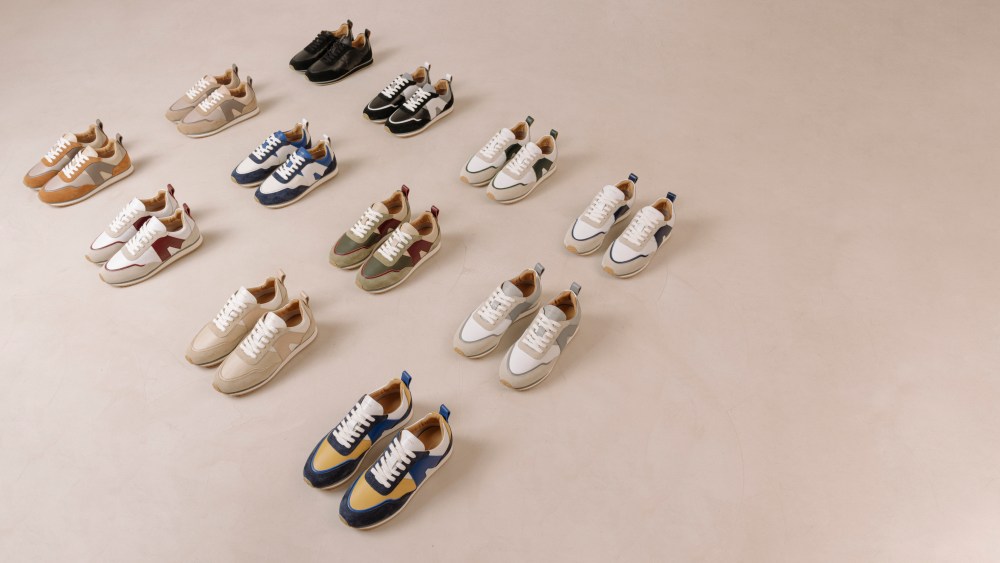
Aloha to Fruit Leather: Barcelona-based footwear brand Alohas’ latest sneaker line may prove to be a fruitful endeavor.
Made, in part, with material innovator Frumat’s apple leather, the material transforms apple waste — typically a minimum of 50 percent apple fiber — from Italian food manufacturers into a high-quality leather alternative. Not an entirely vegan shoe, Alohas latest sneakers still employ Leather Working Group-certified “leather” noted for its low-impact dyeing methods, as with Alohas’ regular footwear lines.
Related Articles
Although some launch details remain elusive, the upcoming sneaker line will come in two signature low-top and high-top Alohas styles in nearly two dozen colorways. Selections span mauve, mustard, tan, navy and more, considering the range of contrasting heel options alone.
You May Also Like
Inside the Bobblehaus House: Bobblehaus, a sustainable, New York-based brand, will open its first flagship on the Lower East Side this week.
The two-story store at 180 Orchard Street, is more than 4,000 square feet and will include the brand’s headquarters, studio, showroom, gallery and event space in addition to the retail component. The store will open to the public on Friday, following the brand’s Puma-sponsored runway show in the space at 6 p.m. on Thursday night. Then, on Friday Bobblehaus will host a “Haus-warming,” starting at 5 p.m. with music and drinks.
Bobblehaus, which was founded by two Chinese Americans, Ophelia Chen and Abi Lierheimer, creates genderless clothing made from deadstock and recycled fabrics. It also focuses on providing experiences intended to engage the local and global communities, both online and in person. It launched in 2020 during the height of the pandemic.

The store’s interior was developed along with Juju Studio and is intended to translate Bobblehaus’ online aesthetic into a physical space. The location features custom furniture and finishing such as tigerwood seating areas that double as storage spaces and bright orange velvet curtains. Curtains are used for privacy in the fitting spaces, and circular fluffy rugs and cushions are used throughout. The space also includes a live 8-foot tree in the center of the seating area, a nod to Bobblehaus’ commitment to plant 10 trees for every item sold.
The space is wheelchair accessible, includes an interactive LED floor with radar technology that tracks physical movement and also includes interactive digital art. Alongside the brand’s fourth collection, Bobblehaus will release a digital art experience created in collaboration with computational artist Chloé Desaulles. In the future, the art on display will evolve with the launch of each collection.
New Regenerative Pastures: Merino wool brand Nativa announced a new regenerative program “Nativa Regen” Tuesday, which will expand access to regenerative farming in the U.S.
“We are thrilled to expand our Nativa Regen program to the U.S. in partnership with Shaniko Wool Company as part of our global commitment to innovation and sustainability,” said Federico Paullier, chief executive officer of Chargeurs Luxury Fibers, the parent company to Nativa. “We look forward to welcoming U.S.-based farmers and brands to the program and supporting them as they transition to regenerative practices that improve soil and water quality while promoting an overall healthier habitat that restores natural biodiversity at the farm level.”
Chargeurs manages both the sourcing and initial processing of the certified Nativa wool. Under the program, farmers benefit from blockchain-backed transparency and customers — including brand partners Madewell and Reformation — benefit from the assurance of the Nativa-Responsible Wool Standard (RWS) certification. The first-of-its-kind joint certification provides record of the garment back to the farm it came from.
Scientific studies of regenerative agriculture show improved soil, biodiversity and reduced carbon impact compared to conventional farming. An Oregon-based company, Shaniko Wool Co. oversees nine regenerative farms across four states and was the first U.S. wool producer to receive Textile Exchange’s RWS certification.