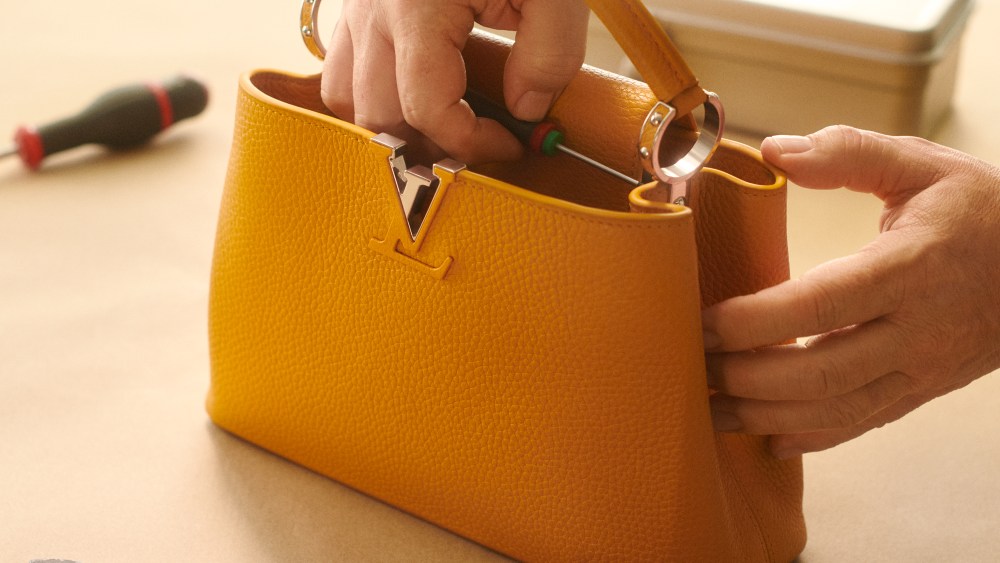
There is a very right and wrong way to perform repair in the world of luxury depending on who you ask. Though as old as time, the storied (and highly skilled) art of repair is seeing disruption as interest in clothing and accessory care rises.
As with resale, alterations is a billion-dollar game. The average American family spent roughly $1,700 on clothes in 2021, according to the Bureau of Labor Statistics, or some $140 a month (despite other reports signaling much higher). For clothing, tailoring fees can cost anywhere from $30 to $200 and up but can stretch the lives of garments considerably.
Related Articles
If repair wasn’t already in the brand’s playbook, it is today and here’s why.
You May Also Like
What the Luxury Brands Say
Despite the rise of resale, luxury brands are apt to keep things in-house when they can, in a nod to tradition.
For Mulberry, there’s a raison d’être behind its own repair program.
“As we outlined in our Made to Last manifesto, Mulberry believes that our responsibility and our business doesn’t end when a customer leaves our store,” a spokesperson for the British fashion company best known for its luxury leather goods, told WWD. “We know that many of the bags we made 50 years ago are still going strong today, and we believe those we make today should be doing the same for the next 50 years. This attitude is fundamental in our approach to undertaking each repair with the upmost care and attention to detail so our bags can one day be passed on, ready for another lifetime of use.”
Mulberry performs some 10,000 repairs a year at The Rookery, one of its two Somerset factories where the brand still makes 50 percent of its bags. Typically completed between five to 16 weeks, Mulberry’s repairs are performed by its lifetime service center experts at no extra cost within a year if the bag is purchased new (or six months from Mulberry’s pre-loved offering). Outside of those windows, repairs can cost anywhere from 45 pounds for hardware replacement to 250 pounds on any of Mulberry’s leather goods.
As for ultra-vintage Mulberry finds?
“Customers are recommended to send their Mulberry bags in for a bespoke assessment — our craftspeople are always ready for a challenge,” the spokesperson said.
Likewise, be it a vintage product or new — Louis Vuitton maintains a quiet confidence in taking ownership of its repairs (and not having the service outsourced) since brand beginnings in 1854. Boasting 11 repair centers around the world and 1,200 professional repairers, the luxury maison is of course able to use correct material and metallics for original products. Louis Vuitton says it does repairs on 500,000 bags per year, and touts the existence of its repair e-service in the U.S. — where customers can request repair appointments online and video chat with an expert — as part of its ongoing sustainability journey.
Louis Vuitton did not provide exact pricing or repair timelines as it depends on the situation, complexity and client needs. Certain small repairs can be done immediately in store, free of charge, while others require more considerable attention, like the complete restoration of historic trunks.
Though a timeless necessity, the business of repairs — and everyday alterations — is still undergoing disruption.

What Tech Start-ups Say
Today, the tech addition is where alterations get altered for the modern user. While luxury says, “I know what’s best for you,” the tech start-up might say: “You get it your way,” and there’s an app for that.
So far, there’s The Restory in London, which is scoring venture capital and retailer buy-in. Another London-based company Sojo — founded by Depop alum and twenty-something entrepreneur Josephine Phillips — is also edging in on the space albeit with more mainstream, everyday clothing alteration. Sojo runs a network of seamsters and bicycle couriers across London and partners with brands like Ganni today. Stateside, two-year-old mobile clothing alterations start-up Alternew is peddling forth more mainstream access to clothing repair in New York City. The company was founded by former footwear designer Nancy Rhodes.
Where it gets complicated is in the realm of luxury handbags.
The Restory aims to work like a “foundation-matching app” but for repairs, using its proprietary tech stack to funnel production and damage data to the right specialist and into a tailored quote for the client. Though an earlier version existed, it was rebranded in 2018 by founder and chief executive officer Vanessa Jacobs. To date, the company has raised $4.5 million pounds to go toward its expansion and brand business.
On the business-to-business side, The Restory counts partnerships with Selfridge’s, Manolo Blahnik and Farfetch, doing things like leather aftercare and clothing services including cleaning, maintenance repairs, replacements and bespoke tailoring. Jacobs said the services are more streamlined today and competitive in the market as far as price and time. Many repairs can be completed in an hour but standard repairs are under two weeks and advanced repairs may take as much as six weeks.
The Restory will follow brand guidelines and repair protocols in the case of its budding branded partnerships business but the creativity happens in the bespoke work.
On the direct-to-consumer side, the company is doing repairs the brands would never do themselves. For one client, a dog chewed through a Louis Vuitton rolling suitcase, which typically costs $2,940 and up. Though The Restory will do color restorations (dyeing loafers black for instance), hand-stitching and more, the team ended up painting the client’s dog’s guilty portrait onto the bag to disguise the bite marks.
“We repaired it, but we couldn’t quite ‘do,’ well — we didn’t have the monogram. So what we did is she gave us a picture of her dog, and we painted the dog onto the bag and made something quite unique for her,” shared Jacobs. Louis Vuitton did not comment on this job.
As for how luxury companies are thinking of repair, Jacobs said: “At the higher end of the luxury spectrum, they have offered this for a while as a small-scale, unloved side operation in the corner.
“I think that’s all shifting with the awareness of sustainability, the pressure to be more circular,” she added. “They’re under enormous pressure not only from consumers but also from regulators and from investors as well to make sure they’re addressing these things in a non-greenwashing way.”
How to Be ‘Brand Compliant’
Doing right by the brand is a foremost thought for some businesses.
For Jessica Henderson, senior curator at Fashionphile (who has been with the company 11 years, and as director of authentication for more than half that time), a regular repair is worlds different from a luxury repair. Fashionphile does minor repairs or cosmetic cleanings, and the company’s term for getting repairs right is “brand compliant.” Anything that takes away from the authenticity of the brand — which can be anything from an incorrectly folded strap, dye job, spot treatment, wrong screws, finish or hardware — is out of compliance and not something Fashionphile messes with.
Henderson gives credit where it’s due to the brand originators of the styles. “[Others] don’t really understand the nuances in materials and construction that the brands have.
“If you are repairing for your own use, luxury is using the highest standards. Chanel used to use real 24-karat gold in the alloy. They stopped doing that in 2009,” she added. “They won’t dye a bag a color other than it was originally, they won’t alter a bag other than it was.”
(Chanel declined comment for this story).
“Brands will not touch it if it’s been altered,” Henderson insisted, and many luxury repair programs require a proof of purchase to utilize free services. In some cases, authentic items have been rejected by brands because there was no receipt or because an alteration had been done. “What they’re meaning is there’s [an alteration] on there that happened. Chanel and Hermès [reject bags] a lot, but they’re doing it for a reason. The products that regular repair centers use are not the same as luxury repair centers,” said Henderson. “Gatekeeping is really a good word. [The brands are] trying to keep it in the house. They’ve been open about not liking the resale service.” As with repair, resale is a recent circular economy unlock in fashion and subject to droves of capital investment.
“Customers are expecting more out of brands now. Not just to buy a Chanel for the name itself. How are you going to ensure this item won’t end up in a landfill?,” Henderson posed. She quoted Fashionphile’s 2021 ultra-luxury resale report with researcher Kantar. “For luxury handbag shoppers, 92 percent [of customers] agree it’s important to buy accessories that will last a long time.”
“We don’t want to do any major alterations,” she said. “Treating and conditioning a bag if it needs it” and “getting it ready for its new home.” There’s no charge (and customers don’t have to ask) for basic in-house services, which include removing forgotten items like cash, crumbs or makeup smears.
For everyday wearers, Henderson does have some tips.
“Condition leathers properly and understand the materials. How to store them is very important,” she said, adding that there are certain no-no’s; don’t lay the chain directly on the lambskin, don’t overstuff your bags, shield them from humidity and never dye them.
Fashionphile is planning to offer more repair services down the road. The company also admitted to outsourcing some work — to 30-year veteran leather craftsman Gerry Gallagher. According to Henderson, he did repairs for Chanel for years, even the gold restoration. Per his business website “Leather Surgeons,” Gallagher has performed repairs and authentications on more than 250,000 Chanel handbags, as well as museum-worthy restorations for the Museum of Natural History. Though Gallagher used to be based in the Garment District, he is now based in Philadelphia and is training his sons to preserve the art and craft of luxury repair.
Few get to be as trusted, and Gallagher has a few words on the matter.
“At the end of the day, you just need to walk the walk and put the customer’s interests first,” he said. “That’s led us to do things that have cost us a lot of money in the short term, but I think it’s the reason I’ve ended up in the position I’m in. I spend hours every day on the phone with customers, we write letters to help people get their money back if they’ve bought a counterfeit bag, we talk customers out of repairs that we don’t think would be in their interest — God knows how many free restorations we’ve done. You just have to look at your little corner of the world and try to be the person it needs, as best you can. If you do that year after year, you’ll earn people’s trust.”
He also maintains a stance to “preserve and restore handbags as best I can to what they originally were.” Not that Gallagher condemns drastic changes (but he’d personally never do anything like dye or embellish a designer bag). He, too, abides by what he calls “brand etiquette.”
“You can have a piece of fashion history and, if you take care of it and understand the right way to restore it, it can still be here when you are gone,” he said. To that he surmised, “The best restoration is the one you don’t notice.”