
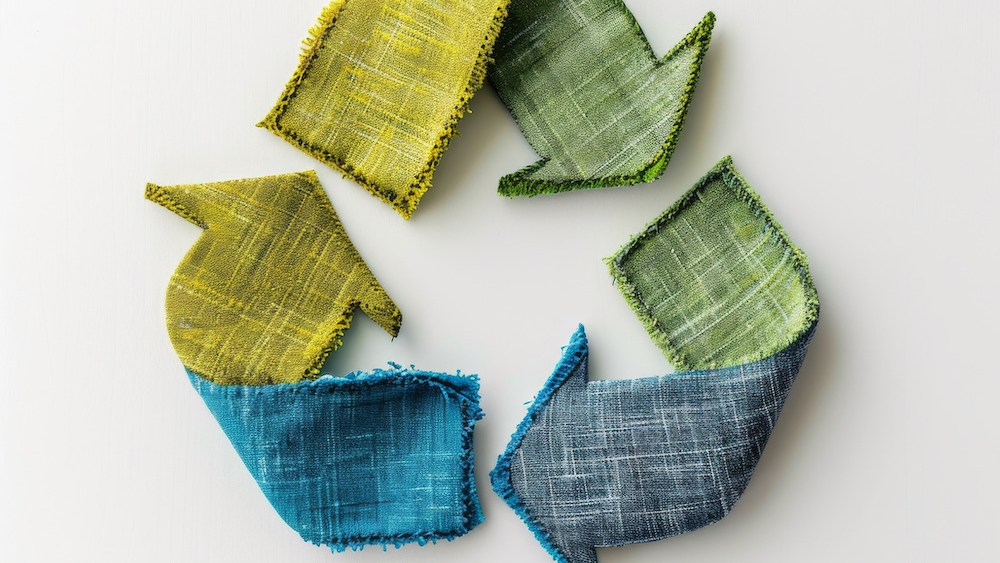
Looming European Green Deal regulations to reduce net greenhouse gas emissions by at least 55 percent by 2030 have fiber suppliers, mills, brands and retailers alike scrambling to meet protocols. Here, Simon Whitmarsh-Knight, Hyosung’s global sustainability director – textiles, explains how Hyosung’s broad portfolio of 100 percent recycled, BIO and circular sustainable textile solutions is well-positioned to help partners meet their impact goals.
Fairchild Studio: What were some industry firsts along Hyosung’s sustainable textile solutions journey?
Related Articles
Simon Whitmarsh-Knight: Hyosung has always been ahead of the curve, offering new possibilities long before they become the norm, and our path to sustainability goes back 17 years. Hyosung was the first company in the world to develop recycled nylon from raw materials recovered from discarded fishing nets in 2007 and the first company in South Korea to produce GRS-certified 100 percent recycled polyester from PET bottles in 2008. Hyosung was also the first to launch RCS-certified, 100 percent recycled regen Spandex made with the reclaimed waste from our spandex production in 2020. To expand beyond recycled products, we were the first company to produce at scale, our USDA- and SGS-certified regen BIO Spandex partly made from renewable resources in 2021. This year, we expanded our regen BIO Spandex program to include yarn offerings of higher renewable resource content, plus began developing a textile-to-textile recycling program to address circularity.
Fairchild Studio: What is the update on Hyosung’s new regen Bio BDO collaboration with Geno?
S.W.K.: We have already started work on a new 50,000-ton Bio-BDO (Butanediol) facility at our Vietnam facility, with plans to expand to 200,000 tons annually. This will utilize Geno’s proven plant-based Geno™ BDO™ technology, which ferments sugars derived from sugarcane to replace the fossil raw materials. It will be the world’s first vertically integrated spandex manufacturing plant from raw material to fiber. Through this vertical integration to produce regen™ BIO Spandex, our goal is to increase production efficiency, provide faster response to our customer needs, and integrate value chains to significantly reduce carbon footprint.
Fairchild Studio: How will the new regen BIO Spandex made with sugarcane be different from your existing regen BIO Spandex offering?
S.W.K.: Hyosung’s current regen BIO Spandex offering is made with various percentages of renewable resources that come from industrial corn; our regen BIO Spandex from our Vietnam facility will be made with renewable resources derived from sugarcane. The sugarcane supply will be via fully traceable, recognized platforms as we are investigating robust industry-leading supply chain platforms and certification schemes. Significant reductions in carbon emissions and water use will be provided via 3rd party LCA when our BIO BDO plant is in full operation.
Notably, our regen BIO Spandex fibers have the same performance as conventional spandex in terms of powerful stretch, recovery, shape-retention and durability.
Fairchild Studio: Tell us about Hyosung’s textile-to-textile program.
S.W.K.: The industry needs to collaborate to achieve circular business models. Hyosung has a clear strategy across three areas—develop new recyclable fibers, invest in start-ups working on recycling technologies and team up with partners to help scale up selected solutions. For this third strategy, one of the partners we teamed up with is Los Angeles-based leading material science company Ambercycle to become the first manufacturer in South Korea to introduce a textile-to-textile, circular polyester into supply chains. This repurposes end-of-life products into high-performing fibers for brands looking to curb their environmental impact.
Fairchild Studio: What question do your customers ask you the most?
S.W.K.: I’d say: ‘How can you help us reach our unique sustainability impact objectives and provide accurate and trustworthy data to measure this impact?’ As a fiber innovator, the road to sustainability often starts with us. So, we must keep innovating for the future to predict and meet our supply chain needs. We also need to continually provide them with trusted certifications and independent LCA documentation, not to mention the necessary educational tools to help them share their unique journey to sustainability. Regulations, digitalization and recycling are top of everyone’s mind!
Fairchild Studio: Is there one sustainable solution over another that fashion brands tend to be leaning towards?
S.W.K.: Sustainable strategies vary widely among fashion brands. For example, some customers have been committed to using recycled materials for a significant time and are now looking to expand their fabric offerings to include materials made from renewable resources. On the other hand, there are fashion and retail customers who prefer 100 percent recycled materials and are not yet ready to explore fabrics made from bio-based fibers. Nevertheless, through communication and education about new sustainable technologies, we have observed an increased willingness among brands and retailers to incorporate these options into their product lines.
Fairchild Studio: Can you give an example of some of recent brand adoptions?
S.W.K.: Pangaia, who was the first brand adopter of our regen bio-based spandex partly made with renewable resources, is switching this fabric to our new regen BIO Max spandex made with a much higher content of renewable resources. Additional regen BIO brand adoptions include Van Harvey, Icebreaker, Silver Sea and more. Vitamin A has also adopted programs with our GRS-certified regen Ocean Nylon made from discarded fishing nets. There will be more to announce in early 2025!
Fairchild Studio: How is Hyosung helping to anticipate customers’ concerns around sustainability regulations?
S.W.K.: We understand that achieving the 2050 net zero greenhouse emissions target requires a collective effort across the industry to develop effective solutions. To this end, Hyosung is actively partnering with industry leaders such as Geno, utilizing its BDO™ technology, and more recently with Ambercycle in the development of circular business models. Our collaborations with Textile Exchange and Cascale have also given us valuable insights that we can share with our customers to support them on their sustainability journey.
Fairchild Studio: What trade shows will Hyosung TNC be attending to share more about its sustainable textile solutions?
S.W.K.: In Q4, we’ll be showcasing key sustainability solutions at several major events, including Performance Days Munich, the Textile Exchange Conference in California, Kingpins Amsterdam, the Functional Fabric Fair in Portland, the Future Fabrics Expo in NYC and ISPO Munich. A highlight at the Textile Exchange Conference will be Hyosung’s presentation of pioneering bio-spandex innovations, along with several collaborative projects with Ambercycle focused on advancing textile-to-textile recycling initiatives.
To learn more about Hyosung circular textile solutions, please visit www.hyosungtextile.com/en.