While countries across the globe are facing hardships due to the double-digit duties imposed by the Trump administration, they’ve been particularly detrimental to the American fashion industry’s leading China alternatives.
According to new data from the United Nations Development Programme (UNDP), shocks caused by tariffs are pummeling Southeast and East Asia with ferocity, rivaled narrowly in impact by South Asia and the Pacific.
The group’s data, released last week, showed that Cambodia’s exports to the U.S. could fall by 24 percent, Vietnam and Fiji by more than 19 percent, and Sri Lanka by about 15 percent.
Related Stories
Vietnam, America’s premier footwear supplier outside of China, could see one-fifth of its export volume evaporate because of the 20 percent tariffs it now faces. While that rate is less than half of the 46 percent President Donald Trump originally threatened earlier this spring, the country (which was the No. 6 exporter to the U.S. last year with volumes of goods worth $136.5 billion flowing through ports of entry) now stands to see its exports fall over time by over $25 billion.
Its own export data showed that exports fell 2 percent month-over-month in August, with shoes alone seeing a 5.5 percent decrease. Vietnam produces products for Nike, Adidas, Timberland, Puma, Skechers, Dr. Martens and dozens of other household name brands, and is the second largest footwear supplier in the world.
According to the UNDP, the potential hit to one-fifth of Vietnam’s export business is almost twice as high as the 9.7 percent average decrease being felt across other Southeast Asian production hubs. “Exporters are adjusting, but resilience depends on market exposure and product mix,” analysts wrote.
And while the longtime target of the president’s ire—China—also faces new tariffs, they currently stand at just 10 percent while officials from Beijing and Washington work toward a long-term bilateral trade agreement. That pause on much higher 30 percent duties expires Nov. 10, and there are signs that it has given China time to adapt its strategy, allowing for export growth rather than the dwindling exports its neighbors have faced.
Between April and August, China’s exports grew 5.9 percent from the same period the year prior, with a 25 percent fall in exports to the U.S. worth $57 billion offset by 11 percent gains in exports across the rest of the world, amounting to $146 billion in new business.
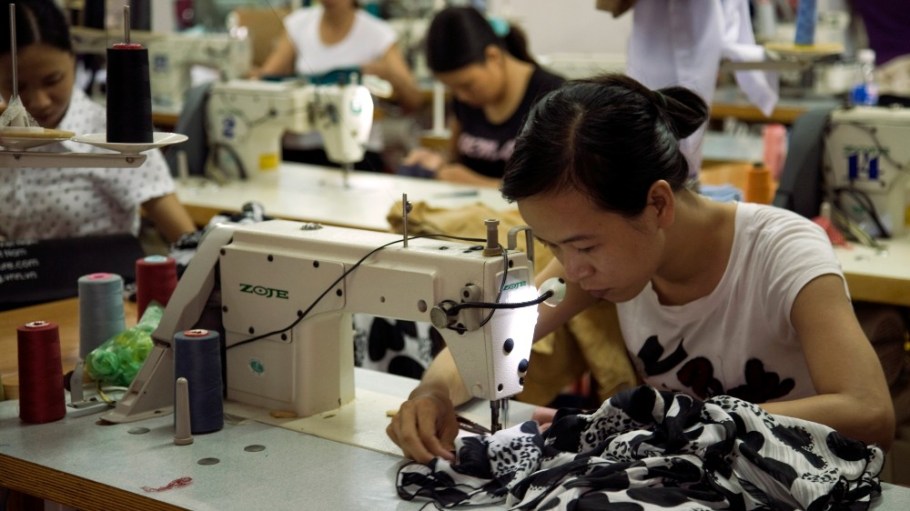
Cambodia’s losses stand to be great, too, due to its dependence on the U.S. as an export market, though they pale in comparison to Vietnam in value and volume. As one of the most vulnerable nations to Trump’s tariff regime, the Southeast Asian nation could see its overall exports to the U.S. tumble 23.9 percent. Last year, Cambodia exported $2.79 billion in apparel to the U.S., and $933.8 million in footwear.
When considering that 58 percent of the country’s exports are destined for American shores, the country’s exposure to tariff impacts is substantial. “In effect, Cambodia could lose more than half of its U.S.-oriented exports, translating into a contraction of over one-third of its total export sector,” the UNDP report said. “Such a shock is deeply consequential for an economy so dependent on trade.”
The social toll to the Asia-Pacific region could be “severe,” it added, as only 54 percent of its people have social protections, and 1.3 billion are employed informally, meaning there’s no safety net should they lose their jobs. UNDP wrote that the small enterprises that make up many export-led sectors are often “the first to fall” in the event of trade shakeups, like an aggressive new tariff policy from a primary export market.
More than 60 percent of the countries in the region are seeing stagnation or backsliding when it comes to social progress, and the tariffs could drive that number down to new lows. For example, last week, the Cambodian government approved a new minimum wage significantly lower than the nation’s nearly 1 million garment, footwear, textile and travel goods workers were demanding.
“The global economy is entering a new chapter of rising protectionism, shifting trade alliances, and deepening uncertainty,” said Kanni Wignaraja, UN Assistant Secretary-General and UNDP Regional Director for Asia and the Pacific. “For Asia-Pacific, one of the most trade-dependent regions, this turbulence is seismic. It is also a moment of choice for economic and social reform.”