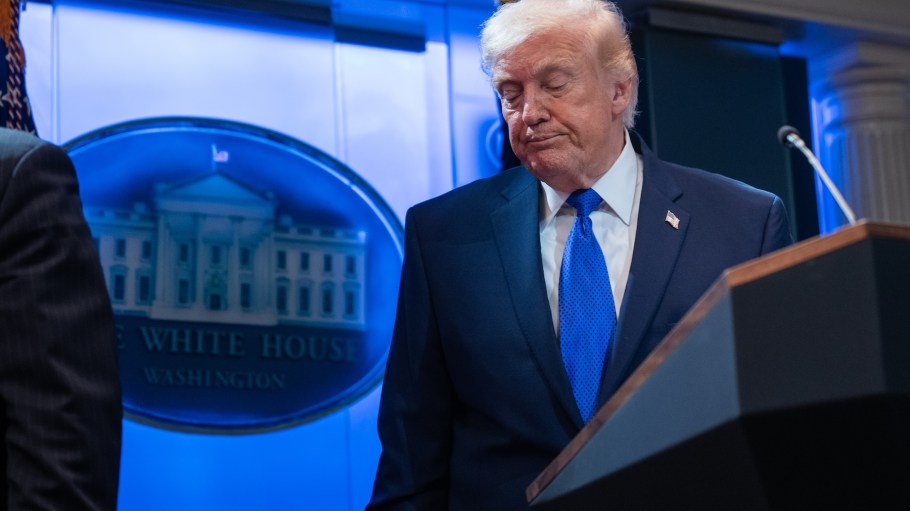
President Donald Trump on Friday sharply criticized a U.S. Supreme Court ruling limiting his use of emergency tariff powers, praised three justices who dissented, and announced plans to move ahead immediately with new across-the-board tariffs under a different legal authority.
Trump said he will impose a 10 percent tariff on all imports under Section 122—signaling that he intends to press forward with sweeping trade penalties even as businesses warn of economic disruption.
Section 122 of the 1974 Trade Act allows the president to temporarily impose tariffs of up to 15 percent for 150 days to address balance-of-payments issues; Trump is using it to apply a 10 percent tariff across the board while his administration evaluates more targeted trade actions under Section 301.
Related Stories
Calling the decision “deeply disappointing,” Trump said he was “ashamed of certain members of the court” for “not having the courage to do what’s right for our country.”
He singled out Clarence Thomas, Samuel Alito and Brett Kavanaugh for what he described as their “strength and wisdom,” adding that “foreign countries that have been ripping us off for years are ecstatic… they’re… dancing in the streets.”
He said the ruling would not slow his trade agenda, arguing that the decision effectively clarified alternative authorities for imposing tariffs. “To the contrary, the Supreme Court did not overrule tariffs,” Trump said. “They merely overruled a particular use of IEEPA.”
Trump said he will sign an executive order imposing a 10 percent global tariff on all goods entering the United States and suggested it would take effect within days.
“We’re going straight ahead with 10 percent straight across the board,” he said, describing the move as an immediate step while the administration conducts investigations that could lead to additional tariffs.
Administration officials said Section 301 investigations are being initiated and could result in more targeted tariffs. Trump also said existing tariffs imposed under other authorities, including Section 232 national security tariffs and current Section 301 tariffs, will remain in effect.
While Section 232 gives the president the authority to impose higher tariffs on national security grounds, Congress defined Section 301 as what allows the president to impose tariffs or other restrictions against foreign countries that “engage in unjustifiable, unreasonable, or discriminatory trade practices that burden U.S. commerce.”
Section 301 also empowers the U.S. Trade Representative (USTR), at the direction of the President, to take all appropriate action—including tariffs and quotas—against foreign trade practices deemed unjustifiable, unreasonable or discriminatory. It acts as a tool to counter unfair foreign actions that burden U.S. commerce; its use was seriously diminished after the World Trade Organization (WTO) was established in 1995.
That said, the Trump administration heavily used Section 301 to target Chinese imports in March 2018, after the president alleged that Beijing was using “sharp-elbowed” tactics to undermine U.S. technological leadership.
Trump did not provide details on how the new global tariff would interact with existing trade agreements, nor did he clarify whether foreign governments may seek renegotiations.
He declined to explain how potential refunds would be handled for companies that paid tariffs under IEEPA. When asked about roughly $175 billion in tariff revenue that could be affected by the ruling, he said the court’s opinion did not address the issue, calling it a “very fair question.” He suggested the matter could face years of litigation.