The United Kingdom is once again in President Donald Trump’s tariff crosshairs.
Speaking to reporters at the Oval Office on Thursday, the president said he planned to hit the U.K. with harsh duties if it fails to walk back its digital services tax, which targets tech companies like Meta, Alphabet, Amazon and Apple with a 2 percent duty on revenue generated by their products within the country.
Introduced six years ago, the tax applies to the social media platforms, search engines, online marketplaces and other online applications utilized widely by consumers across the globe that generate global revenues of 500 million pounds ($673 million) per year. Under the law, 25 million pounds of that revenue must be made in the U.K.
Related Stories
In Trump’s view, the law disproportionately targets American companies, as some of the world’s most successful firms are Silicon Valley stalwarts. He accused the British government of taking cheap shots at U.S. tech firms, and he said the actions could have consequences in the form of new duties.
“They think they’re going to make an easy buck. That’s where they’ve taken advantage of our country,” Trump said. “We’ve been looking at it, and we can meet that very easily by just putting a big tariff on the U.K.”
The digital services tax generated about 800 million pounds ($1.08 billion) in revenue for the country’s government in fiscal 2024-2025 and about 944 million pounds ($1.27 billion in fiscal 2025-2026). Tax Justice U.K. estimated that the levy would rake in between 4.4 billion pounds ($5.9 billion) and 5.2 billion pounds ($7 billion) between 2024 and 2029.
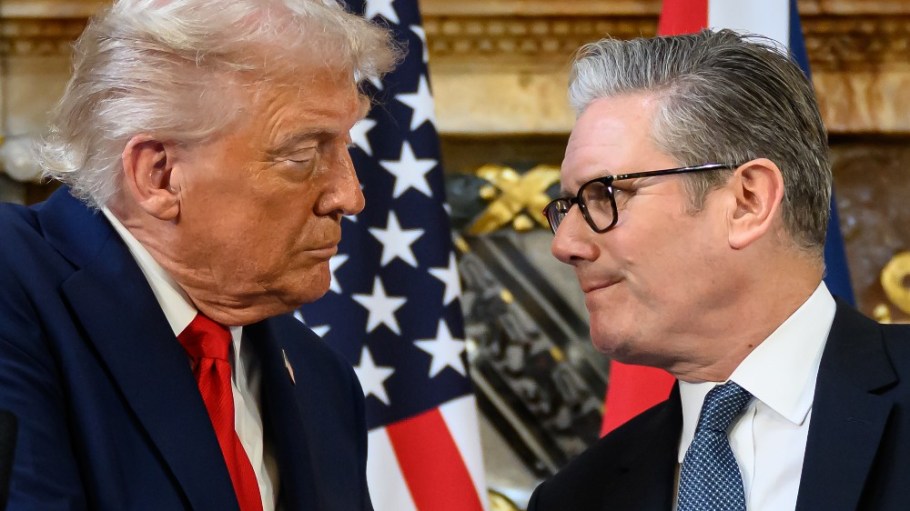
On Friday, U.K. Prime Minister Keir Starmer’s office responded to Trump’s threat, saying, “Our position on that is unchanged. It is a hugely important tax to make sure that those businesses continue to pay their share. So it is a fair and proportionate approach to taxing business activities in the U.K.”
On Thursday, Trump indicated that he could use tariffs to generate revenue for the U.S. federal government worth “more than what they’re getting” from the digital services tax. “What we’ll do is we’ll reciprocate by putting something on that’s equal or greater than what they’re doing,” he said. France, Italy and Spain also have digital services tax programs and have seen similar threats of retaliation from the president in recent months.
Notably, the U.K. government had agreed to phase out the tax in 2021 with the goal of replacing it in 2024 with a different global statute following the Organisation for Economic Cooperation and Development (OECD) brokering a pact between 140 countries. Under that agreement, large, multinational firms would pay a minimum 15 percent corporate tax rate in the countries they do business in, but the rollout has been stymied by concerns from multiple nations.
The digital services tax has been a particular point of contention between the U.S. and the U.K. for some time, and was a topic of major discussion during trade negotiations last year. However, the tax remained intact even as the two countries announced a trade deal in May of 2025.
Earlier this month, Trump suggested that the deal “can always be changed.” Tensions have ratcheted up between the two trading partners, with Starmer’s government indicating that the country does not intend to get involved in the war in Iran being waged by the U.S. and Israel. The U.K. will not take offensive actions in the context of the conflict, and will take a “defensive-only” stance as it works with allies to urge deescalation, it has said.
According to a report from Reuters on Friday, an internal Pentagon email reveals a plan to punish NATO allies that don’t support the U.S. war effort. One of the concepts discussed was revoking U.S. support for the U.K.’s claim to the Falkland Islands in the South Atlantic, along with suspending Spain from NATO.
Meanwhile, King Charles III and Queen Camilla are slated to visit Washington next week as part of the celebration of the 250th anniversary of America’s independence. Asked whether he believes the visit could help alleviate some of the tensions between the nations, Trump said, “Absolutely, the answer is yes.”