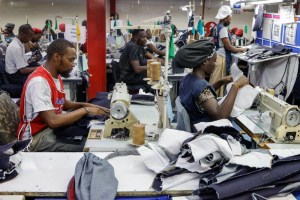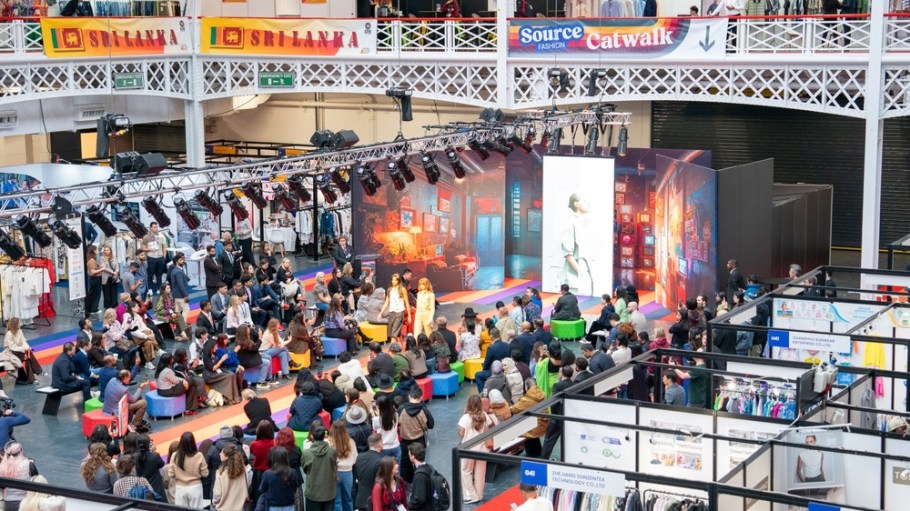
At the “Merch Shop” inside Source Fashion in London last week, attendees cranked out pinback buttons and heat-pressed graphics on tote bags.
Nearby, buyers from British retailers such as Asos, Barbour, Next and Marks & Spencer, tried their hand at spinning cashmere roving into yarn or learned how to sew on a ruffle made from scrap fabric. Others watched a “live” denim repair and learned how factors such as construction and fiber choice can influence the longevity of a pair of jeans.
Related Stories
The hands-on activations offered a bit of nostalgic relief that was sorely needed. As the global sourcing community continues to reel from a year of trade disruptions fueled by geopolitical tensions and the Trump administration’s changing tariff policies, many of the trade show’s participants have been on edge.
But for three days, the dream of a pre-digital world filled with cassette tapes and Polaroids was alive and well at the Olympia’s teeming exhibition hall in West Kensington, where Hyve Group, one of the world’s largest trade show organizers, brought together 250 exhibitors from 20 countries for the sixth edition of its responsible sourcing tentpole.
While official figures are not yet available, the show estimates a 16 percent increase over the already-record 3,200-plus visitors it recorded last July. Suzanne Ellingham, Source Fashion’s event director, credits much of the increase in attendance to word of mouth.
“Where we’re seeing real growth is people who come with one person and now come in with their teams,” she said. “We’re also seeing growth in non-retailers, so people who are looking for licensing merchandise, things for their own use, sports teams and premiership football clubs. So, although it’s called Source Fashion, this is honestly a show where anyone who needs to manufacture clothing can find what they need from a reputable business.”
Source Fashion launched in 2023 to fulfill a demand other shows weren’t meeting: showcasing a broad range of suppliers already vetted for their sustainable credentials, including at least one up-to-date certification. The creative theme of the biannual event’s latest iteration, “Analog Futures,” was also born out of necessity.
“When we look at the impact of technology and how it can change things, I don’t think anybody’s asking the question of, ‘Is it changing for the better?’” she said. “It’s fantastic that it can give transparency and accountability to brands and retailers as to what’s in their supply chain, but I also think we’re losing a lot of trust with consumers over what they’re buying. I think we need to consider how we advertise and communicate to them.”

What is needed, Ellingham said, is a vibe shift. The ‘80s generation, she said, had deposit return schemes for cans and bottles. People paid more for their clothes, spent time tailoring them and made them last longer.
“I think there’s something in that that we can learn from,” she added. “We’re sitting here 40 years later, and we are now going back to a stage where we want consumers to behave like that. Fashion has become cheap. It’s become easy, it’s become disposable and people don’t value it. Let’s go back to where fashion costs something.”
If the throwback palette of gold, burgundy and plum didn’t signal a desire to revert to form, the soundtrack of ‘80s hits like “I Think We’re Alone Now” by Tiffany, “Radio Ga Ga” by Queen and “Never Gonna Give You Up” by Rick Astley surely did. The name of the canteen area just off the rainbow-striped catwalk where models paced up and down three times a day and panel discussions rotated with fireside chats? Rewind Café.
All of this is part of a broader rebrand that is leaning heavily on the retro aesthetic, Ellingham said. It’s something that reflects Source Fashion’s commitment to community, including promoting the deeper interpersonal connections that make the fashion industry “more human” and “more real.”
“I think people have lost touch with how things are made,” she said, referring to the inaugural “Fashion Deconstructed” area of the show, where classroom-style workshops and demonstrations have been taking place. “There is a massive knowledge and talent drain within the buying community. Buyers used to have really in-depth knowledge of how clothes were made, what good construction looked like and what quality looked like. They spent a lot more time going to their manufacturers. So we thought, why not build a feature where we can show them what goes into denim, what weaving is and how materials are made?”
Again, it’s about humanizing fashion,” Ellingham said, adding that she plans to expand the program in July. For her, Source Fashion isn’t just a place to drum up orders, even though plenty of exhibitors from tariff-hit China and India were eager to replace orders from U.S. customers they’ve lost. It’s also a platform to advocate for a better industry, particularly in the United Kingdom.
“It’s estimated that there are fewer than 400 British manufacturers left in the U.K. that employ more than 20 people,” she said. “And the reality is, when we ask ourselves, why is this industry so distressed, it’s because fashion has become cheap and people have moved their production offshore.”
Ellingham flipped a label on her sweater that said, “Designed in the U.K.” Beneath it was a second, smaller label that read, “Made in China.” She’s planning an initiative to get British retailers to source 5 percent of what they sell domestically from the United Kingdom.
“It would create thousands of jobs, and it would transform our industry,” she said. “If a retailer can’t afford to bring 5 percent of their production back to the U.K., they really need to look at what they’re prioritizing in terms of how they’re doing their ranges.”
Making its debut was the U.K. pavilion, part of a program that offers 15 free booths to British manufacturers over the next three shows. Source Fashion has always hosted its countrymen, but their presence has been sparse and “spread out,” Ellingham said. Exhibitors from China make up about 30 percent of the expo floor, while those from India comprise another 10 percent.
The remaining proportion spans other manufacturing hubs such as Bangladesh, Egypt, Ethiopia, Mexico, Morocco and Pakistan. Sri Lanka organized its own pavilion this season to take advantage of tariff-free access to the United Kingdom under the Developing Countries Trading Scheme. Turkey did the same to gain a bigger foothold.
“Many of our international pavilions have government subsidies. Our British manufacturers don’t,” she said. “We’re also investing in video content where we will go out and tell their story for them. So we’re able to use our platform to, in a small way, help British manufacturers find business.”
This isn’t purely an altruistic move, Ellingham said. If U.K. manufacturers thrive, so too will Source Fashion because “we’re part of that.” Similarly, the ROI for domestic retailers could work out.
“What a great PR move for brands like Marks and Spencer, if they could have a little label that said, ‘5 percent of everything we make is made here,’” she added. “Five percent means you’re investing in your community, and I think that, again, helps build trust.”
But while the show itself may have “gone full ‘80s,” as Ellingham described, the looks on the catwalk—designed to combine the exhibitors’ talents with trend forecasts from Source Fashion partner Trend Suite—aimed for a more timeless quality. Take “Red Renaissance,” which joined trends like the urban-inspired “Surreal Street” and frothy ”Air Layering,” along with upcycled outfits by the winners of the most recent Redress Design Award in Hong Kong.
“We picked red as a color theme this year because it’s a bold choice, and it’s a color of power,” she said. “And actually, that shade of burgundy red is incredibly commercial as well. It’s also seasonless, and it’s a move towards quality and clothing that lasts rather than ‘This is going to be in in the next six months.’”