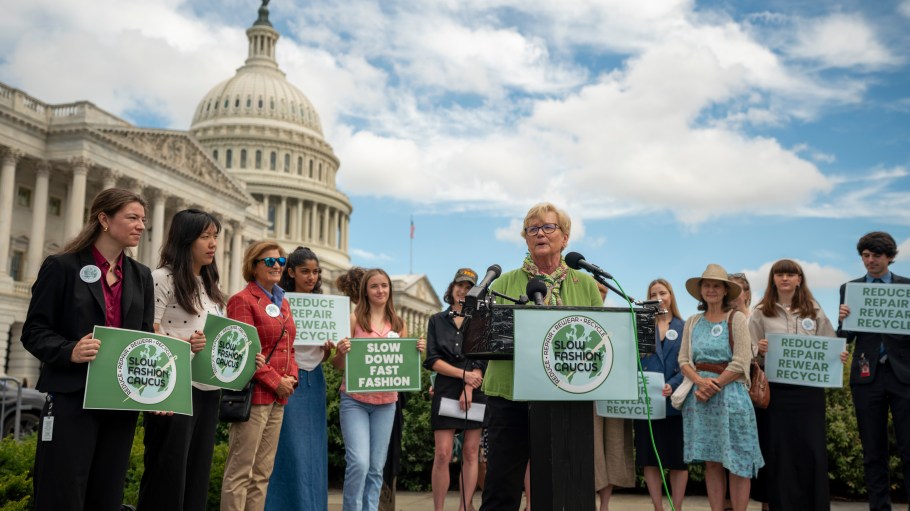
The Slow Fashion Caucus wants to help leaders in the fashion and textiles industries weave their way into policy discussions.
Six members of Congress have called on President Joe Biden to include members of the fashion and textiles industries in the White House Task Force on Climate and Trade. The task force, announced by the Biden administration in April, aims to construct trade policy that addresses climate and emissions-related issues.
In May, members of the fashion, apparel and textiles industries submitted their own appeal to the president, asking his administration to add industry representatives to the task force to enrich the discussion.
Related Stories
Now, members of the Slow Fashion Caucus have penned a letter to Biden with a similar request.
The caucus, established in June by representatives Chellie Pingree (D-Maine), Marie Gluesenkamp Perez (D-Washington) and Sydney Kamlager-Dove (D-California), works to create policy that will reduce negative environmental impacts from the fashion and textile industries while also promoting better labor conditions.
Glusenkamp Perez did not sign the letter, but representatives Jerrold Nadler (D-NY), Jared Huffman (D-CA), Kathy Castor (D-FL) and Jill Tokuda (D-HI) joined Kamlager-Dove and Pingree in calling the Biden administration to action.
The signatories said that, in order to continue Biden’s work on climate change in a meaningful way, his administration should consider involving a wider swath of stakeholders.
“This complex issue requires representatives from across government and private sector industries to create an appropriate mix of policy and initiatives to ensure we are all doing everything we can to address this 21st century challenge,” they wrote. “Unbeknownst to many, fashion and textile-related industries are a fundamental missing piece to many of these conversations. We encourage you to include representatives from the textile and fashion industries in this new task force.”
The representatives also noted that the U.S. “lags sorely behind many other nations in sustainable textile policy, both in regulations and incentives.” By adding industry voices to the table, they asserted, the country has a chance to “capture the nascent promise” of sustainable fashion, in turn boosting the economy and adding jobs domestically.
According to consulting firm McKinsey, the global fashion industry produced about 4 percent of greenhouse gas emissions in 2018. Other estimates say that number may now be as high as 8 percent. That in mind, the representatives said, leaders need to consider how to help curb the sector’s emissions.
“As an industry, fashion has the capacity to drastically reduce its emissions. As a leader in global trade, we seek to engage with you and your team on designing robust policies to catalyze the sustainability of the fashion industry,” they wrote.
But even as government officials push the administration to give the industry a seat on the task force, it’s possible it could still be iced out.
Politically InFashion, the policy-centric group that catalyzed industry leaders to pen a May letter to President Biden, has already heard from the administration that it does not plan to involve industry leaders directly on the task force.
“We did hear back from the White House, and we were told that they are this task force is going to be just government agency members. There was not going to be private sector representation, but they were willing to engage, and very much interested in engaging with the industry on these issues, so we were very pleased with that,” Politically InFashion’s founder, Hilary Jochmans, told Sourcing Journal.
Sheng Lu, professor of fashion and apparel studies at the University of Delaware, said his recent research with the U.S. Fashion Industry Association (USFIA) showed that the industry has legislation at the top of their list. The study, published in July, showed that seven in 10 leaders in fashion and apparel have plans to allocate more resources to tracking regulation in the sustainability and compliance areas.
That, he said, shows that companies in the sector have a particular interest in the kinds of concerns that the task force would be addressing.
“In other words, fashion companies see trade policy’s importance and great potential in supporting their sustainable sourcing efforts,” Lu told Sourcing Journal. “Given the complexity and global nature of today’s textile and apparel supply chains, it is essential that policymakers collaborate with the textile and apparel sector to develop policy tools that can meaningfully promote sustainability and effectively address climate change.”
He said one example of the type of policy that could be influenced if the Biden administration brought fashion to the table is enforcement of the Uyghur Forced Labor Prevention Act (UFLPA), which prohibits any goods made, wholly or in part, in China’s Xinjiang Uyghur Autonomous Region from entering the U.S. The Department of Homeland Security (DHS) said last month that it will continue to tighten enforcement.
However, fashion and textile industry experts have some concerns about how strict enforcement could impact processes like textile recycling. If companies send mixed-waste garments to a recycler outside of the United States, they face scrutiny over whether the recycled fibers will be allowed back into the country, because they cannot prove the origin of every garment collected, particularly when they accept consumer waste shipped into the U.S. prior to the UFLPA going into effect.
“While fashion companies are interested in using more recycled textile materials in their products, ambiguity surrounding the enforcement of the UFLPA on recycled cotton remains a key concern,” Lu explained. “We need more channels, including the White House Task Force on Climate and Trade, through which the textile and apparel sector can directly provide valuable input on developing high-quality and effective climate and trade policies.”
Jochmans said other issues of interest to the industry include the de minimis provision, how labor is legislated when it comes to trade, tariffs and tax incentives. She said, in some cases, these issues dictate where the future of the industry might be headed.
“Some [other] issues you can kind of say, ‘Well, there’s tangential relation to the fashion industry.’ No, these are issues directly on point to the industry and how they operate,” she said. “We need somebody that the administration has in place that can look at all these issues in a holistic way—at the 30,000-foot level, and not so siloed—because the industry is impacted by so many different public policy issues, and it’s so important to see how it’s all connected.”
That same sentiment in mind, some industry players have put their support behind the letter from the caucus.
American Circular Textiles (ACT), is among the list of industry groups and companies that have backed the Slow Fashion Caucus and its recent request to Biden. The group’s CEO, Rachel Kibbe, said fashion cannot continue to be passed over in the policymaking process.
“For too long the textile reuse and recycling sectors have been left off the menu on the national sustainability agenda… These companies, with operations throughout the country, have a large national employment and economic presence with robust manufacturing potential,” Kibbe said in a statement. “Without federal action, we will continue to fall behind other nations that are already capturing the circular textile opportunity. Having a seat at the table in the…task force would ensure the opportunities of our sector don’t continue to be overlooked.”