The regenerative agriculture conversation has largely centered around cotton, a needy crop that, when employing a start-with-the-soil approach, yields both near- and long-term environmental gains.
But where do ruminant mammals (aka cows aka leather) fold into this agro-concept?
Future Fabrics Expo (FFE) in New York City attempted to answer this question during a panel conversation titled “Field Notes: Regenerative Agriculture Partnerships” held at the Metropolitan Pavilion in Chelsea.
Related Stories

Considering the industry hasn’t landed on a universal definition of what exactly regenerative farming practices does—and does not—encompass, Megan Meiklejohn set the scene for the seminar’s standard.
Meiklejohn, a sustainability practitioner currently serving as the interim chief executive officer of Land to Market, explained it as a system where land health improves over time through sustainable practices. Animals are a (debatably large) part of this system. When farmers, for instance, integrate herds into that system by pasture cropping and mob grazing, it’s to yield soil restoration and increased biodiversity within the farm.
Assuming this intensification-based approach—which, again, is controversial—requires a shift in mindset: one that emphasizes ecosystems’ complexity over industrial efficiency.
“The farmers are trained in moving their livestock herds in a way that, basically, mimics natural herds of animals during that predator-prey relationship,” Meiklejohn said. “The humans actually step in as the predator and move them to certain areas of the farm to allow for intense animal impact and grazing [also] longer resting periods.”
Land-to-market principles are based on creating outcomes that can be seen and felt when on the landscape. Taking that principle and marrying it to Meiklejohn’s definition of regenerative agriculture (regen ag), moderator Lucianne Tonti asked nonprofit Wildlife Friendly Enterprise Network how its work sees those ideas interrelate.
Christine Lippai, the British executive director of the WEFN, passed the question to the Wildlife Conversation Society’s Ezequiel Infantino.
“What I can add to what [Meiklejohn] said is about where we come from,” Infantino, a team member at the WCS’s nearly 60-year-old Argentinean outpost, said. “The regenerative approach is something that makes a lot of sense because it’s not just about protecting an area—conserving—but it’s about trying to restore areas that have been really degraded over time by climate change.”
For British Pasture Leather, a for-profit business producing leather sourced from cattle raised on regenerative farms in the UK, creating a market for responsibly sourced leather was the incentive. Supporting the farmer, as opposed to an abattoir, is of particular interest to co-founder Sara Grady.
“In the work that I’m doing with British Pasture Leather, I really enjoy the opportunity to point out that leather is a product of our food system,” she said. “It’s exciting to see the academic research that is proving the positive impact of what we consider regenerative practices, looking at everything Megan described in terms of soil health and biodiversity [but] let’s not forget the nutritional value of the food that is coming from these systems.”
In fact, Grady was a vegetarian for most of her life. But after the native New Yorker spent a decade with the Glynwood Center for Regional Food and Farming in the Hudson Valley—a nonprofit deploying resilient systems like intensively managed pasture rotations—she became an omnivore.
“When you hear people say, ‘eat less meat,’ my answer is eat better meat,” Lippai said. “If we’re eating better meat, we might just be able to have our cow leather.”
Lippai’s answer—which ultimately boils down to the idea that raising livestock in smaller spaces will save the planet—has been explored a few times over. The Environmental Change Institute at the University of Oxford’s 2017 “Grazed and Confused” report, for instance, investigated the role of grazing ruminants in relation to climate change.
“If beef—and, logically, milk—is bad, then several courses of action present themselves,” The 127-page manifesto starts. “One approach, generally favored by policymakers and intergovernmental institutions, is to manage the damage.”
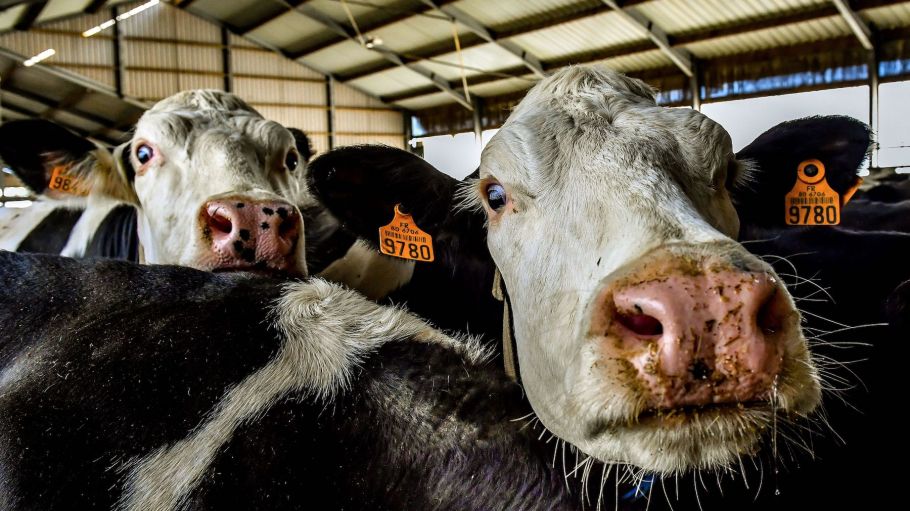
This pragmatic mindset assumes that the growth of the livestock industry is both inevitable and valuable; thus, the solution is to keep that growth as lean as possible. That’s done via intensification: optimizing breeding and feeding through methods such as those identified by Meiklejohn. By this logic, the extensively-reared ruminant (i.e., a dairy cow) is the “most problematic of creatures,” considering they emit more than they’re worth.
“If we are to eat ruminant products, let them be the products of intensive systems,” the report by Oxford’s Food and Climate Research Network (FCRN) explains. “Better still, the growing preference for monogastric products (pork and poultry meat, and eggs) is to be encouraged since these animals emit much less methane and use far less land per unit of livestock product over their production cycles.”
It’s a comforting concept. Citing 300-plus sources, “Grazed and Confused” determined it’s just that—a comforting concept, not a climate solution.
“Grazing livestock are net contributors to the climate problem, as are all livestock. Rising animal production and consumption, whatever the farming system and animal type, is causing damaging greenhouse gas release and contributing to changes in land use,” author Dr. Tara Garnett said at the time. “Ultimately, if high consuming individuals and countries want to do something positive for the climate, maintaining their current consumption levels but simply switching to grass-fed beef is not a solution. Eating less meat, of all types, is.”