Functional Fabric Fair and Future Fabrics Expo (FFE) are leading by example.
The respective trade shows strategically collaborated for the former’s powered-by-Performance Day’s New York City session, held July 21-23 at Manhattan’s Jacob K. Javits Center, to spotlight innovation within functional textiles.
“Future Fabrics Expo has long been a global leader in responsible material innovation, bringing together true innovators, chemists and visionaries. We’re proud to provide a new platform for their work in New York and Portland,” said Steve McCullough, event vice president of Functional Fabric Fair. “As demand for sustainable, performance-driven materials continues to rise, we’re creating stronger, more inclusive events that foster meaningful connections and drive real impact across the supply chain.”
Related Stories
Adjacent to the Functional Fabric Fair’s main entrance is FFE’s “innovation hub,” a dedicated space spotlighting a few dozen next (and new) gen materials. The duo’s partnership went live in London last month, with Performance Days and the trade-only sourcing event sponsoring FFE’s Innovation Hub. Other plans include curating content for the Functional Fabric Fair Portland, as well as additional Performance Days events in Munich and Shanghai.
“This partnership allows FFE to reach new audiences and expand our presence globally. It also reflects our commitment to supporting nature-positive, decarbonized supply chains through innovation,” Nina Marenzi, founder and CEO of The Sustainable Angle (TSA) and FFE, said. “Together, we aim to make sustainable materials more accessible and actionable for fashion and textile professionals worldwide.”
The hub kicks off with a printed partition breaking down a few bio-buzzwords.
Here, the term “biomaterial” is used to indicate materials that have “non-specific biological association,” reads the Swiss nonprofit organization’s 411 on all things next-gen at the top of the hub. To clarify: all biomaterials are biobased—it’s the biobased content that can vary radically, ranging from less than 10 percent to 100 percent, per the poster.
While we’re at it: biobased materials are “wholly or partly derived from biomass, such as plants, trees or animals. The biomass can be manipulated—physically, chemically and biologically treated, too. It just cannot be derived from fossil sources, TSA’s “Understanding Next-Gen Materials” signage reads.
Biobased materials are pretty common. Think natural fibers like cotton and wool, manmade cellulosics like viscose, natural polymers like chitin and casein, as well as animal leathers and their alternatives. If a material’s bio-percentage meets the required minimum, fabrics like polycotton blends can be biobased, too.

While ideas further into their material innovation journeys—such as Uncaged Innovations’ Elevate, Balena’s BioCir and Ponda’s BioPuff—were spotlighted alongside suppliers like Circ and Spinnova, more nascent designs were emphasized, too. Of the 30-odd startups on display, a dozen had designations indicating which more-nascent designs were raising capital—and for which round.
London-based Sages’ proprietary process isolates phytochemicals in food waste—like avocado pits and red cabbage—and extracts these as industry-ready powder dyes. Alt. Leather, a 100 percent biobased material with LCA-validated results like a climate impact three times lower than animal leather, using up to 70 percent less fossil energy, too. The Melbourne-based manufacturer is actively fundraising for its seed round, too.
As is Amphicolor.
Developed by Ampico, the waterless textile coloration technology was developed with support from Innovate UK. The process—what ultimately boils down to optical mixing—essentially halves water use (55 percent) and emissions (at least 50 percent) by combining dope-dyeing with color theory and AI-driven formulation.
From across the pond was Fibe’s potato waste yarn and Flocc’s cellulose-based flock fiber developed from textile waste produced by MYB Textiles—one of the last remaining heritage lace mills in the UK—actively fundraising through a Crowdfunder campaign to support material development, pilot production and further testing.
London’s graphene-based Nanoloom is “weaving the future” and also fundraising for a seed round; while the material is currently being scaled at a European plant, Nanoloom’s circular, conductive stretch alternative will be cost-competitive from its first year of commercial scale production. New York’s AO Textiles, meanwhile, is currently seeking partners to explore development potential for its tree-derived natural dyes.
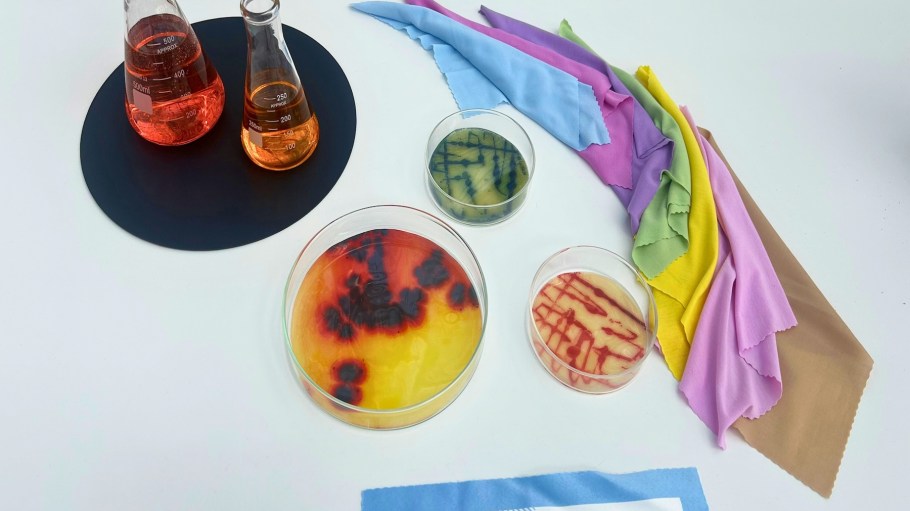
Rheom Materials, meanwhile, is fundraising for 5–10-million-pound (between $6-14 million) in funding to further expand its biobased resin, Benree, and leather alternative, Shorai. So is Post Carbon Lab, a biotechnology company that “upcycles atmospheric CO2 into colors, dyes, pigments, coatings and finishes using photosynthetic microbes for textile and polymer applications,” per the Innovation Hub.
Sci-Lume Lab, meanwhile, is raising a pre-seed bridge round. Founded in 2021 by chemist Oliver Shafaat, the Oklahoma City startup develops Bylon—what the former Spiber researcher has penned as “the truly circular apparel fiber without compromise.” The thermoplastic polymer plugs into existing synthetic fiber manufacturing facilities and reports 100 percent recyclability and biodegradation upon end-of-life.
The UK-based Sustainable Sequin Company (TSSC)—a micro-enterprise researching, developing and creating biobased, lower-impact sequins—is currently applying for grant funding.
Evoralis “designs enzymes that can break down blended textile fibers into their constituent building blocks,” per the hub. At the same time, Evoco’s bio-foam (featuring up to 85 percent biocontent) works to “detoxify and decarbonize” performance products.
Lotte Plumb’s Lab to Loom considers the application of bacterial cellulose as a fiber for the denim industry—including an exploration of bacterial pigment in place of traditional synthetic indigo. Emily Gubbay’s Infinity Blue is a circular color system recovering synthetic indigo from denim. The core extraction process has been validated in a lab setting and tested using both pre- and post-consumer denim waste, with current production limited to sampling and prototyping volumes. Jehnna Yang’s Homage to Mountain applies biomimicry to utilize flavone—a naturally occurring compound found in alpine species—to explore PFAS-free, biodegradable textile coatings.
Noosa’s Noocycle technology can chemically separate its fibers from any component (aka regardless of chemicals, pigments, material blends), which can then be recycled in perpetuity. Textile recycling startup FibreLab out of East London uses custom-built mechanical shredders to turn pre-consumer and commercial textile waste into Papertex recycled fibers.
Fibarcode offers durable authentication, traceability and end-of-use data management across the entire textile product lifecycle while mitigating recycling disruption. The collaborative effort between the University of Michigan and the MIT Lincoln Laboratory Defense Fabric Discovery Center’s pre-seed round opens in fall 2025.
Colorifix’s microbial dyes and Positive Materials’ 100 percent merino wool were also showcased, as well as DyeRecycle’s patented green chemistry technology recovering synthetic dyes and high-value fibers from textile waste, AltMat’s agri-waste “Altag” blends, Peerasin Punxh Hutaphaet’s fungal and microbial “Growink” pigments and craft-led weaving innovation molder, Form Weben.