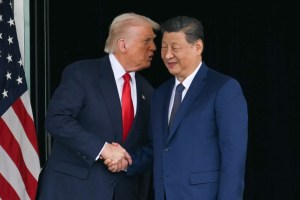
The probability of a “universal tariff” on all countries isn’t a key priority, while the odds for a proposed 25 percent hit on imports from Canada and Mexico remain low.
That’s the conclusion from Goldman Sachs, according to a research note Tuesday from managing director and chief political economist Alex Phillips.
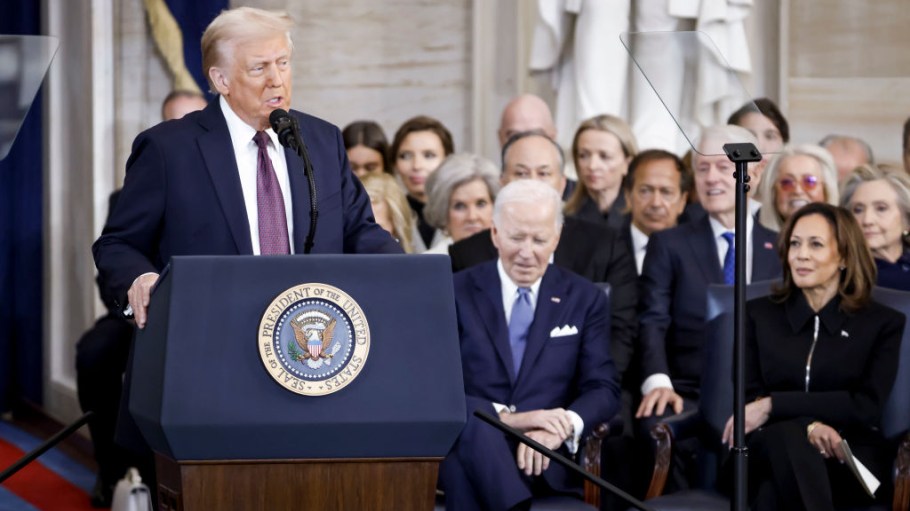
“President Trump’s Inauguration Day policy announcements on tariffs were more benign than expected,” Phillips wrote. “While we did not expect major policy pronouncements so soon following inauguration, Trump’s comments on China were notably less hawkish than during the presidential campaign or even his more recent comments since the election.” He added that a universal tariff was seen as a clear risk prior to Inauguration Day, but Trump’s comment—”I may, but we’re not ready for that yet”— suggests that it is now a lower priority.
Related Stories
Goldman lowered the odds of a universal tariff this year to 25 percent. Phillips said that if one were to be implemented, it would more likely be targeted to “critical imports,” making it “narrower” than the proposal Trump had stated during the campaign.
As for Trump’s late day comment on Monday that he could impose a 25 percent tariff on Canadian and Mexican imports starting Feb. 1, Phillips isn’t convinced, noting that the odds of a 25 percent tariff on both countries are low, with the probability at 20 percent.
That’s not to say Trump won’t impose tariffs, only that it may not be as high as he’s talking now or maybe not at all.
“We note that in 2019 he also stated that he would impose a tariff of up to 25 percent on Mexico within 10 days but the tariff was never implemented. More recently, in November 2024 he pledged to ‘sign all necessary paperwork’ to implement the tariff on Canada and Mexico on Inauguration Day, but did not do so,” Phillips noted.
Goldman also lowered its odds of a 20 percent tariff hike on imports from China to 70 percent from 90 percent as its best-case scenario. With a deadline of April 1 for recommendations on trade policy—listed Monday on the White House website as a presidential action dubbed “America First Trade Policy”—from the U.S. Trade Representative and the Secretaries of Commerce, Defense, Homeland Security, State, and Treasury, there’s a chance implementation could occur in the second quarter, although the back half of the year is more likely.
Trump’s trade policy memo cites applicable law for national defense, unfair trade practices, and the International Emergency Economic Powers Act as possibilities giving him broad emergency powers. Also a potential option, but never been used according to Phillips, is Section 338 of the Tariff Act of 1930 that authorizes tariffs of up to 50 percent in response to trade practices that are deemed “unfair.”
TD Cowen’s Washington strategist Chris Krueger said on Monday that another reason for the delay in any decision on tariff implementation is Trump’s plan for an External Revenue Service to collect tariffs on imports, which still needs to be established.
The expectation generally among economists is that if tariffs are placed on goods from Mexico and Canada, the two countries would impose retaliatory tariffs of their own.
UBS economist Paul Donovan in a Tuesday podcast said that in Trump’s scripted inauguration remarks, “references that were made tended to focus on the misplaced idea that trade taxes will be paid by foreigners rather than by U.S. consumers.”
Donovan explained that a 25 percent tax on imported goods from Mexico and Canada “would raise U.S. consumer prices of those goods by 10 percentage points on average.” He added that there is a “risk of more inflation from second-round effects, [such as] the drop in competition, leading to U.S. producers to raise prices and retailers engaging in a profit-led inflation episode.”