While the belated extension of two legacy trade statutes—the African Growth and Opportunity Act (AGOA) and Haiti HOPE/HELP—was welcomed by both lawmakers and industry stakeholders this week, the action raises questions about the meaning and importance of trade pacts and preference programs in the age of Trump’s tariffs.
With the passage of the extensions tucked into Congress’ sweeping appropriations bill, 32 sub-Saharan African nations and Haiti have now seen crucial duty-free access to the United States market restored—or have they? It’s a question that’s on the minds of both importers and exporters facing the Trump administration’s double-digit “reciprocal” tariffs.
Related Stories
“Imports that qualify under AGOA and Haiti preferences are still subject to the IEEPA reciprocal 10 percent tariff,” Josh Teitelbaum, senior counsel for international trade policy at Washington, D.C. law firm Akin-Gump explained.
As of today, “The only free trade agreement-qualifying apparel products exempt from the reciprocal tariffs are those qualifying under the U.S.-Mexico-Canada Agreement,” he said, while El Salvador and Guatemala—which announced agreements with the U.S. last week—will also receive duty-free treatment on apparel that qualifies for the Dominican Republic-Central America Free Trade Agreement when those pacts take effect.
This may be because of lingering desires on the part of lawmakers to reform the Africa and Haiti trade programs—ambitions it voiced in the months and years before their lapse. With the AGOA and Haiti HELP/HOPE acts extended until December of this year, “Congress will now use the few months it just bought itself to try to address some of the concerns that its Members and Senators have about how the program has operated recently,” Teitelbaum surmised.
The trade lawyer believes the short-term extension was deliberate, given that the House of Representatives passed a three-year extension bill on a bipartisan basis in January. That’s not what ended up in the appropriations bill.
“I think the extension was shortened ultimately because there was still at least one leg of the policymaking stool between the Administration, House, and Senate that doesn’t like preference programs and wants to see deeper reforms before a longer extension,” he said. “These deadlines and expirations have a way of forcing action.”
Nonetheless, a short extension provides a bit of near-term relief to brands and their supply chain partners in the impacted markets, Teitelbaum believes. “It’s helpful to keep companies that were already there from leaving. My hope is that it’s a strong signal that a three-year extension passed the House with overwhelming bipartisan support in January. My worry is that we will come up against the deadline again in December.”
Sheng Lu, professor of fashion and apparel studies at the University of Delaware, espoused similar hopes, though tempered by worry about the complicated nature of trade programs under the administration’s wide-ranging and ever-changing tariff platform.
“The retrospective short-term renewal of these two programs means positive news for U.S. fashion companies sourcing from the region. However, the actual duty savings and incentives to significantly expand sourcing from these regions may be limited in practice,” he said.
Calling current U.S. trade policies “needlessly complicated in many ways,” Lu said, “This complexity can make it difficult for importers and apparel companies to navigate compliance and optimize sourcing, and it is not always clear that the policies provide clear economic justification or straightforward incentives for sourcing shifts.”
What is clear is that the looming lapse and eventual expiration of AGOA and Haiti HOPE/HELP on Sept. 30, 2025 impacted U.S. apparel sourcing and the utilization of the trade preference programs.
Lu pointed to data from the International Trade Administration’s Office of Textiles and Apparel (OTEXA) which showed that although the value of American garment imports from AGOA member nations increased by 11.1 percent from January through November of 2025 compared to the same period the previous year, “the value of those imports claiming AGOA’s duty-free benefits fell sharply by 35.8 percent over the same period.”
That’s a precipitous decline in the trade preference program’s utilization rate. While 96 percent of U.S.-bound apparel exports from AGOA countries claimed the legislation’s duty-free benefits in 2024, only 55 percent utilized AGOA to bring in clothing from Africa in 2025. “This is a very unusual phenomenon, but it could reflect the negative impacts of AGOA’s expiration on U.S. fashion companies’ sourcing from the region, along with the broader effects of Trump’s tariff-hiking policy,” Lu said.
The impacts are being felt acutely by individual countries. Haiti, for example, saw its total apparel export volume destined for the U.S. decline by 14.8 percent. Apparel products shipped to the U.S. utilizing AGOA fell a whopping 43.9 percent.
“The sharp decline in U.S. apparel imports of these products could be a direct result of the expiration of AGOA,” Lu assessed, as “U.S. companies have warned that they will no longer place sourcing orders with AGOA members unless they receive the duty-free benefits.”
Lu also presented a conjecture about what could be responsible for the 11.1 percent rise in apparel imports from sub-Saharan Africa that did not utilize AGOA benefits: transshipment.
“Interestingly, data from the World Trade Organization shows that China’s apparel exports to many small AGOA member countries increased significantly in 2025,” he said, pointing to Kenya, which took in 31.5 percent more apparel from China last year than in 2024, along with Tanzania (up 52.8 percent) and Mauritius (up 27.5 percent). That influx of Chinese imports could be making its way to American shores—and, in the process, stifling the growth of local industry in the African markets.
When it comes to the impact of Haiti HOPE/HELP’s expiration on imports from the country, the numbers paint an even gloomier picture.
U.S. apparel imports from Haiti fell 43.4 percent in October 2025 and and 21.1 percent in November compared to the previous year—declines that far outpaced drawdowns in U.S. sourcing seen in other supplier markets. Haiti now accounts for just 0.6 percent of the clothing that the U.S. takes in from other countries, even though the preference program is focused specifically on bolstering the country’s apparel and textile sector.
Drawing another parallel with AGOA, Lu said the volume of imports claiming duty-free benefits under Haiti HOPE/HELP has plummeted from 90 percent in years past to just 59.3 percent between January and November of 2025.
Meanwhile, China’s exports to Haiti last year grew by 93.1 percent, suggesting that, “excluding transshipment, U.S. apparel imports from Haiti could decline even more sharply,” Lu said. With Haiti bringing in so much more China-made clothing, the local production sector could be further depressed.
“Data points to the trend that U.S. apparel imports from AGOA and Haiti have been negatively affected by the expiration of the two agreements, even in just a few months,” Lu concluded. “This trend echoed the findings of my other studies, in which U.S. fashion companies repeatedly said that the renewal of the two trade preference programs is critical in incentivizing their sourcing from the region.”
For Joseph Nyagari, deputy director of innovation, sustainability initiatives and analytics at Gatsby Africa, the terms of AGOA’s extension leave something to be desired. The private philanthropic foundation aims to help scale Kenya’s textile and apparel exports to $2 billion and create 200,000 direct jobs by 2030.
The extension provides “essential short-term relief and duty refunds,” he said. “While this buys time, it offers limited certainty.”
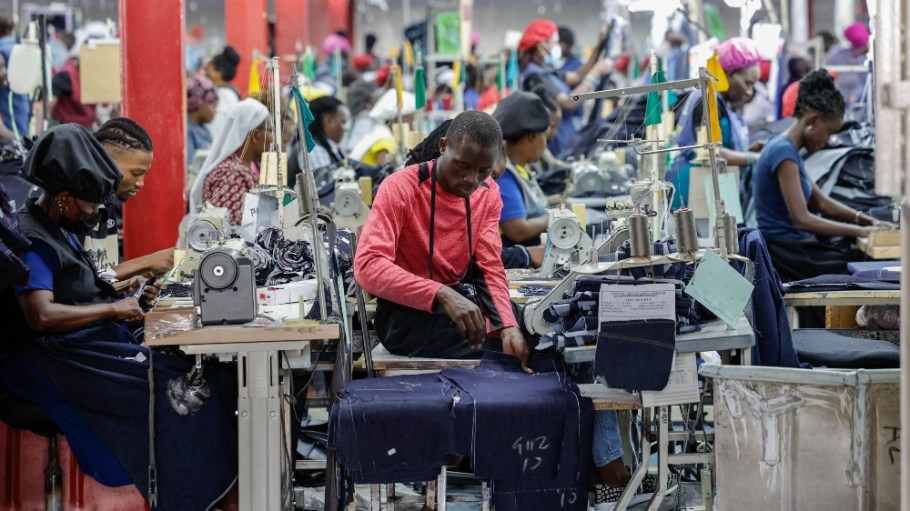
The United States remains Kenya’s most critical export destination for apparel, accounting for over 90 percent of exports, Nyagari said, citing OTEXA data. “The sector delivers significant [foreign exchange] inflows and employment, with over 70,000 direct jobs—more than 80 percent held by women,” he added.
The sector represents a critical lifeline and a burgeoning economic driver for Kenya. Exports surpassed $530 million in 2024 and could exceed $600 million in 2025, the most recent insights show. “Despite the program’s expiration… which imposed at least 10 percent reciprocal tariffs plus Most Favored Nation duties, exports showed strong resilience,” Nyagari added. Between January and October 2025, U.S.-bound apparel exports saw a 17.1 percent increase in value and a 41.2 percent in volume compared to 2024.
But Gatsby Africa’s insights from those on the ground show that Kenya’s grip on growth is tenuous and largely dependent upon the duty-free benefits afforded by the preference program.
“In November 2025, Gatsby Africa surveyed export-oriented apparel investors in Kenya’s Export Processing Zones. About 30 percent responded, representing over 50 percent of the workforce in the export segment. Notably, 76 percent reported U.S. buyers expressing concerns about continued sourcing from Kenya without AGOA,” Nyagari said.
With the survival of AGOA guaranteed only for the next 11 months, the country’s production force and foreign investment opportunities hang in the balance. While AGOA helped many manufacturers plant their stakes in the market and drive meaningful advancement for domestic industry over a period of more than two decades, Nyagari hinted that securing Kenya’s economic future may require a more direct approach.
“The U.S. shift toward reciprocal, bilateral agreements signals the need for Kenya to prioritize a bilateral trade deal for long-term predictability, investor confidence, buyer stability, and sustained investment in the sector,” he said.