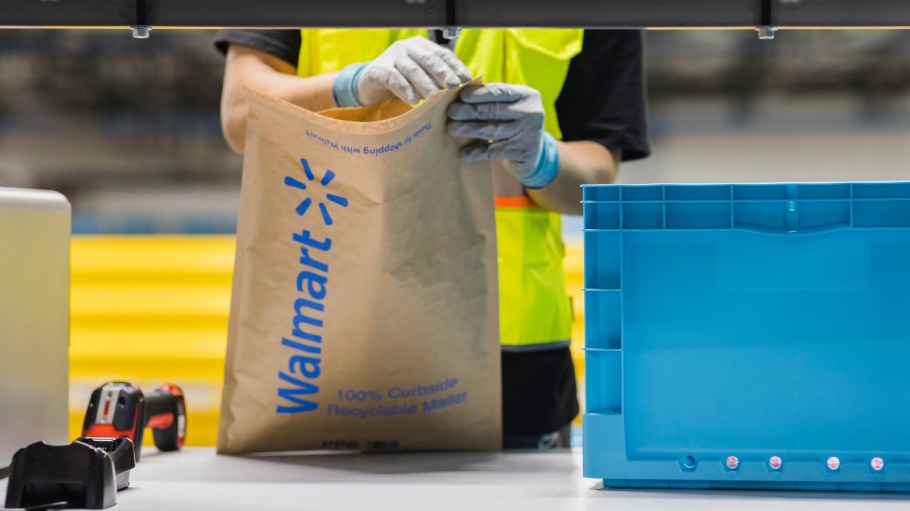
Walmart is working to eliminate packaging waste.
The retailer moved from plastic to recyclable paper mailers, which is expected to eliminate 65 million plastic bag mailers—more than 2,000 tons of plastic—from U.S. circulation by the end of the fiscal year. Customers will soon have the option to opt out of single-use plastic bags for their online pickup orders, which Walmart expects to roll out nationwide by the end of the year. As of April, the retailer eliminated single-use bags in 10 states, and expects to save 2 billion single-use plastic and paper bags a year.
Related Stories
“Our commitment to regeneration is core to who we are and how we innovate at Walmart,” Karisa Sprague, senior vice president, fulfillment network operations, Walmart U.S., said. “Customers have told us how excited they are about these enhancements to make it easier for them to make more sustainable choices that support the planet and the next generation.”
Walmart is taking a stab at reducing the amount of cardboard used to ship products by transitioning to right-sized packaging technology—which helps create a package custom fitted to a customer’s order—in about half of its fulfillment network. By eliminating the unused space in a shipping box, the technology can reduce the need for filler by 60 percent, Walmart said, while also reducing waste caused by oversized boxes by as much as 26 percent, according to Packsize, an on-demand right-sized packaging systems provider that has worked with the mass merchant on this kind of tech. Plus, customers can now ask Walmart to consolidate multiple items into fewer boxes—a move Amazon employed in early 2019.
Walmart has also begun utilizing applied artificial intelligence (AI) to identify when an item purchased online can be fulfilled from a nearby store versus a fulfillment center. If applicable, it would reduce the number of miles driven and the number of boxes used for shipping. And to ensure that those items can travel more sustainably from the store to the door, the retailer combines multiple orders on single delivery routes and delivers them via electric vans. By treating its 4,700 stores like fulfillment centers, Walmart can reduce fleet miles and emissions, aligning with its net-zero by 2040 commitment.
“With a Walmart store located within 10 miles of 90 percent of the U.S. population, we can make a meaningful difference for our customers by strategically using our stores and last mile delivery network to reduce waste and emissions,” Jennifer McKeehan, senior vice president of end-to-end delivery at Walmart U.S., said. “I’m proud of the efforts we’ve made and will continue to make as we keep regeneration at the forefront of delivery.”
Walmart’s packaging news comes after a New York event last month shined the spotlight on opportunities to streamline packaging.
Global Design Forum
Global Design Forum, the thought leadership program developed by London Design Festival, debuted at NYCxDesign, a symposium part of the Circular Design Series in partnership with SAP.
The key takeaway from the May event that focused on sustainable, circular design is that plastic is a design failure, according to keynote speaker Cyrill Gutsch, founder and CEO of Parley for the Oceans.
“As designers, we don’t really have a problem admitting mistakes. You pick the wrong color, it’s bad. Your logo is outdated, you do it again. Taking something apart that you’ve created and questioning it and doing it again is totally normal. At some point, you need to say some things are great and some are bad. Plastic is bad,” Gutsch said. “It’s just unhealthy for everybody and it looks really bad when you’re in nature at the end of the world, a remote island, and there’s a belt of plastic trash.”
But according to Sian Sutherland, co-founder of Plastic Free, a materials and system change solution platform, plastic is also the gateway to change.
“There is an intrinsic connection between the climate crisis and the plastic crisis. It really is this canary in the coal mine. There’s a little tap on the shoulder for us to wake up,” Sutherland said. “And think of it as this defibrillator to wake us all up to not just swapping material[s] but to actually think differently about our entire systems. Because if we fix the plastic crisis, we will directly and indirectly fix so much else about the climate crisis.”
Andrew Dent, executive vice president of research at Material ConneXion, urged fashion to take imperfect action now.
“We would love to both have a reduction in plastics as well as a reduction in carbon footprint at the moment. [But] most of the solutions we are offering as alternatives to plastics are going to be higher in carbon footprint; it’s just a fact of life,” Dent said. “It’s hard to say this [but] I’m okay with actually having a higher carbon footprint for those innovations, as long as we can get them into the market, reduce the amount of plastic, solve the problem and then try and bring the carbon footprint down. If you’re going to try and go head-to-head with [reducing] plastic and carbon footprint, it’s going to be a very challenging process.”