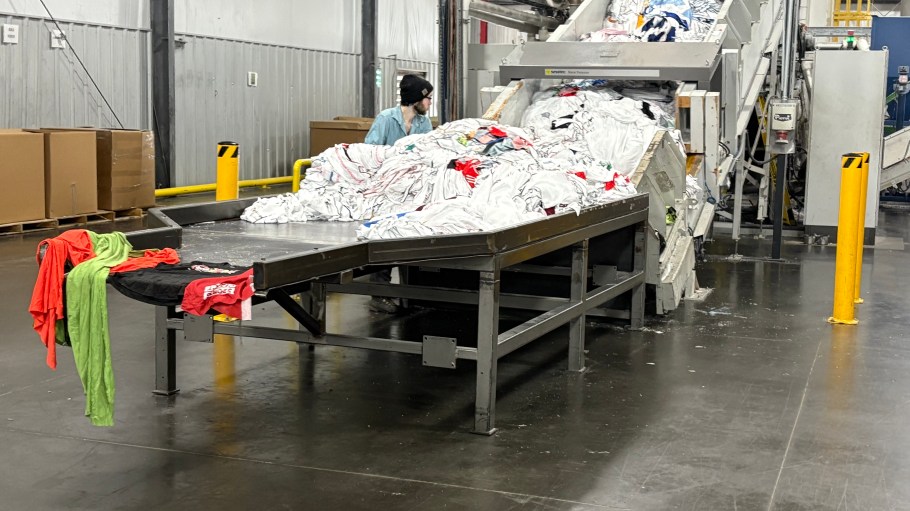
At recycled fiber producer Unifi’s facility in Yadkinville, North Carolina, workers pile hundreds of discarded garments onto a massive conveyor belt. As the belt lurches forward, mounds of old polyester shirts, sports jerseys, socks and other items cascade into a machine that will begin the process of converting them into new Repreve yarns.
Unifi launched its Textile Takeback program in 2022 with the goal of expanding its operation beyond plastic bottle recycling to textile-to-textile recycling produce its signature Repreve recycled fiber. Last year, the company announced it would scale the program with an ambitious goal: recycling 1.5 billion T-shirts’ worth of textile and yarn waste by 2030.
Related Stories
“We’ve created a textile-to-textile system that actually works, and it’s available globally,” said Unifi CEO Eddie Ingle. “Our Takeback process keeps materials in circulation longer, and it conserves resources—these products are made from waste materials, replacing virgin petrochemical inputs.”
In theory, textile-to-textile recycling has the potential to revolutionize the way garment waste is managed on a global scale. But in practice, the process has proven rather complicated for a number of reasons. Synthetic textile-to-textile recycling relies on materials that can be melted down, so blends incorporating natural fibers such as cotton or viscose aren’t easily recyclable, and dyes and finishes also can make it difficult to recycle some items.
And beyond those technical limitations, the lack of built-in infrastructure for post-consumer garment collection and sorting such as that in existence for plastic bottles makes acquiring recyclable clothing more challenging. That aspect contributed to the downfall of cotton textile-to-textile recycler Renewcell, which declared bankruptcy and re-emerged last year under a new owner and moniker, Circulose.
Unifi sources its garment waste from a number of places, much of it post-industrial waste such as cut-and-sew scraps from Southeast Asia factories, as well as misprint returns and pieces such as marathon shirts from races that never occurred due to Covid.
The garment waste is then sorted in Unifi’s facilities (the company has operations around the globe) and filtered based on parameters such as color and material. The pieces are then fed into the company’s proprietary thermal mechanical recycling process. Ingle says the process was developed to solve some of the problems that have hampered textile-to-textile recycling in the past.
“This process has to solve four key challenges in our industry—filtration, color, quality and traceability,” he said. “Our proprietary systems for high-volume grading, purification and strengthening protect the molecular integrity of the polyester while leveraging the efficiencies of thermo mechanical recycling. That ensures the consistency and quality of the products we make, and it also can enhance the physical properties of our products.”
After being sorted and filtered, garment waste travels down that conveyor belt into a machine that will shred it. Those pieces then get melted down and eventually combined with recycled bottle plastic to create new Repreve yarns.

Unifi conducts lifecycle assessments (LCA) of all of its products, including Takeback fibers and yarns, to provide data to partners on carbon footprint, greenhouse gas emissions, energy consumption, freshwater use and other sustainability targets. And like bottle-based Repreve fibers, Takeback incorporates Unifi’s fiber trace technology to ensure full traceability of products made with the material.
“Our data is really important for brands and companies to be able to quantify the environmental impact of their own products,” said Jordan Feigh, sustainability and product stewardship manager, Unifi. “We are a global manufacturer, so we have to take into account different areas and their limitations—for instance, the Vietnam energy grid may be different than the United States, which may be different from Central America. So rather than looking at an LCA on a very broad scale, we’ve drilled down to five different supply chains to assess our products globally.”
That data becomes particularly useful when comparing virgin fibers versus Takeback, both from an environmental and a quality standpoint.
“What we’re trying to look at with these LCAs is how does Repreve compare against virgin?” Feigh said. “Obviously if recycled is not on the same level or better than virgin, then no one’s going to use it. So we need to actually prove that.”
While the Takeback program is growing, for Unifi to meet its 1.5 billion T-shirts’ worth by 2030 goal, Ingle said buy-in not only from brands but also consumers will be essential. Some of that is starting to happen, with Unifi partner Haggar now producing men’s pants designed to be fully recyclable, including their buttons and zippers. Ingle said steps like these will propel this technology forward and allow textile-to-textile recycling to reach the same scale as post-consumer PET fiber production.
“If we learned anything from our bottle recycling experience, it’s that demand will grow,” he said. “People want to be more sustainable. But while circularity can be seen as a commercial burden, especially in the short-term, we believe it’s an opportunity for the early adopters to get ahead of the message. It’s the right thing to do.”